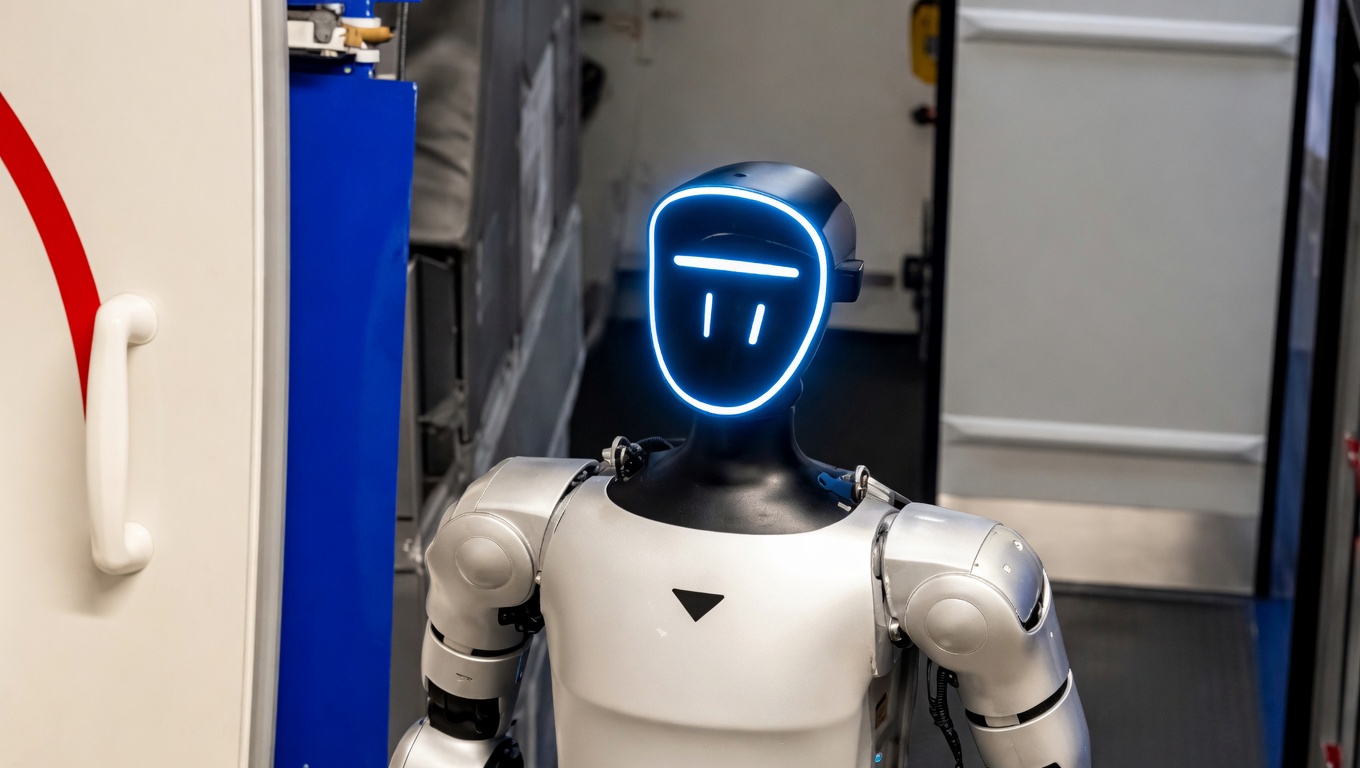
American has now banned large human- and animal-like robots from its planes starting this week, joining Southwest, Delta and United. There’s a real concern over batteries, but this shape-based ban is headed for a collision with the future of better batteries, armies of AI robots, and federal disability rules. The new policy was issued Friday and takes effect Monday, August 17 covering American domestic and international mainline and regional flights. Robots cannot travel in an overhead bin, in a purchased seat, or as checked baggage. American says it has had no known incident involving one of these robots. The airline adopted the policy after reviewing risks associated with their size, design, capabilities, and large lithium-ion batteries. Agents are instructed not to check one and not to allow a passenger carrying one to board. If a robot is discovered after check-in, they’ll invoke procedures for undeclared dangerous goods. Small robots, toys, and electronic devices may still be permitted if they meet the airline’s ordinary size, stowage, and battery requirements. But American does not define how small is small or when a machine becomes sufficiently human-like to be banned. Here’s the airline’s internal policy details for employees: This new approach began at Southwest in the spring after a roughly four-foot, 75-pound humanoid named “Bebop” traveled from Oakland to San Diego in a purchased seat. The crew initially objected to its position and then to its battery, which was removed. A second robot, “Stewie,” flew from Las Vegas to Dallas using a smaller, laptop-like battery. I wrote at the time that passengers were buying seats for robots while airlines had no real rules for them. Within days, Southwest prohibited human- and animal-like robots from both the cabin and checked baggage. Delta followed June 18 with a ‘temporary’ policy. United followed July 23 saying it would continue evaluating the issue. When I covered those two bans, American was the only one of the four largest U.S. airlines without a published prohibition. American’s public restricted-items page does not yet mention the rule, even though it becomes effective Monday. So the policy will be a complete surprise to passengers who have ticketed travel and might be bringing a robot assistant. It’s certainly the case that lithium-ion batteries can enter thermal runaway when damaged, defective, or overheated. That’s why spare batteries and power banks generally have to remain in the cabin, where a crew can see a failure and douse it (a fire hidden in the cargo hold is more difficult to detect and respond to). Under FAA passenger rules, batteries up to 100 watt-hours are generally permitted in personal electronic devices. Batteries from 101 through 160 watt-hours require airline approval. Anything above 160 watt hours generally cannot travel. Many humanoid robots are nowhere close to that. And removing one of those batteries from the robot doesn’t allow passengers to carry it. Oddly, American isn’t prohibiting a risky battery, the rule is based on shape (resembling people or animals). A humanoid shell with no battery can’t fly. A box-shaped machine with a compliant battery is fine. A small robot with a compliant battery is fine, but we don’t know what small is and that’s left to agent discretion. American’s memo anticipates that a passenger may call a robot an emotional support or service animal. The former aren’t accepted, and the latter can only be dogs (and not robot dogs). Airlines already carry cellos and other valuable cabin seat baggage. It seems like removing batteries would be sufficient here. And this won’t be sustainable as the machines become common. A future robotic guide, lifting aide, or mobility assistant could be an “assistive device” under the Air Carrier Access Act. Federal rules define those by what they do, not what they look like. We’re goingt to see AI robots becoming common in the next few years. Not many passengers bring them along today, but that’s surely going to change. Here’s a hotel staffed entirely by robots that’s close to opening. Aeroflot has had robots as supplemental flight attendants. Already TSA allows robots through checkpoints subject to screening and physical size limits. Matt Levine pointed out in the fall that “the world’s richest man demanded that people give him a trillion dollars so that he can have absolute control of the robot army.” Elon Musk said on Tesla’s fourth quarter 2025 earnings call that they would wind down Model S and Model X production in order to use that Fremont production space as an Optimus robot factory with a long-term target of 1 million Optimus robots per year. Now, Musk says things but I don’t think most people appreciate just how weird the world is about to get, even accounting for how weird the world has been over the past decade. It won’t be that long until we begin getting into moral questions of sentience. Topics on this page
American Airlines Bans Humanoid Robots Starting Monday — But The Robot Army Is Coming Anyway
Full Article
Original Source
Read the full article at Viewfromthewing →KhanList aggregates and links to publicly available news content. We do not host full articles from third-party sources. Always verify important information with original sources.