
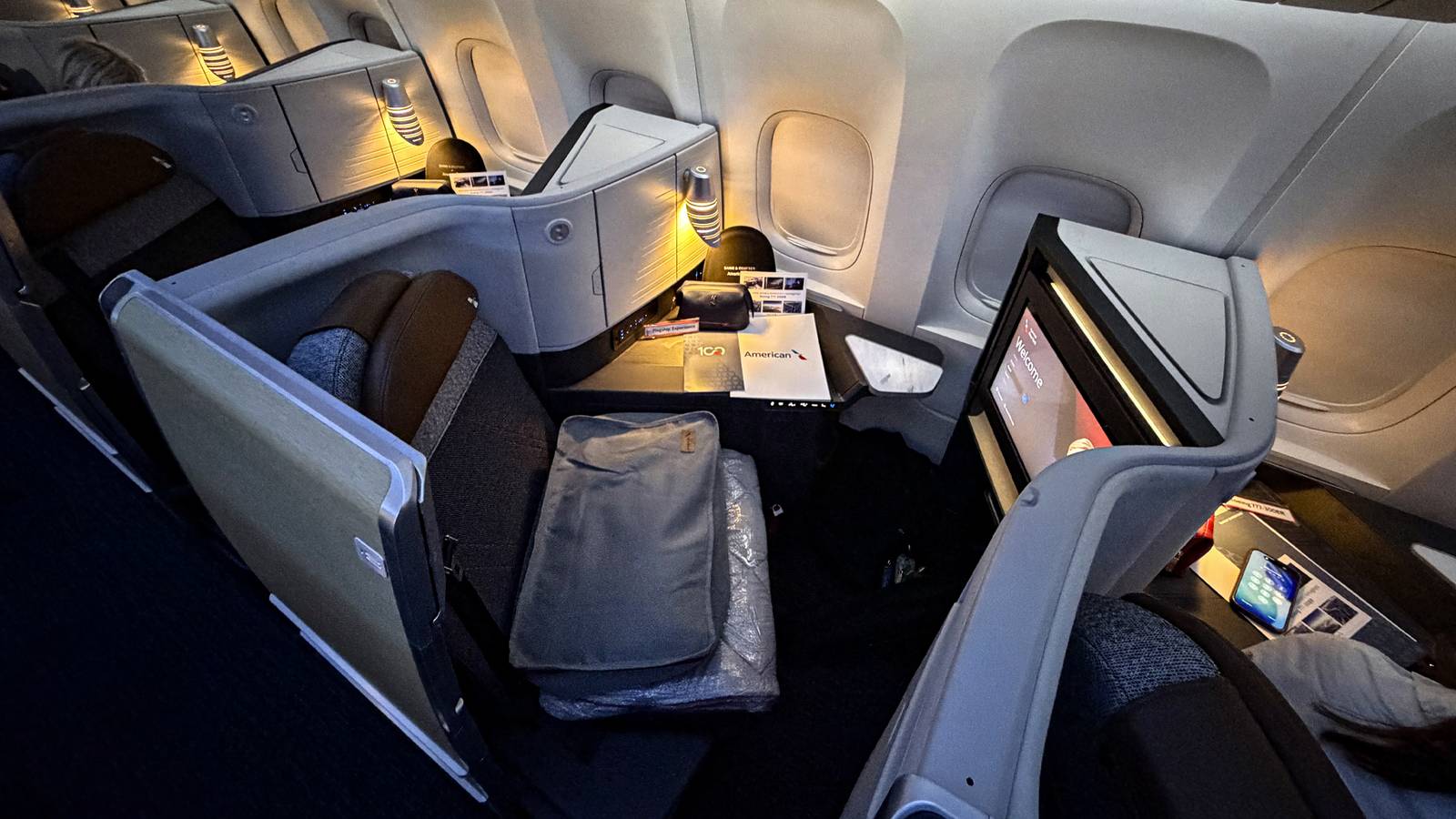
Published Sep 27, 2026, 1:00 PM EDT Daniel comes to Simple Flying with a business focused approach to the aviation world. Daniel enjoys analyzing strategy and how companies move against each other to gain a step ahead in the skies. Besides strategy, Daniel also has a passion for aircraft design and the history of aviation. Based in New York American Airlines has begun retrofitting its Boeing 777-300ER fleet under 'Project Olympus.' The 777-300ERs are American's flagship aircraft, and they are the first to receive the carrier's latest interiors (first introduced on the new 787-9 Dreamliners, of which there are now 11). Although the planes are receiving brand-new seats, American is getting rid of its international first class product once and for all, while the updated layout will be much more space-efficient than before. American's first retrofitted 777, registered as N718AN and assigned the tail number 7LB, has already entered service, flying from New York and Dallas to London. The aircraft has also sent N721AN, tail number 7LE, for refurbishment, and American aims to have retrofitted all 20 777-300ERs by the end of 2027. These aircraft will deliver a significantly upgraded inflight experience for customers and significantly improved operating economics for American. The New Interiors On American's 777-300ERs Credit: American Airlines The Olympus mods to the 777-300ER include updated seats in all cabins. At the front is the Flagship Business cabin, which features the Elevate Ascent platform. This relatively new reverse herringbone suite model is highly customizable and was designed specifically for Boeing widebodies. It's proven tremendously popular with 787 operators in particular, while American Airlines is the first airline to install the Elevate Ascent on the 777-300ER (EVA Air also intends to do so in the future). American Airlines installs reverse herringbone seats across its entire widebody fleet, and the Ascent is essentially a modernized, improved version of this platform type with sliding doors. In addition, American has installed eight Flagship Preferred suites, a front-row product with added space, a larger screen, and a counter area. This type of product has become increasingly popular in recent years, and American is now one of three US airlines to offer a 'business class plus' product (alongside JetBlue and United Airlines). American is using an updated version of the Collins Aerospace MiQ seat previously used for premium economy with headrest wings. Meanwhile, economy now gets the Collins Aerospace Aspire (the 777-300ERs formerly featured the Weber 5751). The screen sizes have been increased, and American has selected the Thales Avant with Bluetooth capability. The carrier now offers USB-C ports in all classes, while it has replaced the Panasonic inflight WiFi system formerly found on these birds with a Viasat system. The New Configuration For The 777-300ER Credit: American Airlines As part of Project Olympus, the 777-300ERs are receiving a new layout. The prior setup featured 304 seats, split between eight Flagship First seats, 52 Flagship Business seats, 28 premium economy seats, and 216 economy seats (including 28 Main Cabin Extra seats). Flagship Business extends to the third set of exits, while premium economy and economy are located behind it. Overall, it's fairly low density for a 777-300ER. However, today, premium is the name of the game, and so American Airlines is increasing the sizes of its premium cabins even more. Main Cabin Extra has been bumped up to 30 seats (surprisingly modest for a 777-300ER), while the premium economy cabin has been increased to 44 seats, still located just aft of the third set of exits. American Airlines 777-300ER Layouts Flagship First Flagship Business Premium Economy Main Cabin Extra Economy Total Seats Current Layout 8 seats 52 seats 28 seats 28 seats 188 seats 304 seats Project Olympus N/A 70 seats 44 seats 30 seats 186 seats 330 seats Meanwhile, the Flagship Business cabin still stretches to the third set of exits, but it now has 70 suites instead of 52, and 330 seats in total. American can fit 18 additional Flagship Business suites because it is eliminating Flagship First and revising its lavatory and galley arrangement. Meanwhile, despite adding 16 premium economy seats, American has kept the same number of economy seats as before (216). This was made possible through a more efficient galley and lavatory arrangement, although this is undoubtedly the biggest drawback of the Olympus 777s for most passengers. Breaking Down The New 777 Layout Credit: American Airlines Part of the reason why American's new 777 layout can fit more premium seats and 26 additional overall seats, in addition to the lack of a first class cabin, is because the seats are configured more efficiently. The new Flagship Business suites feature a seat pitch of 42 inches (106.7 centimeters), which is about an inch (2.5 centimeters) less than the old seat. That makes a big difference with so many seats. In addition, the pitch in premium economy and Main Cabin Extra has been cut by an inch. However, the more impactful changes throughout are the new galley and lavatory arrangements. Ahead of the first set of exits and behind the flight deck are two standard-size lavatories, rather than one large unit. This meant that the lavatory behind the first exit on the right could be eliminated. The galleys near the second set of exits have been rearranged, while there are now two lavatories ahead of the third set of exits rather than four, enabling more seats. Two lavatories near the fourth set of exits have been eliminated, while the galley in this area has been shrunken down and moved to add space for seats. Meanwhile, one of the two lavatories ahead of the fifth set of exits has been eliminated, while American has installed a new rear galley with two integrated lavatories, fewer trolleys, and less working space. In total, there are now nine lavatories as opposed to 12. From the airline's perspective, this is an amazing layout as it features a huge number of premium seats while overall capacity is still relatively high. However, the lavatory situation isn't ideal, and the premium economy seats are now notably tighter than those on many other airlines. Meanwhile, the aircraft has noticeably less galley space compared to before, which will make service more difficult for cabin crew. The Loss Of Flagship First Credit: Rene Dominguez I Shutterstock American Airlines is the last US airline to sell an international first class, branded as Flagship First. This product is only available on the Boeing 777-300ER and the transcontinental Airbus A321-200 subfleet (which features a different seat from the 777). However, Project Olympus is refurbishing the 777s without Flagship First. Meanwhile, the A321s are being retrofitted with a standard domestic layout as more Airbus A321XLRs arrive to take over transcontinental routes without a first class cabin. International first class has become less common because more advanced business class seats have shrunk demand for the former. Many carriers have ditched first class to focus on business class, while those that commit to first class have found success primarily by differentiating the experience and positioning it as an ultra-exclusive luxury offering rather than a more comfortable seating class. American doesn't differentiate Flagship First in a meaningful way today, and it doesn't have the brand power to sell an exclusive luxury product tomorrow. Instead, American is positioning the new Flagship Business suites, and especially Flagship Preferred, as the replacement for Flagship First. Despite the lower price point and market position, the new seats improve on Flagship First in some ways, including privacy and technology. The airline will stop selling Flagship First in November 2026, and will instead sell the seats as part of the Flagship Business cabin until the entire fleet is fully retrofitted. American Airlines' Plans For Its New Interiors Credit: The Global Guy | Shutterstock American's latest 787-9s were the first aircraft to feature the new interiors, while the 777-300ERs were the first in American's fleet to be retrofitted with the updated seats. Once the 777-300ER fleet is complete, the airline will have phased out Flagship First from its widebodies as well as the Safran Cirrus II business class seat. The next aircraft type to be retrofitted will be the 777-200ER, of which American has 47 examples in service. This came as a slight surprise because these are American's oldest widebodies, slated for retirement in the 2030s, and the airline has even requested bids from Airbus and Boeing for replacements. Aircraft Business Class Seat Model Number In Fleet Boeing 777-200ER 47 aircraft Collins Aerospace Super Diamond 28 aircraft Safran Concept D 19 aircraft Boeing 777-300ER 20 aircraft Elevate Ascent One aircraft Safran Cirrus II 19 aircraft Boeing 787-8 Dreamliner 37 aircraft Collins Aerospace Super Diamond 17 aircraft Safran Concept D 20 aircraft Boeing 787-9 Dreamliner 33 aircraft Collins Aerospace Super Diamond 22 aircraft Elevate Ascent 11 aircraft However, American's refurbishment of the 777-200ERs indicates a commitment to long-haul growth over the past several years. Once they receive their new interiors, the 777-200ERs will feature a more premium layout than today and will also have a consistent business-class seat (the fleet currently uses two different models). In addition to the 777-200ERs, American has also committed to refurbishing its 37-strong 787-8 fleet. Once the 787-8s are completed, American will have phased out the Safran Concept D seat, while the only type still flying with an older seat model will be its first 22 787-9s (equipped with the Collins Aerospace Super Diamond). As a whole, American has ambitious plans to refurbish nearly its entire long-haul fleet and will also be increasing the size of its premium cabins in the process.
American Airlines Added 26 Seats To Its Boeing 777-300ER & Killed First Class Without Cutting Economy
Full Article
Original Source
Read the full article at Simpleflying →KhanList aggregates and links to publicly available news content. We do not host full articles from third-party sources. Always verify important information with original sources.