
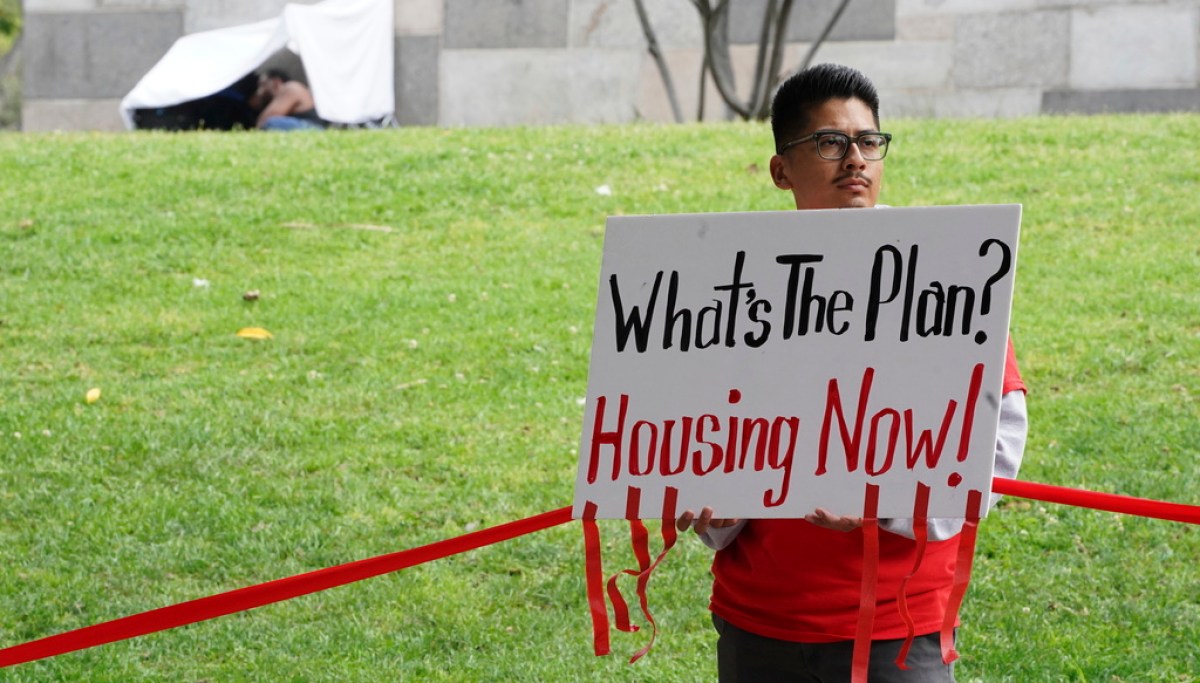
In January 2025, the U.S. Department of Housing and Urban Development’s Point-in-Time count recorded roughly 745,650 people on a single night, a 3% decline from 2024’s record and the first year-over-year drop since 2016. Harvard’s Joint Center for Housing Studies reports veteran homelessness at its lowest recorded level, down 56% over 15 years. Those are encouraging numbers, but they also hide a much more troubling one.Chronic homelessness, HUD’s term for yearlong or repeated homelessness combined with a disabling condition, reached nearly 170,000 people, almost twice the level of 2016. Unsheltered homelessness stood at 266,320. Something different appears to be happening inside America’s homeless population.The conventional explanation for homelessness is increasingly straightforward: Housing costs too much. Colburn and Aldern make the strongest version of that argument in Homelessness Is a Housing Problem. Examining American metros, they found that mental illness, drug use, poverty, weather, and local assistance didn’t explain why some cities have far higher per-capita homelessness than others. Housing prices and vacancy rates did. It’s a powerful finding, probably the best explanation for why homelessness clusters in cities like San Francisco and Seattle rather than tracking poverty, addiction, or mental illness. But there is another question hiding inside the first one. Colburn and Aldern were explaining why some cities have more homelessness than others, not why, within those cities, some people quickly escape it while others cycle through shelters, return to the streets, or remain homeless for years.Those may be two different problems.O’Flaherty’s economic work provides a bridge between them. As rents rise and vacancies tighten, landlords become more selective. People with poor credit, eviction histories, active addiction, erratic behavior, or visible mental illness are pushed out first.Housing prices determine where the cliff is. Individual circumstances help determine who falls off it.Christopher Jencks made a similar point in The Homeless three decades ago: The 1980s explosion of homelessness reflected several forces at once, including deinstitutionalization without adequate follow-up care, the crack epidemic, and the disappearance of cheap skid-row housing. Neither housing economics nor individual pathology alone explained it. Different homeless populations behave differently.A recent Bipartisan Policy Center analysis notes that roughly 80% of shelter users experience a single, brief episode of homelessness, often driven by housing costs or an acute financial shock. The chronically homeless are a much smaller population, but the most visible and system-intensive. That difference matters because the same intervention may not work equally well for both groups.Families and veterans respond relatively well to rental assistance, vouchers, and rapid rehousing. Give a family that lost its apartment after a job loss enough help to get back into housing, and the crisis often ends. The extraordinary drop in veteran homelessness shows sustained housing assistance can work.But the chronically homeless population presents a different challenge. For many who’ve spent years on the street, homelessness is intertwined with serious mental illness, addiction, cognitive impairment, trauma, and patterns of behavior that don’t disappear when someone receives an apartment. Providing shelter may therefore be only one part of what is required.This is where Theodore Dalrymple becomes useful, though not as a homelessness researcher. His Life at the Bottom drew on years as a physician in British prisons, hospitals, and poor neighborhoods, describing a culture in which people came to see their circumstances as things that happened to them rather than choices they’d made. Institutions built around nonjudgmentalism, Dalrymple argued, sometimes reinforced that worldview by separating assistance from expectations of behavioral change.IN THE U.K., ASSIMILATION NOW REQUIRES AN INSTRUCTION MANUALHis work wasn’t about American homelessness and shouldn’t be mistaken for empirical evidence. But it offers a vocabulary for something housing statistics struggle to measure: human behavior. That matters when the population being discussed includes people whose problems extend well beyond the absence of housing.In August, HHS and HUD, along with the White House drug policy office, announced a shift toward what the administration calls “Treatment First.” The new approach emphasizes treatment, recovery, and greater accountability over relying on housing as the first intervention. That shift deserves scrutiny because permanent supportive housing serves an unusually vulnerable population, and poor outcomes don’t by themselves prove it has failed.But they raise a harder question: Is housing alone enough to stabilize the people with the greatest needs?Local evidence suggests that sometimes it isn’t.A 2025 analysis of San Francisco’s supportive housing system examined 58 high-service users, tracking them before and after placement. Sixteen subsequently died, while service spending among high-need residents increased sharply after they entered housing. A San Francisco Chronicle investigation has documented similar difficulty treating serious addiction through housing alone.San Francisco is an extreme case, with an unusually severe drug market and high-acuity population, and shouldn’t be treated as representative. But it illustrates the distinction. Housing can solve one problem while leaving others largely untouched.An apartment can remove homelessness without removing addiction. A lease can provide shelter without restoring someone’s capacity to manage medications, follow rules, or resist fentanyl. Housing can change someone’s address without changing the behaviors that made independent living difficult.This is where the debate turns needlessly ideological. Housing advocates are right that expensive housing and low vacancy rates create homelessness; conservatives are right that addiction, mental illness, and behavior matter enormously among the chronically homeless. Both can be true at the same time.The mistake is assuming those observations contradict each other.America may actually have at least two homelessness problems. The first is predominantly an economic-displacement problem: Families, veterans, and working people pushed into homelessness by high rents, lost income, or temporary crisis. Housing assistance can be remarkably effective here.The second is a chronic incapacity problem affecting a smaller, highly visible population with some combination of severe addiction, serious mental illness, cognitive impairment, and long-term behavioral dysfunction. Housing remains necessary but alone may not be sufficient. Treatment, supervision, and structure may have to accompany it.That distinction should matter to Congress. When lawmakers next review federal homelessness funding, the question isn’t just how much money to appropriate or how many units it buys — it’s whether federal programs distinguish between people who primarily need affordable housing and those whose chronic homelessness requires treatment, supervision, and structure. Congress doesn’t appropriate money to “poverty,” assuming one program fits every cause, and homelessness shouldn’t be treated differently.If someone is homeless because his rent increased beyond what he can afford, treatment isn’t the answer. He needs housing. If someone has lived beneath an overpass for six years cycling through fentanyl addiction, psychosis, emergency rooms, and shelters, an apartment key and little else may not be enough. He may need treatment, supervision, structure, and, in some cases, requirements inappropriate for the first population.The encouraging 2025 numbers suggest America is getting better at addressing the first problem: Overall homelessness declined, unsheltered homelessness fell modestly, and veteran homelessness continued its remarkable decline. Meanwhile, chronic homelessness reached another record. The two trends are moving in different directions.That divergence may be telling us something.ENDING LA’S HOMELESS INDUSTRIAL COMPLEXFor years, America’s homelessness debate has asked whether homelessness is fundamentally about housing or about people. The better question may be which homeless people we mean. Housing markets help determine who becomes homeless, but once someone has spent years on the street, the forces keeping him there can differ sharply from the forces that put him there.Until Congress and federal agencies recognize that distinction, we’ll keep succeeding with the homeless population most capable of responding to housing assistance, while the persistent core grows larger, sicker, and harder to reach.
America has two homelessness problems
Full Article
Original Source
Read the full article at Washingtonexaminer →KhanList aggregates and links to publicly available news content. We do not host full articles from third-party sources. Always verify important information with original sources.