
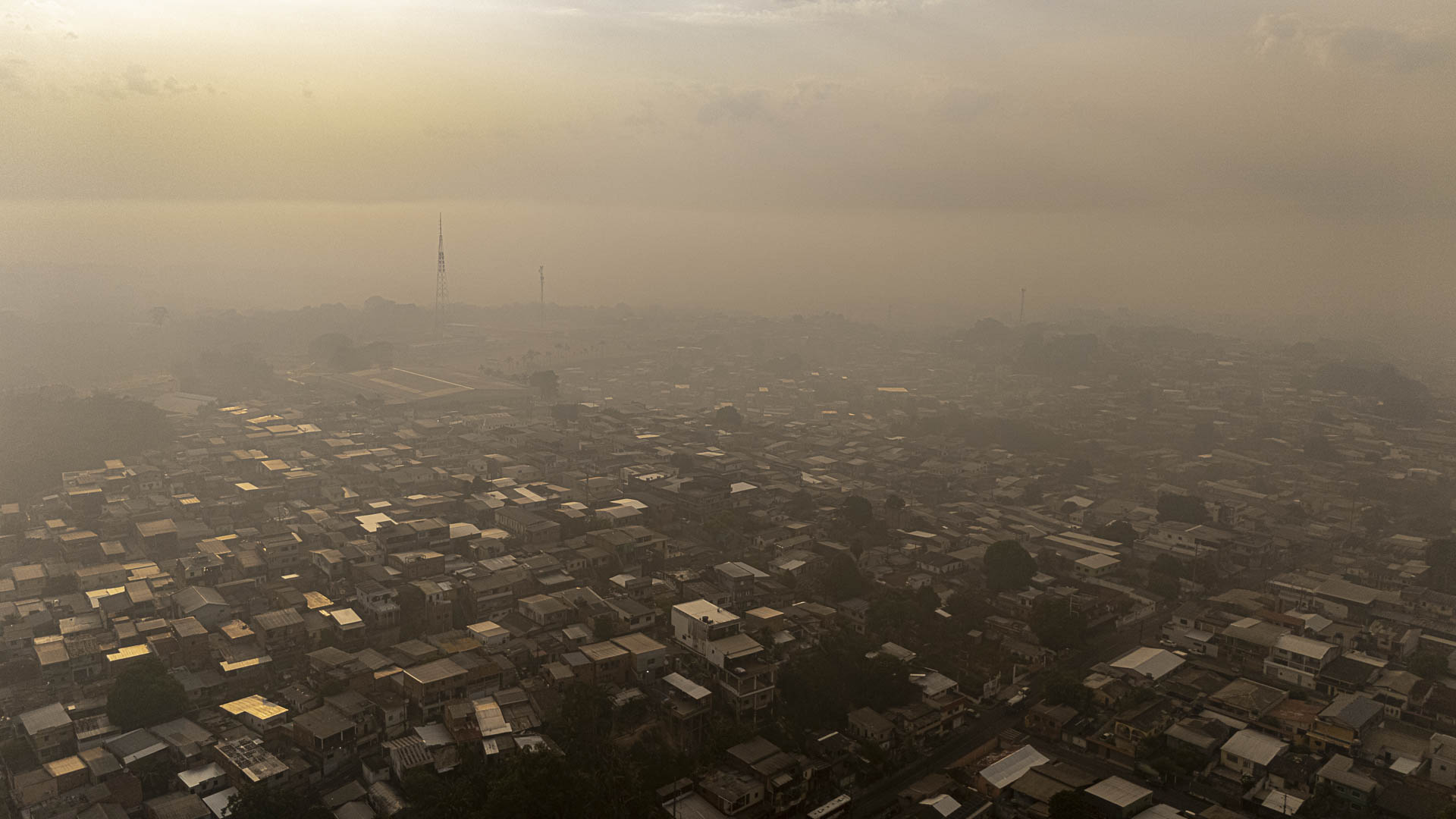
Smoke from fires reaching up to 30 times the World Health Organization’s safe daily limit hits Manaus, Brazil’s largest Amazon city, prompting school closures and worsening respiratory crises.With the giant El Niño looming, environmental agencies and police authorities are investigating possible deliberately set fires in Amazonas, with 11 suspects arrested.Between Oct. 1 and 19, Brazil recorded 1,921 hotspots in the Amazonas state, up 202% from 2025.In the Manaus metropolitan area, a Mongabay analysis found hotspots in landscapes where forests and agriculture coexist. MANAUS, Brazil — Midway through the conversation with Mongabay, Otacílio Farias, a 75-year-old farmer, stops to read a message on his phone: “Right now, there’s a fire near a friend’s house.” Farias has lived his entire life near the Autaz Mirim River, near Manaus, Brazil’s largest city in the Amazon. Forest fires have affected the area for more than 30 days. “Nearby, Lake Miriti was shrouded in haze at dawn, but it wasn’t morning mist: It was smoke,” he said. Farias says the nearby municipalities of Autazes and Careiro da Várzea are experiencing the worst fire crisis of his lifetime. “My throat and nose are in terrible shape,” he said. Farias’ community WhatsApp groups are packed with pleas to save crops and reports of elderly residents rescued as flames approached. Farias was at home on Oct. 1 when friends of his 18-year-old son, Fabrício, arrived on motorcycles, calling for help against fires approaching homes. Around 100 community members joined the effort. It wasn’t until Oct. 10, however, that the Amazonas state government declared an emergency in 36 municipalities, paving the way for federal assistance. Between Oct. 1 and 19, Brazil’s space agency, INPE, recorded 1,921 fire hotspots in Amazonas, up 202% from the same period in 2025. The daily average also rose 51.5% compared with late September 2026. Of these, 584 (30.4%) were in the Manaus metropolitan area: 197 in Autazes, 134 in Itacoatiara and seven in Manaus. Hotspots also spiked after the first round of Brazil’s presidential election: INPE recorded 33 across Amazonas on election day, Oct. 4, and 200 the next day, an increase of more than 500%. Manaus woke up blanketed in smoke from fires in the municipalities of Careiro, Iranduba and Autazes (Oct. 17, 2026). Image courtesy of Alberto César Araújo/Amazônia Real. In late September, smoke had already turned Manaus’s skyline gray. On Oct. 8 and 9, however, conditions worsened, prompting the suspension of classes in municipal schools and universities. For weeks, neither dawn nor night has brought relief. On Oct. 8, Brazil’s federal health research institute, Fiocruz, recorded a daily average concentration of fine particulate matter (PM2.5) six times above (99 µg/m³) the daily average exposure set by the World Health Organization (15 µg/m³). Nine days later, with temperatures ranging from 33°C to 37°C (91.4°F to 98.6°F), the Manaus metropolitan area saw particle concentrations up to 30 times the WHO standard. Changes in people’s routines are most apparent at home: Smoke seeps into bedrooms, making sleep unbearable, while families caring for elderly relatives struggle to avoid exposure. With schools closed, parents rely on support networks to keep working as children suffer throat irritation and shortness of breath. Even being indoors offers little relief. But this isn’t Manaus’s first smoke crisis. “Unfortunately, smoke has already become a recurring problem,” Fernando Almeida Val, a physiotherapist with a doctorate in medicine and a researcher at the Tropical Medicine Foundation, told Mongabay. “What worries me most is the realization that we’re beginning to treat an abnormal situation as part of our daily routine.” During a similar smoke crisis in July, New York City recorded a daily average of 95 µg/m³ as smoke drifted in from Canada to the U.S. The state government distributed more than 100,000 masks, while nearly 600 cooling centers remained open, also in response to a heat wave. In Manaus, however, buses remain crowded, people continue commuting to and from work, and wearing masks outdoors is uncommon. Smoke poses lasting risks to human health. “Smoke contains very small particles that reach deep into the lungs. Exposure triggers inflammatory processes and changes in blood vessels that can affect other organs,” Fernando Val told Mongabay. A 2022 study published in Nature Communications found that each 10 µg/m³ increase in daily wildfire-related PM2.5 was associated with a 3.1% increase in all-cause deaths and a 7.7% increase in “respiratory mortality,” considering effects accumulated over 14 days, based on nationwide Brazilian data from 2000 to 2016. Between Oct. 20 and 25, INPE recorded just 214 fire hotspots in Amazonas, a sharp decline, linked to intensified environmental enforcement. As a result, air quality improved in Manaus. During this period, Lábrea, Nhamundá, and Parintins recorded the most hotspots. Smoke from wildfires blankets the Amazon (Oct. 12, 2026). Image courtesy of Lauren Dauphin/NASA Earth Observatory. The criminal theory Such sudden rises in wildfires prompted environmental agencies and police authorities to step up inspections and investigate intentional fires in Amazonas. By Oct. 14, a task force had opened 120 proceedings to investigate suspected crimes, while in Autazes, the Public Prosecutor’s Office launched a civil inquiry to investigate the origins and authors of fires that occurred between Oct. 11 and 13. According to local newspaper A Crítica, an investigation involving Brazil’s environmental agency, IBAMA, the Federal Police, the Civil Police and the Amazonas Environmental Protection Institute (IPAAM) is underway. On Oct. 7, drone footage registered two men apparently setting fire to vegetation near homes in Iranduba, separated from Manaus only by the Negro River. Environment Minister João Paulo Capobianco cited reports of people in pickup trucks using fuel to start fires along roadsides. IBAMA President Jair Schmitt said teams had spotted people starting a fire beside a road in Autazes. According to the Ministry of the Environment, Brazil’s intelligence agency, ABIN, is helping monitor WhatsApp groups and other channels for signs of possible coordination, which authorities say has not been confirmed. On Oct. 17, the federal government announced expanded efforts to fight wildfires in Amazonas, including deploying additional aircraft, mobilizing security agents and the military, expanding health care infrastructure and allocating funds for emergency response measures. That same day, authorities arrested 11 people in Autazes suspected of setting criminal fires. A group of women wear masks to protect themselves from smoke caused by wildfires in Manaus, Amazonas state, Brazil, Friday, Oct. 9, 2026. Image by AP Photo/Edmar Barros. Fire fronts One fire front lies in southwest Amazonas. The municipalities of Lábrea (262 hotspots detected) and Boca do Acre (189), 850 kilometers (528 miles) and 1,555 km (966 mi) from Manaus, are among those with the highest numbers of fire hotspots in the state. These municipalities lie in the so-called Arc of Deforestation, a region influenced by the BR-319 and BR-230 highways. Municipalities in this frontier accounted for approximately 75% of Amazon deforestation between 2008 and 2019, according to data from Instituto Socioambiental. In 2023, the last time Manaus went through dark days due to smoke, data showed that smoke blanketing the city, particularly between October and November, came directly from fires along the corridor formed by these roads. Closer to Manaus, in the metropolitan area, fire and agribusiness seem linked. Cross-referencing INPE data with MapBiomas’s 2025 land-cover map shows that 28.8% of the hotspots recorded between Oct. 1 and 19 occurred where forests and agriculture coexist. This proportion was higher in Careiro da Várzea (45.1%), Autazes (37.6%) and Careiro (33.3%). “As pastures have expanded over the years, the forest has become more vulnerable, and fires have spread more easily,” Farias said. People navigate the Solimoes River through smoke from wildfires in Manaus, Amazonas state, on Oct. 12, 2026. Image by AP Photo/Edmar Barros. The fire-affected Autaz Mirim River area, once an important supplier of vegetables and fruit to Manaus, has shifted recently toward cattle and buffalo ranching. In 2008, Brazil’s land reform agency, INCRA, transferred part of the land claimed by the Indigenous Mura to the municipality of Autazes. Newly titled plots became pastures, with tractors and fire used to clear land, a common and legal practice in Brazil when following guidelines and permits. Now known as the Land of Milk and Cheese, Autazes has specialized in dairy production. In May 2024, researchers surveyed areas along the AM-254 and BR-319 highways that had burned in 2023. They found machinery clearing land, fences and herds of cattle and buffalo, raising suspicions that criminals used fires to speed up land clearing. Accounts collected by Mongabay from local residents also indicate that areas burned in the past have subsequently been used as pasture. Fire is used to clear vegetation and stimulate pasture regrowth, but frequent burning can degrade soils and reduce productivity. As pastures deteriorate, expanding ranching can put further pressure on forest edges. Under severe drought, fires started for land management can spread into neighboring forests. Firefighters work to put out a blaze in the Amazon forest during a drought and high temperatures in the rural municipality of Careiro Castanho, Amazonas state, Brazil. Image by AP Photo/Edmar Barros. The El Niño push Fire, however, is also part of riverine communities’ farming practices, though on a much smaller scale. Farias recalls that when he was young, these fires rarely got out of control: “Because it always rained in October! The forest didn’t catch fire because it was wet, but now the rain doesn’t come.” The Amazon is now in its annual dry season, June to November, but this year the rainforest also braces for the effects of the giant El Niño phenomenon. Forecasts point to drier months ahead in the Amazon and heavy rain in other corners of South America. Douglas Morton, an Earth system scientist at NASA’s Goddard Space Flight Center in Maryland, U.S., recently told NASA Earth Observatory that the fires around Manaus and Santarém follow a broader wave of tropical burning associated with El Niño’s disrupted rainfall patterns. NASA reports data showing that rainfall in Manaus was 95% below normal in August and 60% below normal in September. Back in Autazes, locals fear more smoke and dry days ahead. “People have lost their crops, their banana groves, their pineapple fields, their small farms,” Farias said. “Now the fire seems to be under control, but difficult days still are to come.” Banner image: Manaus woke up shrouded in smoke on Oct 17. In the background, the Negro River is barely visible on the horizon. Image courtesy of Juliana Pesqueira/Amazônia Real. Brazil boosts budget and number of firefighters amid strong El Niño forecast Citations: Ye, T., Xu, R., Yue, X., Chen, G., Yu, P., Coêlho, M. S., … & Li, S. (2022). Short-term exposure to wildfire-related PM2. 5 increases mortality risks and burdens in Brazil. Nature Communications, 13(1), 7651. doi:10.1038/s41467-022-35326-x Ferrante, L., Marinho, R. R., & Fearnside, P. M. (2025). The 2023 Manaus smoke crisis and the role of highway BR-319 in a new Amazon fire cycle. Discover Sustainability, 6(1), 909. doi:10.1007/s43621-025-01850-1 FEEDBACK: Use this form to send a message to the author of this post. If you want to post a public comment, you can do that at the bottom of the page. Cite this articleTiago da Mota e Silva (2026). Amazon fires trap Manaus in smoke as authorities target arsonists. Mongabay Conservation news. DOI: https://doi.org/10.66709/news-333902 Credits Topics
Amazon fires trap Manaus in smoke as authorities target arsonists
Full Article
Original Source
Read the full article at News →KhanList aggregates and links to publicly available news content. We do not host full articles from third-party sources. Always verify important information with original sources.