
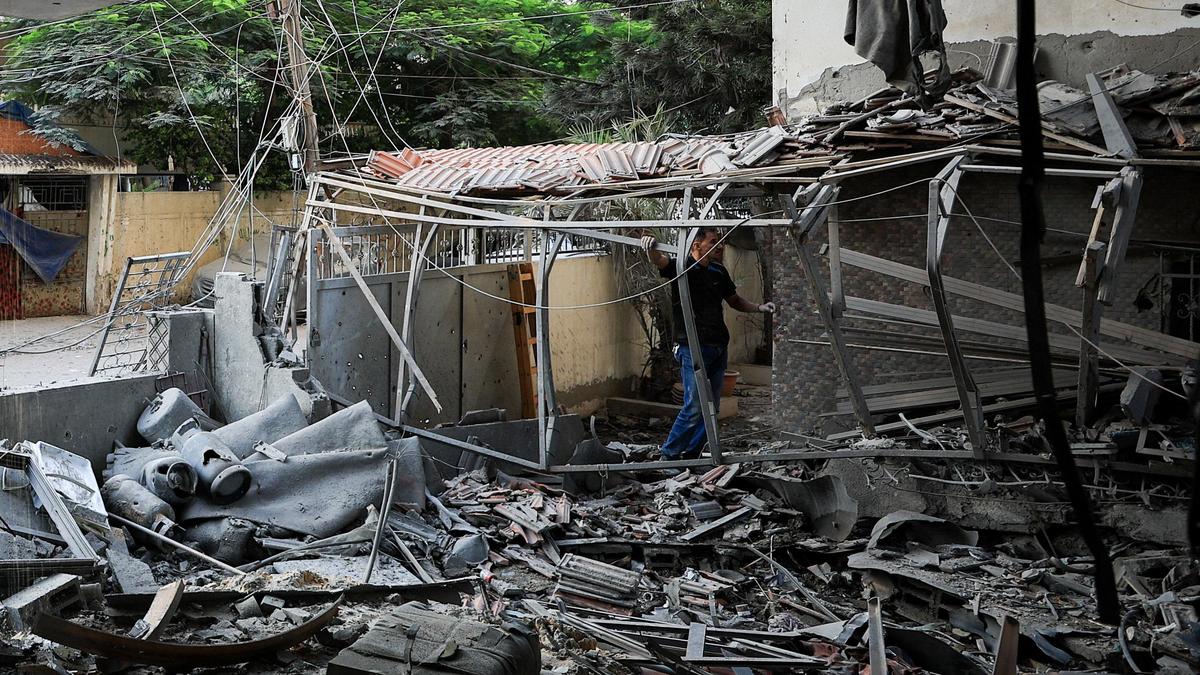
A Palestinian man inspects the site of an Israeli strike on an apartment building in Gaza City on October 3, 2026. | Photo Credit: Reuters On Wednesday (October 7, 2026), which marked the third anniversary of the October 7 attacks, Israel carried out new strikes in Gaza killing at least three people. Just four days before, an airstrike on an apartment building in Gaza killed five, including four women. Since October 7, 2023, Israel's total siege on Gaza has killed around 74,200 Palestinians, with about 60% of the Strip directly under the control of the Israeli military.As many as 2,45,981 buildings, which amounts to 74.5% of all buildings before the fateful day of October 7, 2023, are likely to have been damaged or destroyed, according to a satellite radar-driven structural analysis by Conflict Ecology — a geospatial research lab at Oregon State University, led by Associate Professor of Geography Jamon Van Den Hoek.The analysis was conducted using satellite data from October 7, 2023 until August 3, 2026, and composed of a 12-day period of observations based on 258 Sentinel-1 radar images alongside building footprint data. The graphic below shows the damage received to buildings.Map courtesy: Conflict EcologyIf the infographic isn’t visible or is incomplete, click here to exit AMP mode.The map below also shows the damage received only in the 12-day period of observation. Densely populated areas have been damaged repeatedly in the 34 months of observation.Map courtesy: Conflict EcologyIf the infographic isn’t visible or is incomplete, click here to exit AMP mode.Since the U.S.-brokered ceasefire came into effect in 2025, the Israel Defense Forces (IDF) has killed over 1,460 Palestinians in Gaza, as per the Gaza Health Ministry. Additionally, the IDF has been destroying more buildings in the territory it controls ever since the ceasefire. Conflict Ecology’s analysis shows that a total of 25,801 buildings were detected to be destroyed or damaged in the Israeli-held side of the Yellow Line (shown in the graphic below) - a demarcation line created since the October 2025 ceasefire, with almost 53% of Gaza controlled by Israel. In the rest of the Strip, the 7,643 buildings received ‘new’ damage or were destroyed. Inforgraphic: Conflict Ecology Northernmost Governorates of North Gaza and Gaza have been decimated the most, with 87% of the buildings either damaged or destroyed. Densely populated areas like Gaza City, Jabalia refugee camp, and more, come under these two governorates.The scale of destruction in Gaza has been widely documented in the last three years. The graphic below offers just a snippet into how neighbourhoods have been entirely razed by the Israeli military.Apart from the first few weeks of the war, the intensity of Israeli attacks increased in different neighbourhoods — thereby, damaging or destroying buildings previously undamaged — in May 2024, and in the months of January, June, and July in 2025.Additionally, the United Nations Office for the Coordination of Humanitarian Affairs’ situation report from September 30, 2026 mentions that: 92% of assessed establishments in the commerce and industry sector are destroyed or damaged. 74% of the road network is destroyed and 13% is damaged. 88% of above-ground Water, Sanitation, and Health assets are damaged. 76% of underground networks of the same are damaged. 83% of the Gaza Strip’s coastal zone is fully or partially destroyed. 76% of assessed cultural and heritage sites are destroyed or damaged. 90% of energy infrastructure including electricity distribution network and associated assets are destroyed. 82% of all structures are destroyed or damaged. Published - October 09, 2026 08:26 pm IST
Almost 75% of buildings in Gaza damaged or destroyed since October 7, 2023: An Analysis
Full Article
Original Source
Read the full article at Thehindu →KhanList aggregates and links to publicly available news content. We do not host full articles from third-party sources. Always verify important information with original sources.