
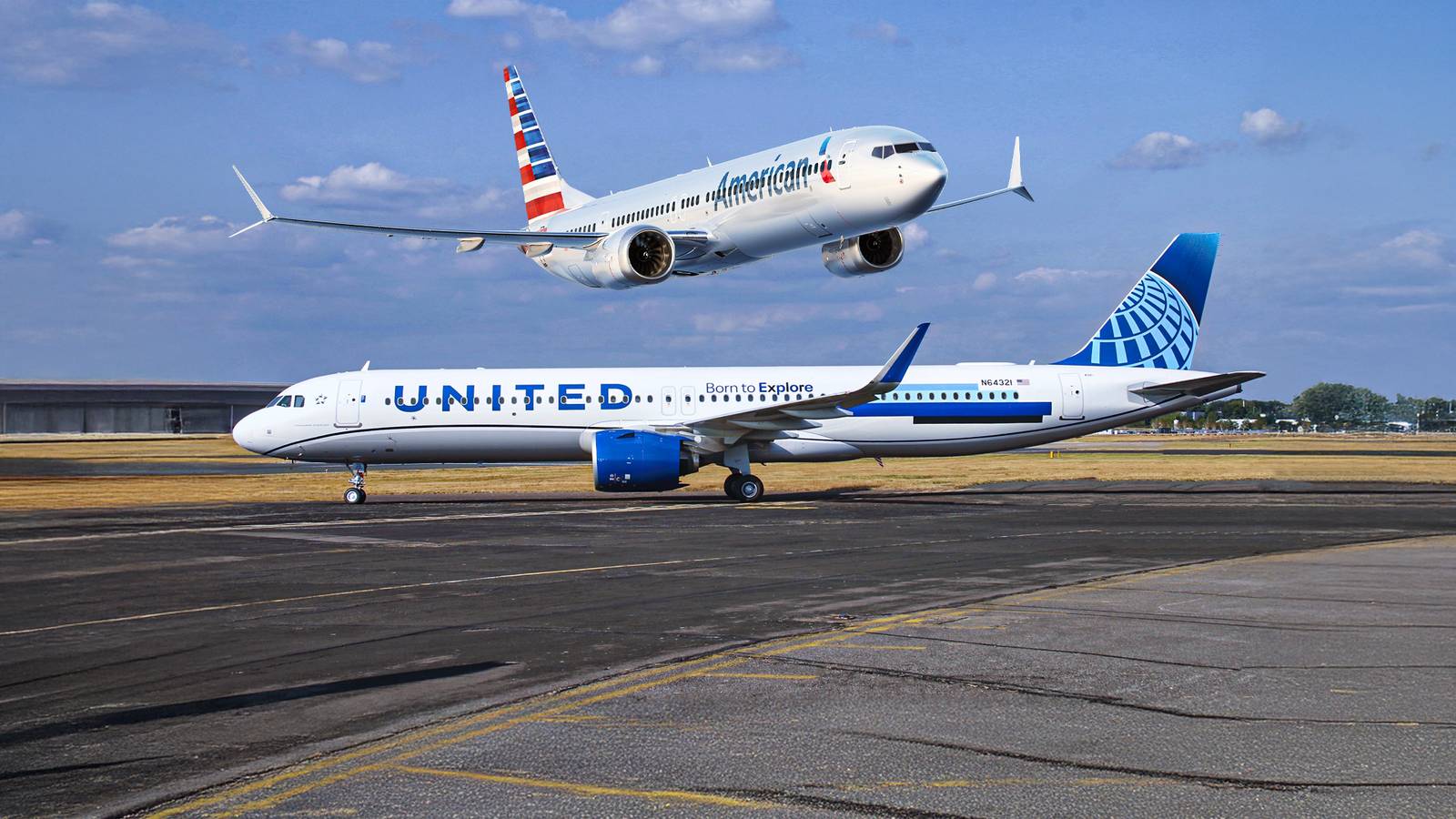
The Airbus A321XLR and Boeing 737 MAX 10 are the two newest narrowbodies from rivals Airbus and Boeing. The A321XLR is a long-range derivative of the A321neo, which is by far the most successful commercial aircraft variant of all time. The 737 MAX 10, meanwhile, is meant to answer the A321neo, as Boeing has lacked a proper competitor to the aircraft and has allowed Airbus to steal huge swaths of market share for years. But it still lacks an answer to the A321XLR. However, despite Boeing essentially having no presence in the market for long-range narrowbodies today, this might not be a problem. After the aircraft attracted several large, high-profile orders at its launch in 2019, sales have been quite modest. Meanwhile, the US is a huge market for large narrowbodies, as well as for long-range narrowbodies. Notably, however, the 737 MAX 10 is far more popular than the A321XLR, and one of the three legacy carriers has stayed away from the XLR altogether. Why Delta Air Lines Doesn't Want The XLR Credit: Markus Mainka | Shutterstock There are benefits and drawbacks to operating narrowbodies on long-haul flights. Fundamentally, the A321XLR, as the newest, most fuel-efficient, and most capable long-range single-aisle twinjet yet, is an aircraft that costs little to operate relative to widebodies, but also earns much less revenue. It works for some carriers, particularly those looking to expand their route networks to secondary spokes, but not for all. For Delta Air Lines, however, the main issue with the XLR is with the carrier's pilot agreement. Delta has traditionally relied heavily on its joint venture partners for long-haul flying, which reduces the need to operate its own widebodies, thus reducing the number of high-paying widebody pilot positions. Therefore, the company's latest pilot labor agreement includes 'Global Scope', which requires Delta to match long-haul flying operated by joint venture partners to the US one-for-one. Notably, however, only flights operated by widebodies count towards Global Scope. Delta has publicly stated that transatlantic narrowbody operations do not fit with its intended brand image, but the carrier is also fairly risk-averse with expensive long-haul flying. Although the A321XLR is cheaper to operate than a widebody, it's still more expensive to fly across the Atlantic than short-haul, and the XLR costs more to buy than a standard A321neo. The plane simply doesn't fit Delta's goals the way that it fits American and United's, which have collectively ordered 90 A321XLRs. The Appeal Of The A321XLR To US Carriers Credit: George Mutch | Shutterstock American Airlines has ordered 40 A321XLRs in total, to essentially serve two distinct purposes. The first is to replace the airline's Airbus A321T subfleet, which is used for premium transcontinental flights. While the aircraft's range isn't necessary here, it does feature business class and premium economy, which is valuable in this market. The other is to operate transatlantic services, and the aircraft is especially well-suited for American, as its primary transatlantic hub, Philadelphia, is a smaller market than Boston or Washington, D.C., while it's the smallest of the three legacy carriers in the New York market. American also has a much smaller widebody fleet than its competitors, which makes the A321XLR crucial for increasing its market share across the Atlantic. United Airlines, on the other hand, has planned a different subfleet of 50 A321neos with lie-flats to serve premium transcontinental routes (giving it 100 narrowbodies with lie-flats, as opposed to American's 40). This means that the A321XLRs will solely be dedicated to transatlantic flying, replacing the carrier's Boeing 757-200 fleet. For both carriers, the A321XLR has excellent commonality with their already-large A321neo fleets, and they're also both looking to expand their Europe route networks. The A321XLR's low operating costs make destinations like Toulouse and Luxembourg, which United will be launching in 2027, much easier to run compared with a depreciated Boeing 767 or a modern Boeing 787. The aircraft's low capacity also helps with yield integrity, further improving the economics of new long-and-thin routes. The 737 MAX 10's Role In US Airlines' Fleets Credit: Lukas Souza I Shutterstock The recently certified Boeing 737 MAX 10 is not a competitor to the A321XLR. Instead, it's meant to compete directly against the A321neo, which has seemingly limitless demand. With it, Boeing essentially stretched the 737 again, slightly bumped the plane's Maximum Takeoff Weight (MTOW) to preserve range, and revised the main landing gear to preserve takeoff performance. It promises to be the most cost-effective 737 ever, and Boeing has received orders for 115 737 MAX 10s from American, 167 MAX 10s from United, and 100 MAX 10s from Delta. The MAX 10 is quite appealing because it essentially offers the same economics as the Airbus A321neo, yet it's a 737. This means that the US carriers can secure favorable pricing from Boeing and get the planes quicker than if it were just A321neos arriving. In addition, the 737 MAX 10 is expected to be more fuel-efficient on shorter routes, which make up the bulk of narrowbody flying in the US and worldwide. As such, it's been ordered by all three carriers, complementing their even larger A321neo orders. Airline A220 Total Orders 737 MAX 8 Total Orders 737 MAX 9 Total Orders 737 MAX 10 Total Orders A321neo Total Orders American Airlines 103 aircraft 115 aircraft 206 aircraft (plus ten used) Delta Air Lines 145 aircraft 100 aircraft 189 aircraft United Airlines 123 aircraft 224 aircraft 167 aircraft 210 aircraft Data: Planespotters.net Of the three, Delta and United will both start taking the MAX 10 in 2027, while American's will begin arriving in 2029. For American and United, they will be joining much larger 737 MAX fleets, with American already flying the MAX 8 while United flies the MAX 8 and MAX 9, while this will be Delta's only MAX variant. Notably, American and Delta have both confirmed that their MAX 10s will come with 24 first class seats, rather than the previously expected 20. Given the current rise in premium demand, this is a more than logical move to capitalize on that. Why The Market For The MAX 10 Is So Large Credit: Ian Dewar Photography | Shutterstock Stretch aircraft like the A321neo or the 737 MAX 10 are much more lucrative for airlines because they burn just slightly more fuel than their smaller counterparts while seating significantly more passengers. In the past, what often limited sales of stretched narrowbody variants was their lack of range, a consequence of their added weight over the base model. However, both the A321neo and 737 MAX 10 have transcontinental range, meaning that they can do essentially any standard domestic route. Since airlines aren't paying a range penalty anymore, the main issue with a larger narrowbody then solely becomes its higher capacity in some cases. While the operating costs are nearly identical to their smaller counterparts, routinely offering excessive capacity can depress yields, hurting revenue. However, US airlines have become extremely adept at price segmentation, using multiple fare buckets and basic economy tickets to help fill seats while collecting as much revenue as possible. The use of different price buckets and basic economy fares has made it easier for airlines to fill larger planes on slow days, while the large aircraft earns more money on days with higher demand. This has reduced the need to operate smaller variants, allowing carriers to standardize on their A321neos and 737 MAX 10s. American and United's orders for the MAX 10 are larger than their MAX 8 orders, while Delta has ordered significantly more large narrowbodies than A220s. Meanwhile, all three airlines have ordered hundreds of A321neos. Why The Lack Of An A321XLR Competitor Is Not A Weakness Credit: Kevin Piechota I Shutterstock Airbus has the market for long-range narrowbody aircraft essentially all to itself with the A321XLR, and this is especially striking because the A321XLR is directly replacing the Boeing 757-200 at some airlines, such as United. The 737 MAX 10, while a good aircraft for its mission, lacks the range and payload capacity to be used on transatlantic services, while the 737 MAX 8 is significantly smaller (hurting its economics in comparison to the Airbus) and still has less range. However, while the A321XLR doesn't have a narrowbody competitor, it essentially does compete against smaller widebodies. Fundamentally, it's a low-risk, low-reward aircraft because of its limited revenue potential, while there are cost issues with running such a small aircraft on long-haul routes due to factors like augmented crews. It's a niche aircraft with benefits and limitations that serves a niche market, and Boeing is likely better off not competing in this market today. The A321XLR is estimated to have received over 460 orders; a fine number for a low-cost subvariant of an existing aircraft, but less than 10% of the nearly 8,000 orders that the A321neo has received as a whole. If Boeing had developed a comparable 737 variant, this would have split an already small market. The 737 MAX 10, meanwhile, has received over 1,500 orders and is arguably the more important aircraft, as it is the first real challenge to the overwhelming dominance that the A321neo has held over the narrowbody market.
All 3 US Legacy Carriers Will Fly The Boeing 737 MAX 10, But Not The Airbus A321XLR
Full Article
Original Source
Read the full article at Simpleflying →KhanList aggregates and links to publicly available news content. We do not host full articles from third-party sources. Always verify important information with original sources.