
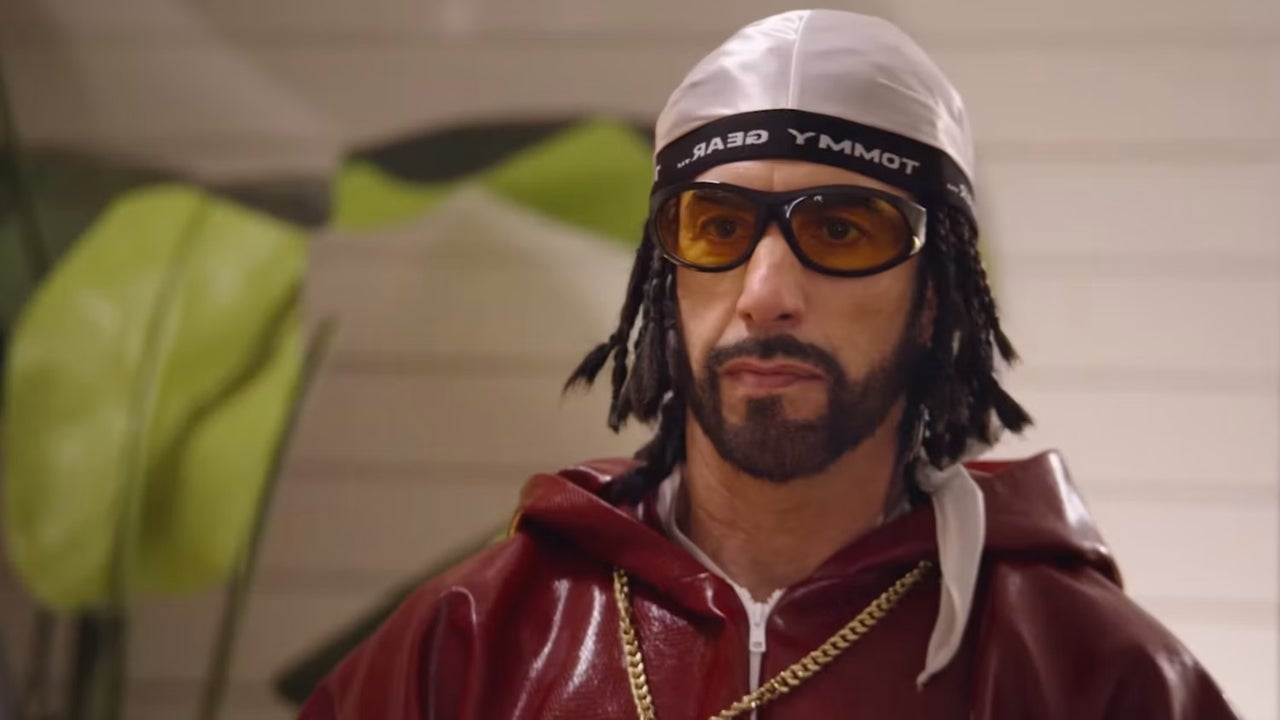
Whenever the jacob’s ladder of social media discourse loops around to discuss classic comedies — think “Blazing Saddles” on “National Lampoon’s Animal House” — there’s always an agonized strain of hand-wringing insisting that movies like that couldn’t be made now. The reasons invariably run the ideological gamut, some ascribing their absence to risk-averse studio execs and others blaming cancel culture run amuck. But the truth is that the bar is simply much, much higher today for genuine transgression than it was 10 or 20 or 50 years ago. Take, for example, the work of Sacha Baron Cohen, whose latest film, “Ali G: Who Iz I?,” revives his character from the early 2000s to middling results. Cohen has delivered third-rail comedy for more than 25 years, breaking through with “Da Ali G Show” in 2000 and exploding in popularity with “Borat,” which celebrates its 20th anniversary in November. Returning to Ali G for his directorial debut, Cohen attempts to confront the fact that he’s simply too well known to easily navigate public spaces in the way he did in those earlier projects. But even acknowledging that immediate hurdle, watching him try to recreate the same magic a quarter of a century and a radically changed culture later is a dispiriting and painfully humorless affair — not because he or his characters failed to change with the times, but because what’s funny and what’s risky in real life has long since outpaced the comedian’s imagination. Picking up where last he left off, Ali G (Cohen) continues to imitate Black British hip-hop culture decades after his namesake show left HBO. Having squandered the fortune earned during his 15 minutes in the spotlight, Ali moves back into his late nan’s Surrey flat with his pregnant girlfriend Julie (Morgana Robinson) and seeks employment at a local wildlife park. While pawning some jewelry and obsolete electronics, he discovers a fax from HBO offering him a few million dollars for another season of “Da Ali G Show.” Ali and Julie hop on a plane to America with visions of ostentatious wealth in their heads, but upon arrival in Los Angeles he learns that the offer expired 22 years earlier. With no prospects for employment, Ali decides to become a content creator on TikTok, recording mukbangs and outfit hauls with local politicians or retired military personnel. His low-key return to the public eye alarms Nira Cain-N’Degeocello (also Cohen), an ultra-progressive gender studies professor who becomes determined to cancel Ali for decades of cultural appropriation. When Cain-N’Degeocello is unexpectedly successful, Julie suggests they return to Surrey to focus on the birth of their baby. But when Ali is offered a gig as the host of a talk show focused on combating woke politics, he’s forced to decide whether to embrace the responsibilities of fatherhood or pursue his dreams of fame. Although the execution is unfortunately much less amusing than it should be, it’s ironic that Cohen and distributor Amazon MGM received a real backlash for reviving Ali G when the film focuses directly on exploring whether a white man can or should be able to speak and dress like a Jamaican Brit. In comparison to other comedians persisting with material that has not aged well, Cohen seems eager to interrogate this character’s identity head-on — although at one point he cheekily enlists race grifter Rachel Dolezal to join a chorus of internet critics taking Ali to task for his behavior. Sacha Baron Cohen in “Ali G: Who Iz I?” (Amazon MGM Studios) As with his other films, Cohen offsets a fully written storyline with unscripted interviews featuring unsuspecting nonperformers, some good-spirited local business owners and others well-known public figures. For the handful of local GOP leaders who willingly join Cain-N’Degeocello and Cohen’s ex-Mossad character Erran Mossad in a plot to kidnap Julie on the eve of giving birth, it’s less surprising that they’re unfamiliar with the comedian’s work (or can’t see his face underneath layers of make-up). But the bigger surprises come when individuals like George Santos, Kari Lake and Newt Gingrich make appearances. One guesses that a culture in which everyone has a hustle has made it more acceptable even for a 6’3” white man in dreadlocks to walk around with a camera crew in tow, but what’s more surprising is how it never seems to raise suspicions (or even a modicum of self-awareness) when it comes to expressing violent, divisive rhetoric. Then again, Cohen’s high wire act has always put him in dangerous situations with people who would probably hate him if they knew who he really was. “Borat Subsequent Moviefilm” tackled such a challenge especially effectively when the film’s main character went to live for a time with right-wing survivalists. And the victims of his humor here are mostly white nationalists, so it’s hard to feel too bad about any of them when, say, they’re encouraged to wear prosthetic penises they have to “pump up” in order to fire a bullet out of their plastic rectum. But 26 years after the debut of Ali G and five movies (not to mention a glut of imitators and the entire “Jackass” franchise) later, the shock value of Cohen’s gags no longer lingers. Back in “Borat,” he exposed the lengths white America would go to be polite and accommodating to a nakedly offensive “foreigner” simply because he seemed friendly. Two decades later, the views espoused by the people Ali G encounters are not just stupid or dubiously sane; they’re reprehensible, and to put them even in an unflattering spotlight does not produce the same laughs as earlier. What’s more telling is the severely limited extent that most progressives and people of color in “What Iz I?” even bother with Ali G’s buffoonish behavior. At one point Cain-N’Degeocello tries to make a case to a gathering of Black residents in Oakland for cancelling his sworn adversary, and they are rightfully more offended by the way that the ultra-liberal professor well-meaningly appropriates their culture than by Ali. Later, Ali presents an AI-created apology video to a cross-section of religious leaders that involves Notorious B.I.G., Tupac and Nelson Mandela trading verses about forgiving him for his past offenses, and most of them simply walk out. These are people facing real, ongoing challenges in their lives and communities, so there’s something satisfying about the way that Cohen’s tomfoolery never rises to the level of mattering to them. The bigger problem is that it never rises to the level of mattering to the moviegoing audience either. Even in Cohen’s less-successful projects, there’s at least one or two sequences that will leave viewers splitting their sides, but I was a bit incredulous to realize I’d only laughed out loud twice during the press screening for this film. (One was at the rapping Nelson Mandela bit, and the other was not at the movie but at a fellow critic who admitted he was embarrassed for giggling at a particularly dumb joke that I won’t spoil here.) Whether he’s considered repugnant or delightful, Sacha Baron Cohen has always elicited a strong reaction. “Ali G: Who Iz I?” does not. After a quarter of a century pushing boundaries, that makes this his most offensive project yet. “Ali G: Who Is I?” opens exclusively in theaters on Oct. 23.
‘Ali G: Who Iz I?’ Review: Sacha Baron Cohen’s Schtick Is Old in Unfunny, Unsurprising New Film
Full Article
Original Source
Read the full article at Thewrap →KhanList aggregates and links to publicly available news content. We do not host full articles from third-party sources. Always verify important information with original sources.