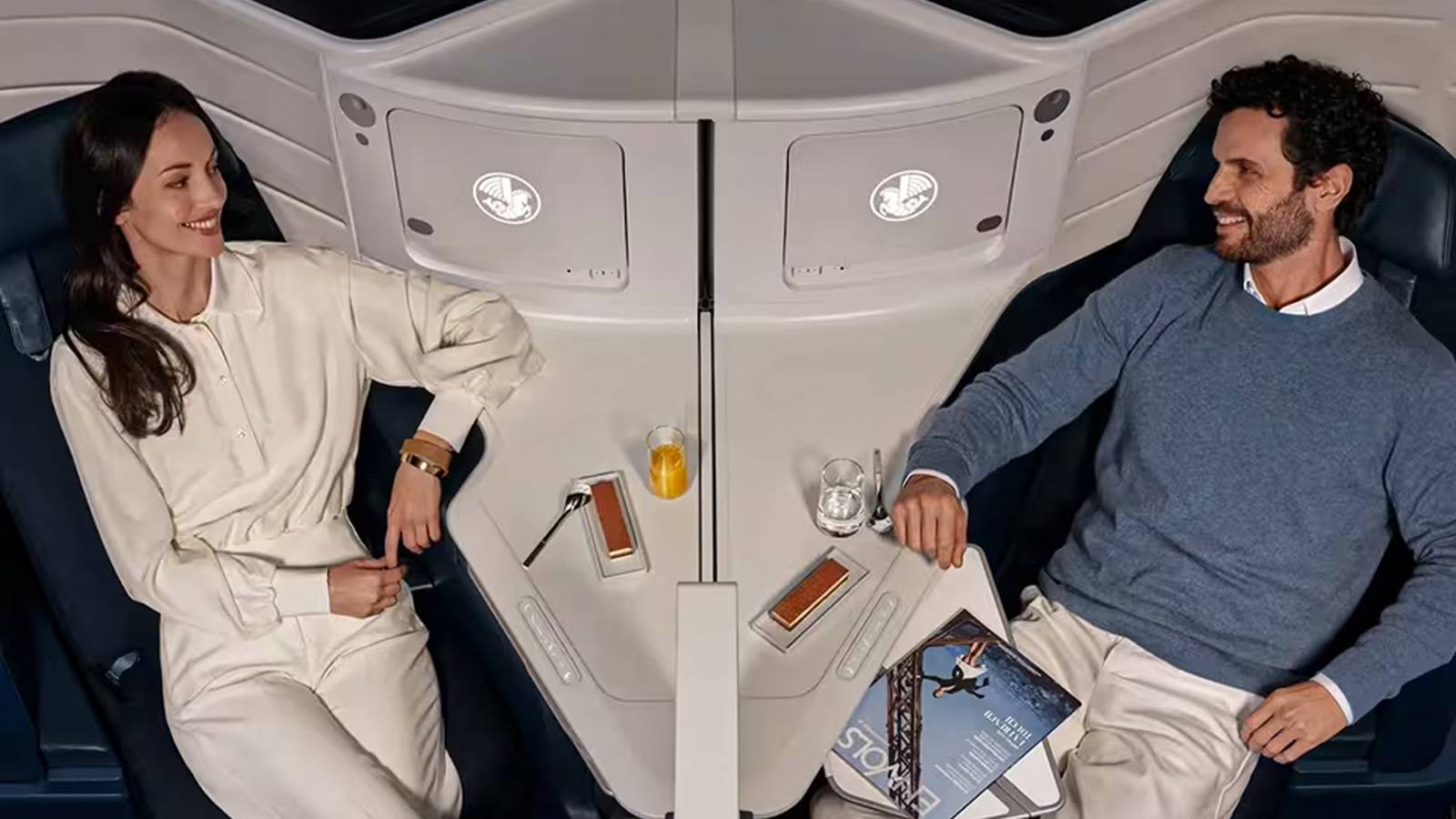
Published Jul 19, 2026, 12:00 PM EDT Passionate about promoting aviation and the beauty of flight, Antonio loves to take photos, read, and write about airplanes and helicopters as well. Based in Palermo, Italy , he is a frequent airshow visitor. Air France's La Première first class suite won the 2026 iF Design Award in March. The jury's citation praised its modular architecture, material craftsmanship, and multi-zone layout. What the jury did not specifically mention, but what Air France leads with in every commercial communication, is that each of the four suites carries two 32-inch (81-cm) 4K screens. One faces the seat. One faces the chaise longue. That number, 32 inches, is the clearest sign that premium aviation has moved into a new competitive register: measurable hardware that a prospective passenger can compare on a spreadsheet before booking. The question this shift raises is not whether premium hardware has replaced soft service: it has not, and carriers still invest heavily in both. It is why, over the past three years, screen diagonals and connectivity features have become among the most visible languages of business class differentiation, and what that means for the airlines whose product launches no longer have a number to lead with. Why Did Two 32-Inch Screens Become The Competitive Benchmark For A Four-Seat Cabin? Credit: Air France La Première's previous configuration featured a single 24-inch (61-cm) screen. The 2025 redesign replaced it with two 32-inch (81-centimeter) 4K anti-glare displays — one per zone within the suite. According to Air France's official press release, the second screen was added because the seat and the chaise longue face opposite directions: Each guest has access to two 32-inch 4K anti-glare screens, allowing them to enjoy over 1,500 hours of entertainment in optimum conditions from their seat, chaise longue or bed. The functional rationale is real, but the marketing reality is equally visible. Two 32-inch 4K screens is a specification that fits on a comparison table, and comparison tables are now how premium cabins are evaluated. The specification race is visible across the industry. As documented in Simple Flying’s ranking of the top new business class seats entering service in 2026, each new product is framed around measurable architecture: United Airlines' Polaris Studio leads with its 27-inch (68.6-cm) 4K OLED, the largest screen of any US airline. Qatar Airways' Qsuite is defined, in commercial communication, by its 79-inch (200-cm) lie-flat bed and 21.5-inch (55-cm) touchscreen. All Nippon Airways' "The Room" leads with a 38-inch (96.5-cm) shoulder width. The screen, specifically, has become the most visible proxy for cabin quality, partly because it is the specification passengers encounter first when choosing seats on comparison sites, and partly because it is one of the few cabin elements that can be verified before boarding without reading a review. But why this shift happened now, rather than a decade ago, requires a closer look at what changed on the supply side of the cabin. What Changed On The Supply Side That Made Spec-Sheet Marketing Possible? Credit: Panasonic Avionics The enabling condition was the convergence of IFE platform technology around a small number of scalable systems. Panasonic Avionics' Astrova platform, which delivers 4K HDR10+ screens, Bluetooth audio pairing, 67-watt (W) USB-C charging, and onboard Spatial Audio, is currently being fitted on Air France La Première, Qatar Airways Airbus A350-1000 business class, and the LufthansaAirbus A380retrofit simultaneously. According to APEX's coverage of the Astrova rollout, this is the first IFE platform designed explicitly to support Bluetooth codec profiles that match the audio quality available on premium consumer wireless headphones. That last detail mattered commercially: passengers traveling with AirPods Pro or Sony WH-1000XM6 could now compare what happens when they connect on an Air France Boeing 777 versus a competitor's aircraft, and airlines knew it. The consequence was that airlines began competing on specifications that originated in the consumer electronics industry rather than in aviation. A 4K screen at 32 inches (81 centimeters) at 110 centimeters (43 inches) of viewing distance delivers an apparent pixel density equivalent to a 1080p display at 220 centimeters. These numbers belong in a home theater guide, not a boarding gate briefing. Airlines are now publishing these numbers in cabin descriptions because their target passengers are the same people who read those home theater guides. The spec-sheet traveler who upgrades their monitor before a 4K streaming subscription is exactly the buyer who compares cabin IFE screen sizes before choosing a transatlantic itinerary. The Bluetooth detail is worth pausing on because it reveals how granular the competition has become. Air France's La Première brochure specifies that passengers can pair their own headphones. The Business Class Versa suites specify Bluetooth connectivity. United's Polaris Studio lists wireless charging at 15W. The next question is what this means for carriers whose product cannot yet make those claims. What Happens To Airlines Whose Cabins Have No Number To Lead With? Credit: Simple Flying The carriers most exposed to the spec-sheet shift are those still operating business class cabins from the 2014-to-2019 wave — products designed primarily around lie-flat beds and direct aisle access, at a time when 1080p screens and wired headphone jacks were competitive advantages. Those products remain functionally comfortable. The commercial consequences are visible well before passengers board. According to AwardFares' 2025 analysis of business class demand signals, cabins on routes where a carrier has introduced a new specification-led product within 12 months consistently outperform legacy cabins on the same route by premium load factor, with the effect most pronounced on transatlantic corridors where product differentiation between competing carriers is highest. Seat-review websites, aircraft-specific booking tools, and social media have made cabin configuration a purchase criterion in its own right. Travelers routinely distinguish between aircraft operating an airline's newest suite and those still flying an earlier-generation product, creating pressure on airlines to complete retrofit programs as quickly as possible. The result is a fleet-within-a-fleet problem: two Boeing 777s can carry the same airline branding while offering materially different premium experiences. The fleet-within-a-fleet problem is a direct consequence. Airlines mid-retrofit operate two or three distinct cabin products on the same aircraft type, and no amount of marketing language can prevent a passenger from discovering at check-in that their 777 has the old and not the new suite some passengers expected. The operational and reputational cost of inconsistency is accelerating retrofits at a pace that would not otherwise be commercially justified, which has a direct effect on how premium product decisions ripple downward to premium economy. For many premium travelers, the first question is no longer whether the seat lies flat, but whether it is the airline's newest suite. Is There A Ceiling On The Spec Race — Or Is Premium Economy The Next Target? Credit: United Airlines | Simple Flying The spec race has a natural upper limit at the physical boundary of the aircraft cabin, defined by the seat pitch. But within business class, that limit is still some distance away. According to PR Newswire, United's 27-inch (68.6-cm) OLED is currently marketed as the largest business-class seatback display offered by a US carrier business class . The gap between 27 and 32 inches in business class is the next specification frontier, and at least two carriers are known to be studying it for widebody programs entering the design phase in 2027. As Simple Flying's comparison of United and American's new flagship business suites details, American Airlines' equivalent studio product offers 17.5-inch (44-cm) 4K screens against United's 27-inch OLED — a gap that AA's commercial team is acutely aware of and that drives the cabin differentiation narrative in a market where the two carriers compete directly on almost every major route. The downward pressure is equally significant. As discussed on Simple Flying’s projection of premium economy's trajectory through 2035, the business class specification race is already forcing premium economy into a parallel spec-sheet competition, which is driven by passengers who cannot afford the business seat but who use the same comparison criteria. Premium economy screens that sat at 10 to 11 inches (25 to 28 cm) in 2018 are now 13 to 15 inches (33 to 38 cm) on the best products, with Bluetooth audio and wireless charging following the same diffusion path downward from first class through business to premium economy on a roughly five-year lag. The diffusion pattern raises the question that La Première's two 32-inch screens make concrete: when the specification becomes universal, what replaces it as the differentiator? When Every Business Class Suite Has A Sliding Door And A 4K Screen, What Does First Class Sell? Credit: flydubai Air France's answer is the clearest statement in the industry of what happens when business class hardware catches up to first class expectations. La Première no longer leads with a seat specification because the Safran Versa suite behind it in the same fuselage already offers sliding doors, 20-inch (51-centimeter) 4K screens, and wireless charging. La Première leads instead with geometry unavailable in business class: a 2-meter (78.7-inch) chaise longue that converts to a fully flat bed, five windows per suite, and a separate armchair facing opposite the bed, requiring two screens because no single screen position works for both orientations. The spatial separation of functions within the suite is the first class differentiator that cannot be matched below it: in business class, every function such as seat, table, bed, screen shares the same square footage. La Première separates them. The screen count of two is a consequence of the spatial separation, not a cause of it. What Air France understood earlier than most is that once hardware commoditizes in business class, first class must commoditize it faster and then move to something hardware alone cannot replicate. According to Aerospace Global News's reporting on the 2026 iF Design Award, the jury specifically called out "separating functions (seat, lounge, bed) rather than combining them" as one of the product's defining advances is a statement that locates the real innovation not in screen size or Bluetooth codecs, but in architecture. Air France's redesign is ultimately a response to an industry-wide convergence: over the past decade, the features that once defined first class have steadily migrated into business class, following the familiar trajectory of airline innovation. Fully flat beds became standard, direct aisle access became expected, privacy doors spread across new flagship seats, and large ultra-high-definition displays, wireless charging, and Bluetooth audio moved from differentiators to checklist items. Every new business class launch now competes on increasingly fine hardware distinctions, leaving airlines with fewer specifications capable of signaling genuine exclusivity. If business class can offer nearly every measurable feature once associated with first class, then first class must compete on dimensions that cannot be reduced to a specification table. The Spec Sheet Has Already Reached The Top Of The Cabin Credit: Michael Doran I Simple Flying The spec-sheet era in premium aviation is already the operative marketing reality. Airlines that introduced new business class products in 2024 and 2025 without exact hardware specs found it difficult to cut through on comparison platforms, social media, or the travel media cycles that drive premium booking decisions. The ones that led with a screen diagonal, a door mechanism, or a charging standard generated coverage; the ones that led with service philosophy did not. The structural test will be in 2027 and 2028, when the next wave of business class introductions, including Singapore Airlines' rumored new suite for the A350 and 777-9, enters the market. The current screen ceiling in business class is 27 inches (68.6 cm) for US carriers. If Singapore Airlines or a Gulf competitor crosses 32 inches in business class, the delta to La Première's first class product narrows to nothing measurable on a spec sheet, and the industry will have its clearest proof yet that architecture and not hardware — is the only sustainable differentiator above business class. Whether the soft product can reassert itself as a primary booking driver, or whether the spec-sheet logic now governs every tier from premium economy to first class, is the question that airlines running retrofit programs through 2028 will effectively be answering with every seat they install.
Airlines Are Now Selling Business Class Seats Like Smartphones: Inches & 4K Screens Replacing Soft Service
Full Article
📰 Original Source
Read full article at Simpleflying →KhanList aggregates and links to publicly available news content. We do not host full articles from third-party sources. Always verify important information with original sources.