
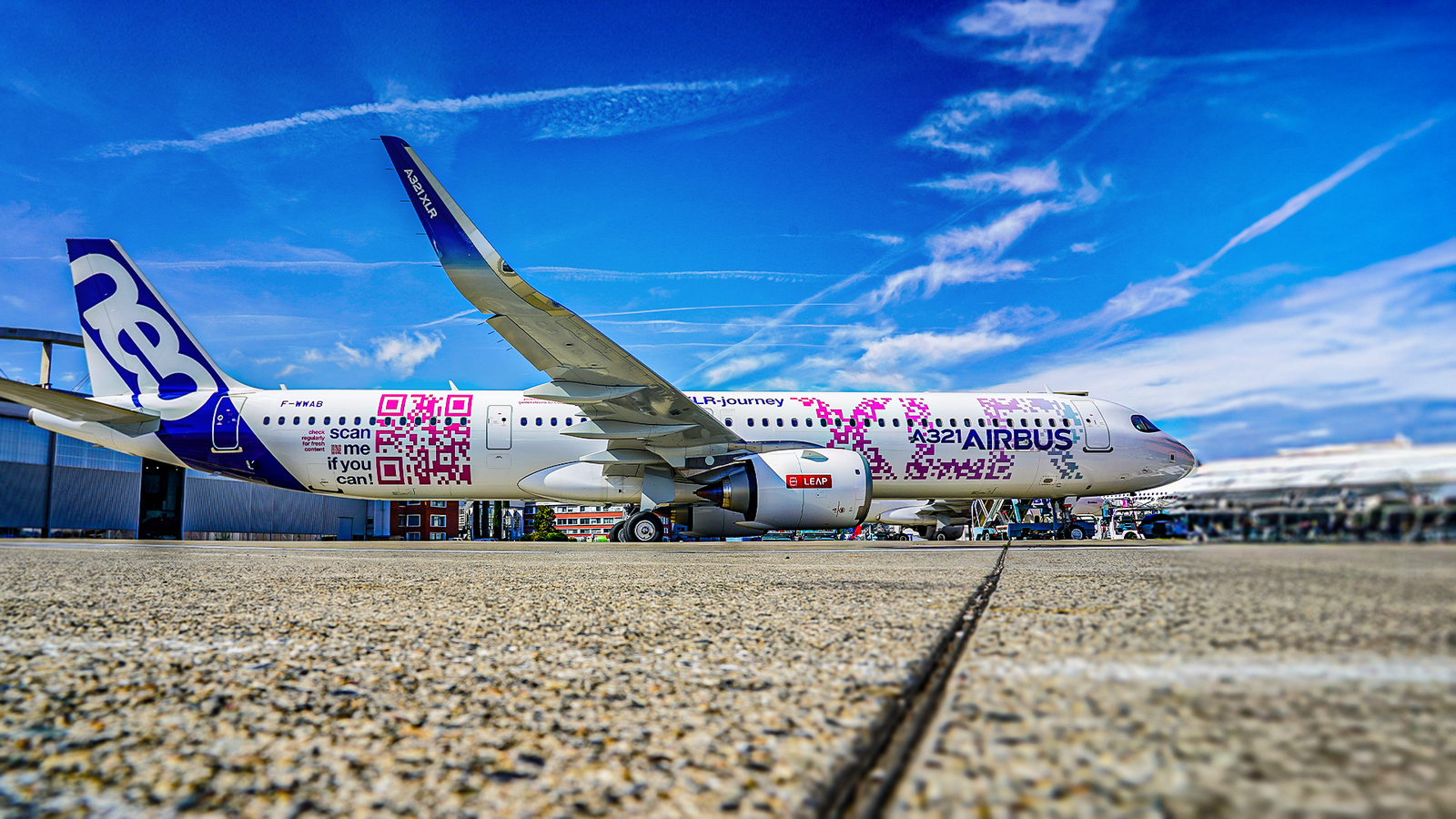
Published Oct 25, 2026, 8:00 AM EDT Luke Diaz is a freelance military writer with experience with active duty experience in the US Navy as well as defense and industrial engineering. He is a former Naval Flight Officer who performed tactical air control on the carrier-based E-2 Hawkeye. The Airbus A321XLR has made headlines for its class-leading range in the single-aisle category in which it is now the only active production airframe since Boeing declined to build a successor to its iconic 757. As the world's most 'long-legged' narrow body, Airbus boasts a maximum range of 4,700 nautical miles, yet commercial flight data reveals that many operators are only flying about 70% to 80% of that distance. Among the current adopters bringing the new Airbus into their fleets, most have chosen to fly between 3,400 and 4,000 nautical miles (5,555 to 7,400 km), leaving plenty of range on the table. For example, Air Canada launched regular service between Montréal and Lyon on September 8 with its new examples to directly replace widebody jets that previously served the route. Falls even lower at just 3,100 nautical miles (5,740 km). The simple answer as to why air carriers are choosing not to fly as far as they possibly can is payload. Air Canada, for example, can configure its new twinjet with a high-density seating layout that allows a two-class cabin to accommodate 182 flyers. This makes it a well-suited airframe for replacing less-efficient widebodies, so it doesn't have to scale down so dramatically that it bottlenecks itself and turns away customers. What The 4,700 Nautical Mile Specification Really Means Credit: Airbus The decision by a carrier to deploy an A321XLR comes down to a strategic choice between two business models: Optimizing for high-yield premium passengers on long, thin routes, or maximizing seat density to achieve low unit costs on mid-range legs. Because the narrowbody twinjet is smaller than even the smallest widebody, it delivers superior fuel efficiency and lower trip costs regardless of journey conditions. Airbus designed the plane by treating range and seating capacity as hard constraints rather than optimal mission profiles. The A321XLR is equipped with a 3,408-gallon permanent rear center fuel tank (RCT) and a strengthened frame that increases the maximum takeoff weight to 101 tons, providing the additional range. These hardware updates push the aircraft roughly 700 nautical miles beyond the older A321LR, which uses removable cargo hold tanks to reach 4,000 nautical miles. While the brochure lists a ceiling of 4,700 nautical miles and up to 244 seats, these figures reflect the aircraft's potential under two different circumstances rather than its standard configuration. A high-density configuration, packing between 180 and 220 seats into a standard two-class or all-economy layout, shifts the focus entirely to volume and market share. By installing luxury lie-flat suites and premium economy sections, airlines can charge higher ticket prices while keeping overall passenger payload lighter. Reserves & Winds Shrink The Usable Distance Credit: Airbus Iberia offers an excellent case study for actual performance with its A321XLR configuration, which can fly a realistic range of 3,920 nautical miles. This layout has 168 economy seats and 14 business suites. While its maximum range is 780 miles below the marketing limit, it is the upper limit of what many airlines typically need. By omitting a premium economy cabin and installing lightweight slimline seats across most of the aircraft, Iberia minimizes the Operating Empty Weight (OEW). The baseline weight penalty becomes acute when network planners factor in the variable winds of the North Atlantic jet stream. Flying westbound from Europe to North America in winter often brings sustained headwinds exceeding 100 knots, which not only increases Baseline fuel but also increases the need for fuel reserves as a safety buffer. The primary regulatory constraint comes from international fuel reserve mandates, which require an aircraft to carry more than enough fuel to reach its intended destination. Under instrument flight rules, flight planning must allocate contingency fuel for a diversion to an alternate airport and a holding reserve. Iberia deploys its aircraft on transatlantic hops like Madrid to Boston (3,230 nautical miles) and Madrid to Toronto (3,280 nautical miles), giving the aircrew a substantial fuel surplus. Cabin Layout Changes What The Same Airframe Can Do Credit: Airbus United Airlines approached the A321XLR from the opposite business angle, prioritizing premium cabin continuity over sheer capacity. United configured its jets with a three-class, 150-seat layout. The forward section features 20 premium Polaris business class suites equipped with privacy doors, followed by 12 Premium Plus seats and Economy Plus rows. To compensate for the weight penalty of an all-premium cabin, United had to remove 32 seats from the potential maximum. That lower-density layout allows United to push deep into Europe. Premium tickets also generate high revenue per seat, so the carrier can run a lower-traffic operation profitably. That makes thinner markets financially viable even after higher baseline costs from extra fuel burn. United plans to launch routes like Newark to Luxembourg (3,390 nautical miles) and Newark to Marseille (3,410 nautical miles). Notably, those destinations are not significantly farther than Iberia's offerings. Partly because United's cabin is burdened with heavy, complex furnishings, even if there are fewer overall. Even if the plane were to fly that far, it would not be as profitable with a fraction of the customers of a twin-aisle. That balancing act is why United holds back from longer Mediterranean destinations like Catania or Olbia, opting instead to deploy widebodies like the Boeing 767. The Longest Routes Today & Those Yet To Come Credit: Airbus The present leaderboard of long-haul A321XLR itineraries maxes out just above the 3,600-nautical-mile mark. Iberia holds the current distance record with its Madrid to Santo Domingo route, which covers approximately 3,617 nautical miles (6,699 km) with an outbound block time of just over nine hours. Other leading routes include Iberia's Madrid to Washington Dulles corridor at 3,326 nautical miles (6,160 km, which clocks in at a little over 9.5 hours block time. Aer Lingus' Dublin-to-Nashville service also ranks high on the list at roughly 3,190 nautical miles (5,908 km). Yet, American Airlines is set to snatch the top spot when it introduces daily seasonal service between Philadelphia and Vienna. Scheduled to launch on May 6, the route will cover 3,755 nautical miles (6,954 km). Its anticipated westbound block time will exceed 9.5 hours, making it the longest scheduled route in the world flown by an A321XLR. The decision comes as part of the airline's wider expansion into multiple new European markets, according to a statement from American's International Operations Vice President José A. Freig, obtained by Breaking Travel News. “Each summer, we want to offer our customers from both the U.S. and Europe the opportunity for new adventures. Next year, adding Reykjavík, Vienna and Porto to our portfolio gives our customers even more amazing destinations to explore.” To make its record-setting itinerary possible amid a volatile North Atlantic jet stream, American will rely on fuel savings from a similarly low-density, premium-heavy cabin layout like United's. American is equipping its A321XLR fleet with a 155-seat layout, featuring its premium Flagship Suite business class and a dedicated premium economy section. Despite having a few more seats than United, the airline is banking on high demand and premium airfare to make the route work and offset high fuel costs. The Philadelphia-Vienna route is a calculated gamble against the winter headwinds. The schedule runs from summer through the holidays into early January, meaning the planes will face the season's peak jet stream on the return leg to Philadelphia. The flight will operate at the absolute ceiling of narrowbody transatlantic endurance. Payload Competes With Fuel For The Same Weight Credit: Airbus The economics of the A321XLR hinge on Maximum Takeoff Weight (MTOW) as a fixed cap because every pound of cabin luxury directly steals miles from the airplane’s range. To maximize range, the carrier must choose a lower payload, and vice versa. The route needs to be shorter if the plane is expected to launch with a fully packed cabin and hold. Extended range itineraries demand that weight that would otherwise be used for passengers and baggage is reserved for fuel. If the A321XLR serves to connect high-traffic hubs, the airline will have to cap its maximum fuel load at a lower total to reserve MTOW capacity for more customers. Additionally, unlike a widebody, which has a spacious lower deck to carry high-yield cargo alongside passenger baggage, the A321XLR's underfloor space is largely occupied by the permanent RCT. Airline Route Distance American Airlines Philadelphia – Vienna 3,755 nautical miles (6,954 km) Iberia Madrid – Santo Domingo 3,617 nautical miles (6,699 km) United Airlines Newark – Marseille 3,410 nautical miles (6,315 km) United Airlines Newark – Luxembourg 3,390 nautical miles (6,278 km) Iberia Madrid – Washington Dulles 3,326 nautical miles (6,160 km) Aer Lingus Dublin – Nashville 3,190 nautical miles (5,908 km) Air Canada Montréal – Lyon 3,100 nautical miles (5,741 km) The RCT's design constraint eliminates the traditional widebody safety net of high-yield belly freight, forcing the upper-deck cabin configuration to carry the flight's entire financial burden. On short segments, a standard single-aisle or a twin-aisle aircraft easily outcompetes the A321XLR by leveraging lower empty weights or dual-source revenue, respectively. Consequently, the airframe becomes economically viable only on medium-range to ultra-long-haul thin routes, where its dramatic fuel-burn advantage over widebodies offsets the complete loss of commercial freight capacity. Those routes typically fall between 3,000 and 4,000 nautical miles, which is why most operators currently fly routes in this range.
Airbus Brochures The A321XLR At 4,700 Nautical Miles, But Airlines Actually Schedule 3,400 To 4,000
Full Article
Original Source
Read the full article at Simpleflying →KhanList aggregates and links to publicly available news content. We do not host full articles from third-party sources. Always verify important information with original sources.