
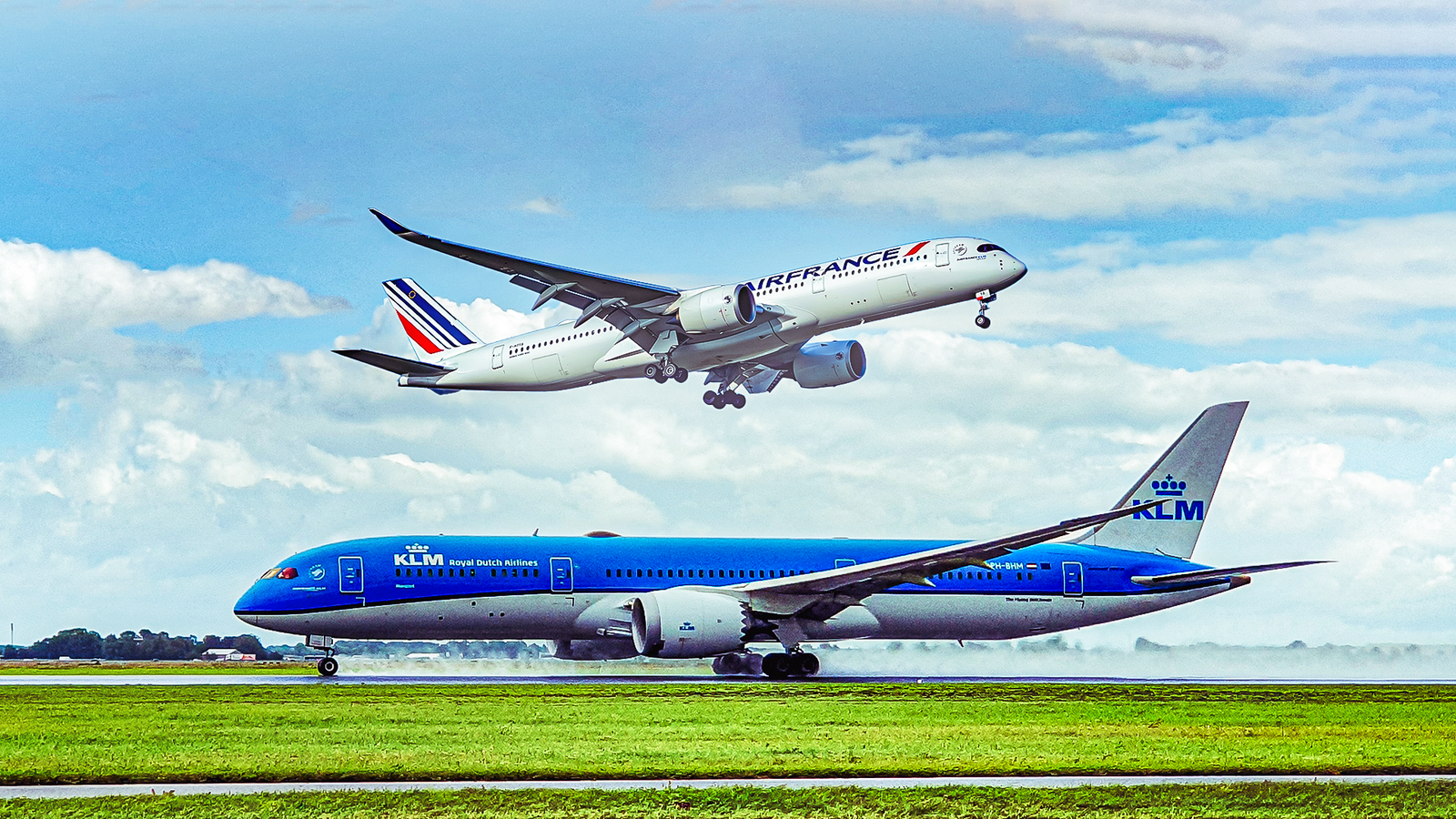
Published Oct 3, 2026, 4:00 AM EDT Louis is a military historian and the staff writer for History of War magazine, a leading military history monthly. He also has an interest in private and commercial aviation. In Air France-KLM Group's H1 2026 report, it extended the depreciation period for its Airbus A350, Boeing 787, and A320neo family fleets from 20 to 25 years. This accounting decision has reduced depreciation costs by €24 million in the first half alone. One interpretation of this decision is that it shows the airline group's confidence in these aircraft and their ability to operate effectively over the next couple of decades. The group operates significant fleets of the aircraft impacted. This includes 42 A350-900s, 23 Boeing 787-9s, and 15 Boeing 787-10s. The group also has orders for 55 further A350s and six A350Fs. These fleets include Air France, HOP! (France), KLM Royal Dutch Airlines, and Transavia France, and a minority ownership of Air Calédonie, Kenya Airways, SAS Group, and WestJet Group. The size of these fleets, aircraft that are yet to arrive, and the new lengthy depreciation period suggest that the corporate group has plans for high longevity with these jets. Simple Flying has contacted Air France-KLM for comment. What The Accounting Decision Actually Shows It would be wrong to interpret the extension of these new planes' depreciation period as either a fixed retirement date or a firm commitment to continue flying these planes until a certain time. It is a useful indication of the time across which a carrier or airline group expects to fly a plane. However, as Fleet Wire notes, "Airlines regularly use accounting assumptions that differ from the actual date on which an aircraft leaves the fleet." This difference can occur if an aircraft is retired early due to rising maintenance costs or the arrival of a better replacement aircraft. Alternatively, airlines may continue to fly a plane past its expected full depreciation. A reason for this could be that there have been delivery delays with a replacement aircraft. For example, the Boeing 777X delays have led some airlines to continue flying outdated Boeing 747s, 777s, Airbus A380s and more to prevent capacity shortfall. Yet, many of these jets now have extremely high operating and maintenance costs, or are considered obsolete. The decision should also be considered as a tentative indication of the position that A350 and 787 planes will occupy within the Air France-KLM group fleets. Instead of simply replacing past widebody aircraft, these planes will likely become the foundation for the group's entire long-haul fleets, with a footprint lasting for two decades or longer. Indications Of A Substantial Long-Haul Role For Air France-KLM Recent years have seen Air France building up a significant A350 fleet. It has been using these jets to replace its aging Airbus A330s and Boeing 777-200ERs. This switch has been made easier because the A350 and the A330 have a common type rating. Pilots can switch between the two aircraft on a course that lasts eight days and doesn't require full simulator sessions. Carriers can use such an arrangement to enormously reduce their training expenditure. The table below shows how Air France configures its A350-900s, making use of Simple Flying's seat map. Air France offers 292 seats on this plane. You can use these pages to understand how major airlines configure their most prevalent jets: Class Seats Configuration Business class 48 1-2-1 Premium economy 32 2-4-2 Economy class 212 3-3-3 Likewise, KLM has spent the last several years building up a substantial Dreamliner fleet. The jet first entered the airline's fleet in 2015. Both the 787-9 and 787-10 variants have a significant role in KLM's intercontinental fleet. KLM also notes it is a preferred aircraft after its operational service, writing that "it is made of 50% composite, 20% aluminium, 15% titanium, 10% steel, and 5% other materials, generating less waste and chemicals than a similar aircraft." Modern Aircraft Design Changes How Carriers Think About Depreciation The cutting-edge aircraft currently emerging from the Boeing and Airbus production lines are more future-proof than ever. They use advanced composite materials, next-generation engines, and upgraded aerodynamics and flight systems. The result is greatly reduced fuel consumption and operating costs compared with older widebody aircraft. The longer that a carrier keeps such planes in service, the more cost savings they can enjoy. An example is the A350. Airbus claims this aircraft has a 25% lower fuel burn and CO2 emissions than aircraft of the previous generation, while boasting an incredibly far 8,600 nautical miles (15,750 km) of range. For an aircraft departing from London, that's enough to reach cities like Los Angeles, Singapore and Perth. It makes use of Rolls-Royce Trent XWB engines to achieve these advances. These engines will be able to fly with a 100% blend of sustainable aviation fuel by the end of the decade. The table below shows the specifications for the A350-900. It uses data published by Airbus: Seating 440 (max) or 332 - 352 (typical three class) Range 8,600 nautical miles (15,750 km) Cruising speed Mach 0.85 Maximum takeoff weight 623,000 lb (283,000 kg) Maximum fuel capacity 44,000 gallons (166,500 liters) Wingspan 212 feet 5 inches (64.75 meters) The A350 also has an airframe constructed from 70% advanced materials. This includes 53% Carbon Fibre Reinforced Polymer (CFRP) in the fuselage, wings, and tail, alongside titanium components. CFRPs are made from carbon fibers. A polymer resin binds them together. Aluminium-lithium alloys, known for their low weight and high fatigue resistance, are also used. The Depreciation Extension Doesn't Mean These Jets' Service Has Been Flawless These extensions to aircraft's operational lifespan do not mean Air France-KLM expects perfect service with no operational issues. The group's carriers have already faced problems. For example, in May 2025, Simple Flying's Alexander Mitchell reported that maintenance concerns had forced a grounding of seven of KLM's Dreamliners. The airline reported that maintenance procedures related to a refueling system had not been followed. The grounding led to flight cancelations and delays for several hundred passengers. "Although there is no safety risk, the seven aircraft will remain grounded and undergo expedited maintenance," said the airline in an NL Times-published statement. It said that the repairs would begin "as quickly as possible." The flights impacted included services from KLM's Amsterdam Schiphol Airport (AMS) hub to Mexico City International Airport (MEX), Chicago-O'Hare International Airport (ORD), and Portland International Airport (PDX). The table below shows the state of KLM's 787 fleet when the groundings occurred: 787 variant: Number in the KLM fleet: 787-9 13 787-10 11 The fuel system in question utilized the same parts as KLM's Boeing 777 fleet. However, there are differences in the maintenance procedures needed to keep these jets in the skies. This shared system both explains how the problem might have initially arisen and made it easier for KLM to amend the issues. How The A350 Ended Up In The Air France Fleet Considerations of the roles that these aircraft will have for Air France-KLM in the years to come require some attention to how they ended up in these airlines' fleets and the initial roles that they were expected to have. In June 2013, Air France-KLM placed its first A350 order. The order was for 21 jets to Air France and seven to KLM. The decision changed in 2020, with Air France set to exclusively operate the A350 and KLM only use the Dreamliner out of the two jets. Simplifying their fleets created more commonality, reducing the costs of training and maintenance. The first A350 arrived in Air France's fleet on September 27, 2019. The carrier named this jet 'Toulouse' after the city that is home to the Airbus assembly line. It has continued to name each further A350 that has arrived after a different location in France. The table below uses Planespotters.net data to show the registration, name, and delivery date for Air France's ten oldest A350s. It shows the huge distance that these jets remain away from their full depreciation under the new 25-year plan: Registration Delivery Date Aircraft Name Age F-HTYA Sep 2019 Toulouse 7.1 years F-HTYB Oct 2019 Lyon 7 years F-HTYC Nov 2019 Saint Denis de La Reunion 6.9 years F-HTYD Feb 2020 Nice 6.7 years F-HTYE May 2020 Bordeaux 6.5 years F-HTYF Jun 2020 Marseille 6.3 years F-HTYG Mar 2021 Reims 5.6 years F-HTYH Apr 2021 Dijon 5.6 years F-HTYI Apr 2021 Saint-Malo 5.5 years F-HTYJ Jul 2021 Cannes 5.3 years Air France-KLM made a further order for A350 jets, responding to the success that the plane had experienced in the Air France fleet. The order included 50 firm commitments with options for 40 more jets. At the time, the completed order would have made the group the largest operator of the A350. It now uses the jet to fly some mammoth routes. Its longest one-stop route is from CDG to Papeete via Los Angeles. This route has a block time of 22 hours and 20 minutes, and makes use of Air France's fifth freedom flights between Los Angeles and Tahiti. The frequency ranges from five weekly to daily and uses the A350-900 exclusively.
Air France-KLM Just Quietly Committed To Flying Its Airbus A350s & Boeing 787s Into The 2040s
Full Article
Original Source
Read the full article at Simpleflying →KhanList aggregates and links to publicly available news content. We do not host full articles from third-party sources. Always verify important information with original sources.