
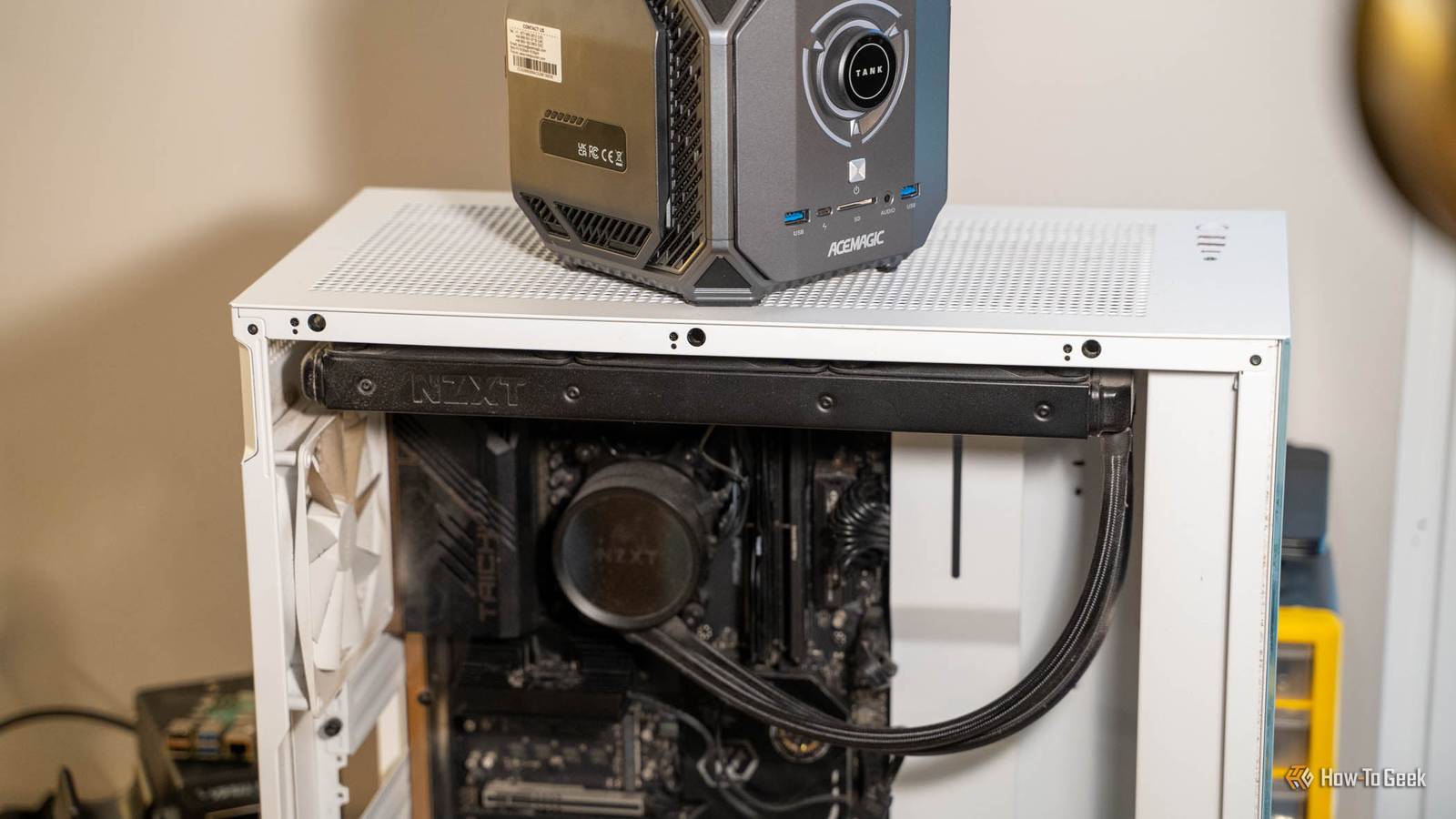
Published Nov 26, 2026, 2:30 PM EST Monica J. White is a journalist with over a decade of experience in covering technology. She built her first PC nearly 20 years ago, and she has since built and tested dozens of PCs. PC hardware is her main beat, and graphics cards and the GPU market at large are her main area of interest, but she has written thousands of articles covering everything related to PCs, laptops, handhelds, and peripherals. From GPUs and CPUs to headsets and software, Monica's always willing to geek out over all things related to computing. Outside of her work with How-To Geek, Monica contributes to TechRadar, PC Gamer, Tom's Guide, Laptop Mag, SlashGear, Whop, and Digital Trends, among others. Her ultimate goal is to make PC gaming and computing approachable and fun to any audience. Monica spends a lot of time elbow-deep in her PC case, as she's always making upgrades, testing something, or plotting out her next build. She's the go-to tech support person in her immediate circle, so she's never out of things to do. Whenever she has spare time, you'll find her gaming until the early hours and hanging out with her dog. When did we go from almost everyone, bar the enthusiasts, having a CPU air cooler, to AIOs being seen as the default? As the kind of thing where a lack of them will cook your PC, especially if you're using one of the best CPUs of all time? AIOs look impressive, but they're not necessarily for everyone. Let's stop pretending otherwise, please. Your gaming CPU probably isn't as hot as you think It may be gettin' hot in here, but not that hot Somewhere along the way, we started treating every CPU, especially those gaming chips, like a volcano on the verge of eruption. There could be some overlap between the current state of things and the fact that AMD's X3D chips dominate gaming performance, and it's true that AMD's chips do tend to run a little hot. I own one myself and I can confirm that, while it's a beast, it does need good cooling. But the reality is a lot less scary than many guides will have you believe. Take AMD's Ryzen 7 9700X, for instance. It's a perfectly capable gaming CPU with a default TDP of just 65W. While the mighty Ryzen 7 9800X3D has a 120W TDP, that doesn't mean it's constantly sipping that much while you game. That's another thing worth remembering: you're not going to be gaming constantly, and even if you are, it's not like your processor is going to be hammered with an all-core stress test 24/7. Most games won't push every CPU to its limits for hours on end, so the cooling requirements are nowhere near as constant or as hard to meet as it might seem. Just as I've recently argued (I do love a good yap) that CPU bottlenecks aren't always what people think they are, I think we've reached a new level of "misguided" when it comes to pushing AIO coolers on people whether they need it or not. Let's do better. The reality is that most people genuinely don't need one, and I've built PCs for 20 years, so I'd like to think I know what I'm talking about here. Air coolers have gotten ridiculously good You don't need a radiator to keep temps at bay A decade or more ago, I begged my useless, albeit expensive, air cooler to please, please, just do something. This was when my PC was overheating constantly and would shut down at the mere mention of gaming. But these days? Air coolers be good, friends. Some air coolers can genuinely give expensive AIOs a run for their money. Take the Thermalright Peerless Assassin 120 or Phantom Spirit 120, for example. These relatively cheap dual-tower coolers deliver fantastic performance without needing a pump, tubing, or a massive radiator. And if you're willing to spend more, there's always something like the Noctua NH-D15, which will still be cheaper than many of the larger AIOs. I'm not just throwing opinions out into the void. I've tested several myself, and although I have an AIO, I know I could've gotten away with an air cooler. In fact, Gamers Nexus tested 26 CPU coolers on modern AMD processors, including the Ryzen 7 9800X3D and Ryzen 9 9950X3D, and found that air coolers remain extremely competitive, especially when comparing performance at similar noise levels. Lower CPU temperatures don't necessarily mean better gaming performance Your frame rate won't magically improve with liquid cooling The thing about cooling is that your CPU may not magically work a whole lot better just because you manage to make it drop a few degrees. It's more about thresholds. The threshold is: is your CPU struggling? Is your CPU overheating? If yes, then sure, dropping below that point may help tremendously, as you're probably experiencing thermal throttling. But if it isn't, then going a little cooler won't magically give you better fps. Yes, modern CPUs adjust their clock speeds based on temps, power limits, and other factors, so better cooling can help, but if your CPU is already running comfortably, you won't gain any major benefits from cooling it a little harder. While one cheap upgrade can indeed turn an old PC into a gaming machine, an AIO cooler most likely is not it (nor is it really cheap). Liquid cooling adds some failure points that air coolers don't have That pump won't last forever Many people proclaim that AIOs are borderline dangerous, and will often state that as an absolute PC-building truth. While that's not the case, and it takes a lot of bad luck to actually break your PC because of an AIO, it's still true that air coolers are wonderfully simple. A metal heatsink, some heat pipes, a fan or two, and that's it. AIOs, on the other hand, have pumps, tubing, radiators, seals, and liquid running through the whole thing. They're intimidating for newer users, that's for sure. Beyond that, they do have some more failure points, and potentially more catastrophic (although, as I've said, AIOs breaking down are an edge case and not something you need to worry about if you're careful). Pumps wear out, coolant can gradually permeate through the tubing, and while leaks are rare, they're not impossible. An AIO isn't automatically going to make your PC quieter Mine is actually super loud Credit: Patrick Campanale / How-To Geek Another myth (if you can call it that) is that an AIO makes your PC way quieter. That's not universally true; my AIO is loud at all times, and even if the PC is just chilling (pun somewhat intended), it's noisy. I've gotten used to it, but I wouldn't mind it if it was quieter. And yes, I have tried to fix it. After all, AIOs still need fans to dissipate heat, and you've also got a pump adding its own hum or whine to the mix. A large radiator can certainly help keep fan speeds down during demanding workloads, but a well-designed air cooler can be impressively silent, too. There are still good reasons to go liquid Not declaring war on AIOs, by the way. I own one, I like it (noise aside), and I understand why people buy them. If you're running a power-hungry CPU through hours of rendering or other demanding workloads, a large AIO can give you some much-needed thermal headroom. Liquid cooling can also make sense in cases that don't have enough clearance for a massive tower cooler. And, let's face it, if you like the bling, AIOs look gorgeous. All I'm saying is don't treat them as the default, because they've never been less default than they are now.
AIO liquid coolers don't make sense for most PCs anymore
Full Article
Original Source
Read the full article at Howtogeek →KhanList aggregates and links to publicly available news content. We do not host full articles from third-party sources. Always verify important information with original sources.