
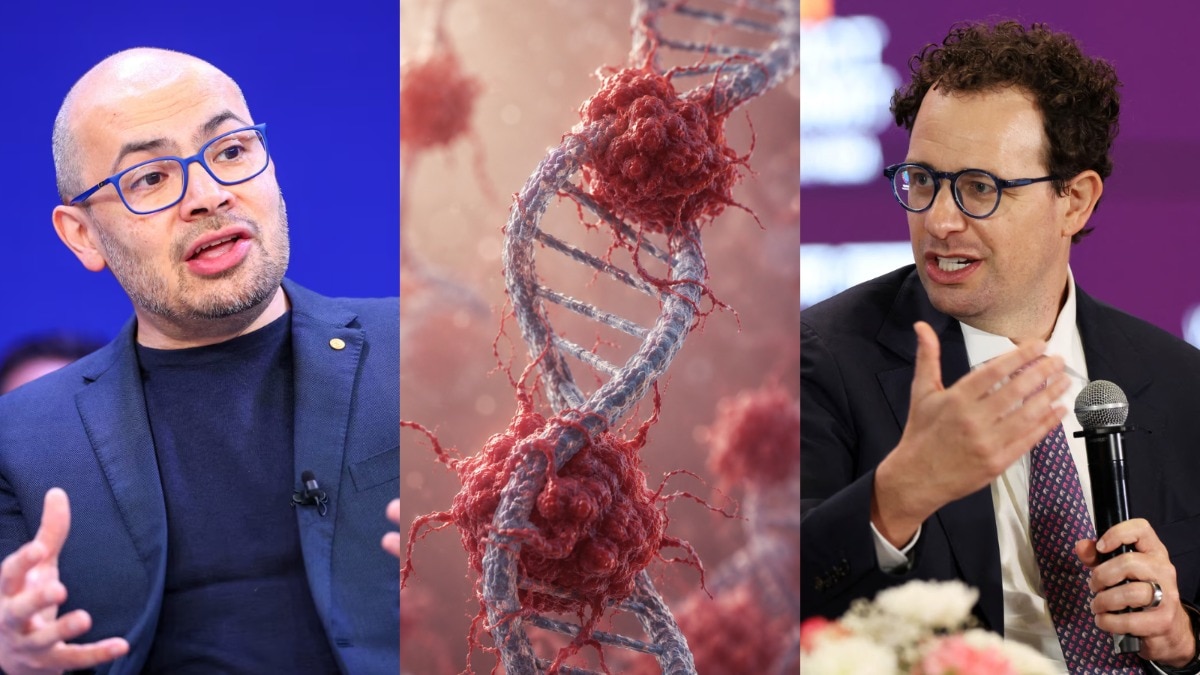
AI is powerful but is it powerful enough to find cure for most cancers within a decade? AI leaders like Dario Amodei and Demis Hasabis are convinced that cancer will be tamed within a decade. India Today Tech spoke to top oncologists to find out if they too feel similarly hopeful.Google DeepMind's Demis Hassabis and Anthropic's Dario Amodei believe AI can cure cancer within the next decade, but oncologists are not as confident. (Photos:Reuters/AI)If you look at the tech news today, you will likely see a headline telling you that AI has helped researchers find a vaccine that almost defeats melanoma, a particularly aggressive form of skin cancer. The news is not wrong. But it is also somewhat disingenuous. Moderna and Merck, two drug giants, have indeed been able to create an mRNA vaccine that cuts down chances of melanoma recurrence drastically. Phase 3 trial data is clear. It is a major medical breakthrough. But the claim that AI has helped the two companies do it is a bit of a misnomer.AI has been likely used but not in a way that probably contributed a lot to the development of intismeran autogene, a personalized vaccine against melanoma. But in whatever way AI has been used, it has been enough for the Silicon Valley insiders to reaffirm the potential of AI to defeat diseases, including cancers within a decade or so. The news also comes just days after Anthropic CEO Dario Amodei said AI would find cures for most diseases, including cancers, within 5-15 years.The news of Moderna and Merck breakthrough, and claims that AI helped them speed up the process, are bound to reignite a debate that has been going on for some time. At one end there are the senior tech executives, and at other are the actual doctors and health researchers who are in hospitals and labs looking through their microscopes at different proteins and potential drugs.The claim from Silicon Valley that AI will eliminate almost all diseases within our lifetime is not new. The people who have made it are quite serious people. Dario is one of the hopefuls. "I think it will actually be possible to cure most human diseases in 5 to 10 years, as crazy as it may sound to ordinary people and frankly to biologists as well," he wrote last week. "I feel the urgency here: I lost my father to Hepatitis C only a few years before the development of direct-acting antivirals (sofosbuvir), which cure 95% of patients and probably would have cured him.” The word "Anthropic" spelled out in the form of protein structures designed by the company's AI models. Dario got a lot of support for his statement from Silicon Valley, but doctors were not impressed. As he came under heavy criticism from them, Elon Musk came in his support. “AI will do it,” Musk wrote, saying that AI has the potential to eliminate most diseases, including cancers, in the next few years. A day later when Moderna news broke, he wrote: “Artificial RNA essentially makes curing diseases a software problem. Synthetic RNA will cure many diseases. So many breakthroughs are coming.”The statements echo sentiment that Demis Hasabis, a Nobel Prize winner and who until recently was the CEO of Google DeepMind, has expressed often. Demis has made his name through his pioneering work in using AI to fold proteins, a crucial step in understanding the human body and diseases, as well as in developing drugs. He has talked about AI defeating almost all diseases, including cancers, for several years now. Around 10 days ago, he told The Times in London, “I was hoping it would be in the next decade or two that we’d make these big advances in medicine. Now I’m, you know, very sure. I wouldn’t say I’m certain, but I’m very confident that is the case.”Oncologists say not this quickly The reality, however, is not just confined to Silicon Valley. The world outside is big, and messy. And various diseases, cancers in particular, can be strikingly resilient even to most modern treatments. Senior oncologists do believe in the potential of AI but differ with Silicon Valley in their assessment on timelines. Although, given what they have seen cancers do to people, they hope that Demis and Dario are somehow right.Dr Garvit Chitkara, Oncosurgeon and Associate Director of Breast Surgical Oncology and Oncoplasty at Nanavati Max Institute of Cancer Care, Mumbai, agrees AI could be a powerful tool in the fight against cancer. “AI has the potential to become one of the biggest accelerators of medical science because it can analyse biological and clinical data at a scale that humans simply cannot,” he says.But the timeline that Silicon Valley is suggesting seems way too optimistic. “I do not think that most diseases will be cured within five years, because biology does not work on a fixed timeline,” he said.This gap between a scientific discovery and an actual treatment is where the reality of medicine comes in. Dr Mandeep Singh Malhotra, Director, Surgical Oncology at The CK Birla Hospital, Delhi, makes a similar point. “AI has enormous potential to accelerate medical research, but the idea of curing most or all diseases within 5 to 10 years is highly ambitious,” he said. “Translating a computational discovery into a safe, effective therapy still requires laboratory validation, clinical trials, regulatory approval, and long-term safety monitoring. I would therefore view the 5 to 10-year prediction as a powerful vision rather than a guaranteed timeline.”Dr Sandeep Nayak, Chairman of Oncology at MACS-Renova Oncology Institute, KIMS Hospital, Bengaluru, highlights that biology is far more complicated than the kinds of problems AI has traditionally been good at solving.“Not realistic on that timeline,” he says. “The field is held back by the quality and quantity of biological data, which lags far behind the data AI has mastered elsewhere. Machine learning works best on well-specified questions with abundant, high-quality data, curing diseases is not that.”But not all the doctors are looking at the predictions made by Musk, Dario and Demis with the same level of skepticism. Dr Aanchal Bhatia, Orthopaedic Oncologist at Medicover Hospitals, Bengaluru, is quite optimistic about what AI can achieve over the next 5-10 years. She believes it could dramatically accelerate medical research, help doctors detect diseases earlier, understand disease biology better and identify potential treatments much faster.But she draws an important line between accelerating medical research and actually practising medicine. “Whether that translates into curing most diseases is difficult to predict because biology is complex. But AI could compress years of research and analysis into a much shorter period,” she says.- EndsPublished By: Armaan AgarwalPublished On: Aug 21, 2026 08:01 IST
AI will cure cancer in 10 years: Dario and Demis are sure, oncologists not so much
Full Article
Original Source
Read the full article at Indiatoday →KhanList aggregates and links to publicly available news content. We do not host full articles from third-party sources. Always verify important information with original sources.