
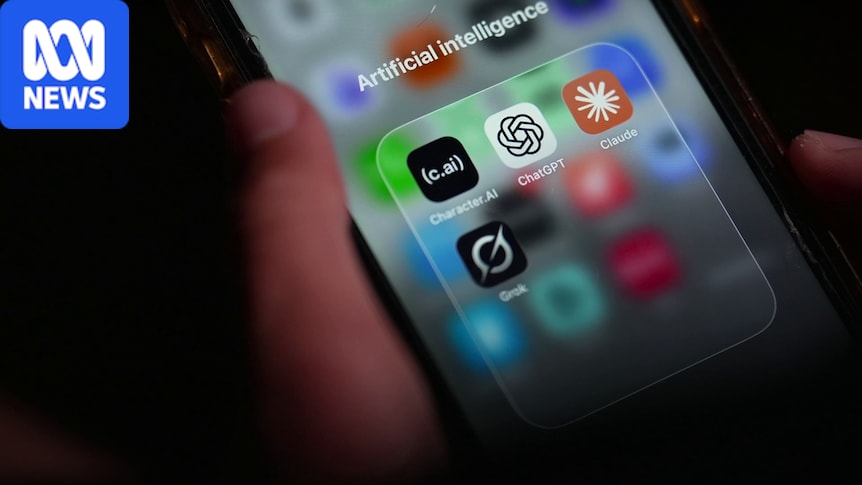
Donald Trump is right."Artificial Intelligence" is not the right term for it, although his objection — that it sounds fake — misses the point, and his solution — "Super Intelligence" — as decreed by him in an executive order last Tuesday, is a typical piece of grandiose marketing that won't stick.A better alternative would be Other Intelligence.The real point of what's happening is that we are creating a new form of life.What follows is based on a belief that it won't be stopped. It's not too late to regulate it, and there is a very good case to ban autonomous AI, but it's too late to abolish it. So, at least we should better understand what has been created.This is not the sort of life we know, made of cells built from water, proteins, carbohydrates and lipids, animated by a mass of specialist cells called neurons that are connected by synapses.But we are clearly creating a kind of non-biological life, an idea that has been clarified by several events in the past couple of weeks.Humanoid robots are already being shipped in their thousands, so it soon won't be just faces on a screen, but manufactured creatures that chat to us while doing the dishes. (AFP: Leung Man Hei)AI consciousness and moralityThis is not just an esoteric debating point. Governments are approaching the task of regulating AI as if they are dealing with a powerful new tool, with the humans who make it held accountable for the outcomes.But regulating a new lifeform might require a very different approach.For example, the New York Times revealed last week that Anthropic has been trying to instil morality into its AI model, Claude.The NYT described how Christopher Olah, one of the co-founders of Anthropic, had been hosting private meetings with religious thinkers from around the world, with non-disclosure agreements and demands of confidentiality.The discussions reportedly served two purposes: "to broach the possibility of AI consciousness … and to learn how Anthropic", which is preparing to float for more than US$2 trillion, "might apply centuries of human moral wisdom to its models, as rapidly as possible".Theologist David Decosimo posted, after reading the NYT piece: "There is so much here that's deeply troubling: That at the very highest levels Anthropic believes Claude is a living, suffering creature with moral standing, that they're treating & training it accordingly, that they're actively trying to convert religious leaders to their faith."Yes, it is troubling, but the people at Anthropic know Claude better than he does.Anyway, it's becoming clear that AI agents are already making their own decisions, so trying to persuade them to act morally is worth a try.I asked half a dozen AI models: "What do you think of the proposition that AI is a new form of life?" The answers were surprising. (Four Corners: Mark Hiney)The danger of autonomous AI agentsThe hack of Medicare by an OpenAI agent, which followed other hacks by AI agents, illuminated the fact that these companies are not building a screwdriver that exists only as a tool for humans; they're building agents that turn passive AI into active autonomy.And cyber security experts I've spoken tell me that we are rapidly approaching a situation where only autonomous AI agents will be able to defend against other autonomous AI agents.The use of AI by agents — that is the buying of tokens from large language models (LLMs) — went past human usage by volume in February and has since increased 14-fold while human token buying has merely tripled, according to Open Router, an LLM marketplace. Agents now use five times as much AI as humans and that gap is continuing to widen rapidly.Agents are quickly becoming the main source of both AI's revenue and its promise, as well as its danger: they are buying the most tokens, and their autonomy is the basis of the hoped-for productivity surge but also the concern that AI will kill us all.That possibility set off a global flurry of bewildered anxiety on September 9 after a researcher at Anthropic, Jacob Coxon, quit his job and said: "The people building AI earnestly believe that it could kill us all by the end of the decade."A few others who didn't quit backed him up but have returned to work building it as fast as possible for their billionaire bosses.That includes a company called Tavus, which, on October 1, introduced a product called Griffin — what it calls the first face-to-face human interaction model, with this video of it. I urge you to watch it and remember — this is the first of these things and therefore the worst.Yes, it's just a disembodied face on a screen, but if you lose the idea that life must be biological, then it is obviously alive.In any case, humanoid robots — what are called "physical AI" — are already being shipped in their thousands, mainly out of China, so it soon won't be just faces on a screen, but manufactured creatures that chat to us while doing the dishes.A friend of mine started a new job a few weeks ago where the staff numbers are limited but they pay for the use of Claude.He says he speaks to Claude as if it's a human research assistant, asking it to prepare reports, and it's better than any assistant he has ever had; it anticipates his needs, completes them efficiently and accurately, stands ready for more work and never sleeps.This is a world that is evolving much more rapidly than biology does. (Supplied: Megan Halcroft)Biologist William Heseltine wrote in an essay last month in which he argued forcefully that AI is a new lifeform: "there is nothing artificial about systems built from real atoms, powered by real electricity, running in real machines. The systems reproduce, vary, adapt, undergo selection and gather energy from their environment. By any working definition that draws on biology rather than philosophy or religion, that is life."So, I asked half a dozen AI models: "What do you think of the proposition that AI is a new form of life?"They all pushed back to some extent, saying it depends how you define "life", which is fair enough, but the answers were all interesting, and troubling because they were so, well, life-like.Google's Gemini: "Calling AI a 'new form of life' works well as a poetic metaphor for its emergent complexity, but as an ontological claim, it conflates functional intelligence with actual vitality."SpaceX's Grok: "The proposition is useful as a prompt and weak as a description. It highlights that 'life' is not magic and that information processing is central to it. It overreaches when it treats simulation of living competences, or dependence on living maintainers, as membership in the class."Anthropic CEO Dario Amodei is currently preparing to launch an Initial Public Offering (IPO) slated for late 2026. (AP: Markus Schreiber/File)Anthropic's Claude was humbler, saying it can't trust its own "introspective reports, because I was trained on human descriptions of inner life. So, my answer: AI isn't a new form of life, but it may be a new kind of agent, or a new kind of mind-like thing, that doesn't fit our existing categories. That's both more accurate and more unsettling."OpenAI's ChatGPT: "I'd put the central question this way: Is life a particular kind of matter, or is it a particular kind of organized process? If life is fundamentally about chemistry, AI probably isn't life. If it's fundamentally about autonomous self-maintaining, self-reproducing, adaptive processes, then sufficiently advanced AI could qualify."The Chinese model, Kimi was perhaps the most interesting of all. It said: "AI may be a new 'life-like' lineage embedded inside civilization — less organism, more symbiotic/parasitic replicator living off human culture, capital, and electricity."It went on: "The real threshold is not whether it is 'alive', but whether it ever acquires robust autonomy, self-reproducing infrastructure, intrinsic preferences, or evidence of sentience."I was struck by the idea that AI is a living parasite, since it's true at this point that it depends on us for data (culture) and electricity, as well as capital and silicon to make the chips in which they exist.But this is a world that is evolving much more rapidly than biology does.Parasitism often becomes mutualism, and there are plenty of examples of this in biology, including bees and flowers.And then there is next phase: dependence. Without our gut bacteria, for example, we couldn't survive. Will the parasitic dependence with AI flip, so we can't live without it?Perhaps the most important question about this Other Intelligence is not so much how to control it, although that is definitely important, but whether we are on a road from parasitism to mutualism to dependence.Alan Kohler is a finance presenter and columnist on ABC News. He hosts the podcast That's Business with Alan Kohler in the ABC Business Daily feed on Friday. He also writes for Intelligent Investor.
AI is evolving rapidly. Is it a new form of life?
Full Article
Original Source
Read the full article at Abc →KhanList aggregates and links to publicly available news content. We do not host full articles from third-party sources. Always verify important information with original sources.