
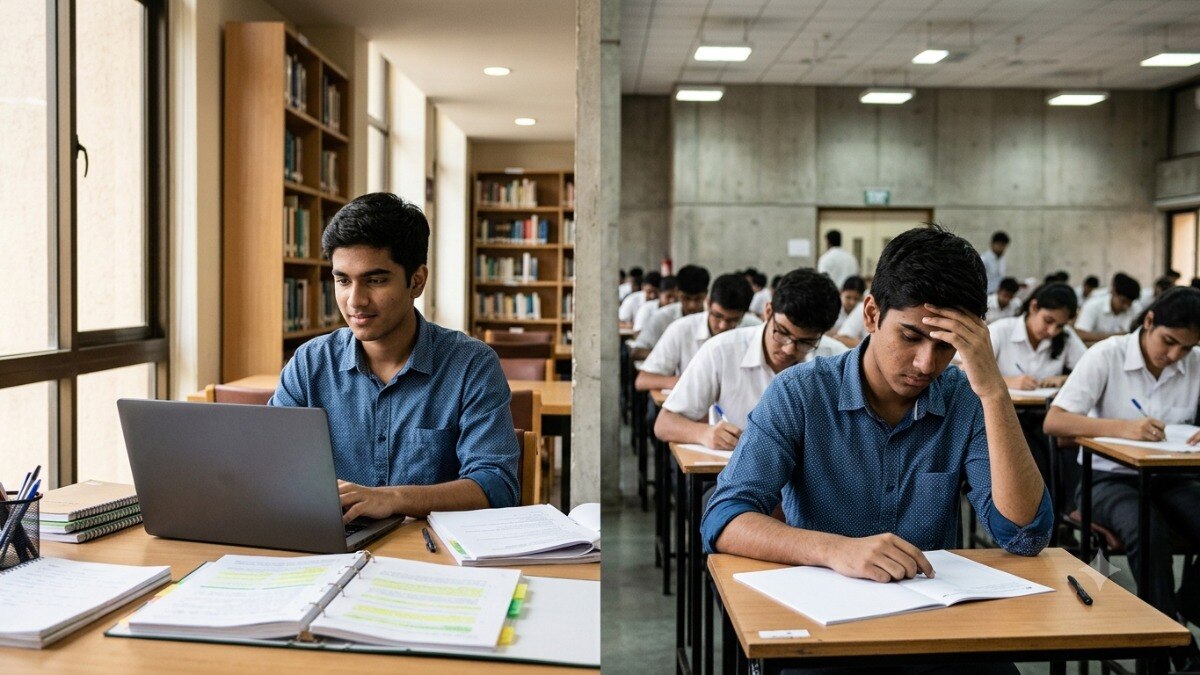
Artificial intelligence is becoming a regular study tool for Indian college students, but its impact on learning remains an open question. A FICCI-EY-Parthenon report reveals widespread AI adoption, while a preliminary Chinese study cited by the World Bank found homework scores rising as in-class exam marks fell, raising concerns about independent learning.Artificial intelligence is becoming a regular study tool for Indian college students, but its impact on learning remains an open question. (AI-generated image)New Delhi,Oct 13, 2026 15:45 ISTArtificial intelligence is becoming a regular study companion for students in India and abroad. But while AI can make assignments easier and improve the quality of written work, emerging evidence raises a harder question -- are students learning enough to perform decently when the AI tool is taken away?AI has become a regular part of academic life in Indian colleges, according to the FICCI-EY-Parthenon report, From AI Adoption to Readiness: Preparing Indian Higher Education for the AI Era.Around 23% of students use AI every day for academic work, while another 43% use it several times a week. Only 1% reported never using these tools.Research is the most common application, reported by 84% of students. Writing comes next at 76%, followed by understanding difficult topics at 68% and editing work at 63%. These uses can make learning more accessible. Students can use AI to clarify concepts, organise their thoughts and improve their writing.But there is a difference between using a tool to understand an answer and asking it to produce an answer that a student submits without understanding. That distinction matters because better assignments do not necessarily mean better learning. (AI-generated image) HOMEWORK SCORES ROSE 18%, EXAM MARKS FELL 20%A study cited in the World Bank's World Development Report 2026 offers a striking example of this problem.The study tracked students in grades 7 to 12 in China as their use of generative AI increased between 2022 and 2025. Within the study sample, self-reported AI use rose from almost zero to approximately 80%.In the six months after students first began using AI, their homework scores gradually increased by 18%. Yet their monthly in-class exam scores fell by 20%.The contrast shows that while students were getting better at completing assignments, they were likely not developing the knowledge and skills needed to perform independently.The report also found that students who continued spending roughly the same amount of time on homework as they did before using AI experienced less impact on their in-class exam performance. This suggests that the effort students put into learning may matter alongside their access to AI. (AI-generated image) The study further found that students who had ever used AI scored, on average, 5% to 7% lower in senior high school and college entrance exams. The report noted that negative effects compounded with longer exposure.However, the Chinese study had not been peer-reviewed when the report was prepared. Its findings are preliminary and should not be treated as conclusive proof that AI use causes academic performance to decline.WHEN HELP STARTS REPLACING LEARNINGThe concern is not that students are using technology to study. It is what happens when the technology does too much of the thinking.A student who asks AI to explain a difficult mathematical concept may gain a useful learning aid. Another who copies the solution without working through the problem may finish the assignment but miss the practice needed to solve a similar question independently.The World Bank examines this risk in its discussion of generative AI and the erosion of knowledge, learning and human skills. (AI-generated image) The distinction is relevant to Indian colleges too. The FICCI-EY-Parthenon report identifies concerns around overdependence on AI, independent learning and academic integrity. It also points to a grey area between productive assistance and misconduct, particularly when institutional rules are unclear.Researching a topic with AI, using it to improve grammar or asking it to explain a concept is not automatically academic dishonesty.Submitting generated work as one's own, however, raises different questions about authorship, assessment and what a qualification actually certifies.CAN COLLEGES STILL TRUST ASSIGNMENTS?The growing use of AI presents a challenge for conventional assessments. A polished essay or well-structured project may no longer provide a reliable picture of how much a student knows or how independently they can apply that knowledge.Simply banning AI may not solve the problem. Students may be using these tools because they face heavy workloads, language barriers or difficulties understanding classroom teaching. Institutions need to consider those pressures while establishing clear rules for acceptable use.Assessment methods may also need to change. Oral examinations, supervised problem-solving, classroom discussions and tasks requiring students to explain their reasoning can help teachers assess understanding beyond the final submission.For students, the practical test is simple: after using AI to complete an assignment, can they explain the answer, defend their reasoning and solve a similar problem without assistance?AI can be a useful study partner, but it cannot replace the knowledge students need to carry into an examination hall, a workplace or a real-world problem.As its use spreads across campuses, the bigger question is not whether students are using AI. It is whether they are using it to learn, or simply to make their work look better.- Ends
AI helped students score better on homework. Then their exam marks fell 20%
Full Article
Original Source
Read the full article at Indiatoday →KhanList aggregates and links to publicly available news content. We do not host full articles from third-party sources. Always verify important information with original sources.