
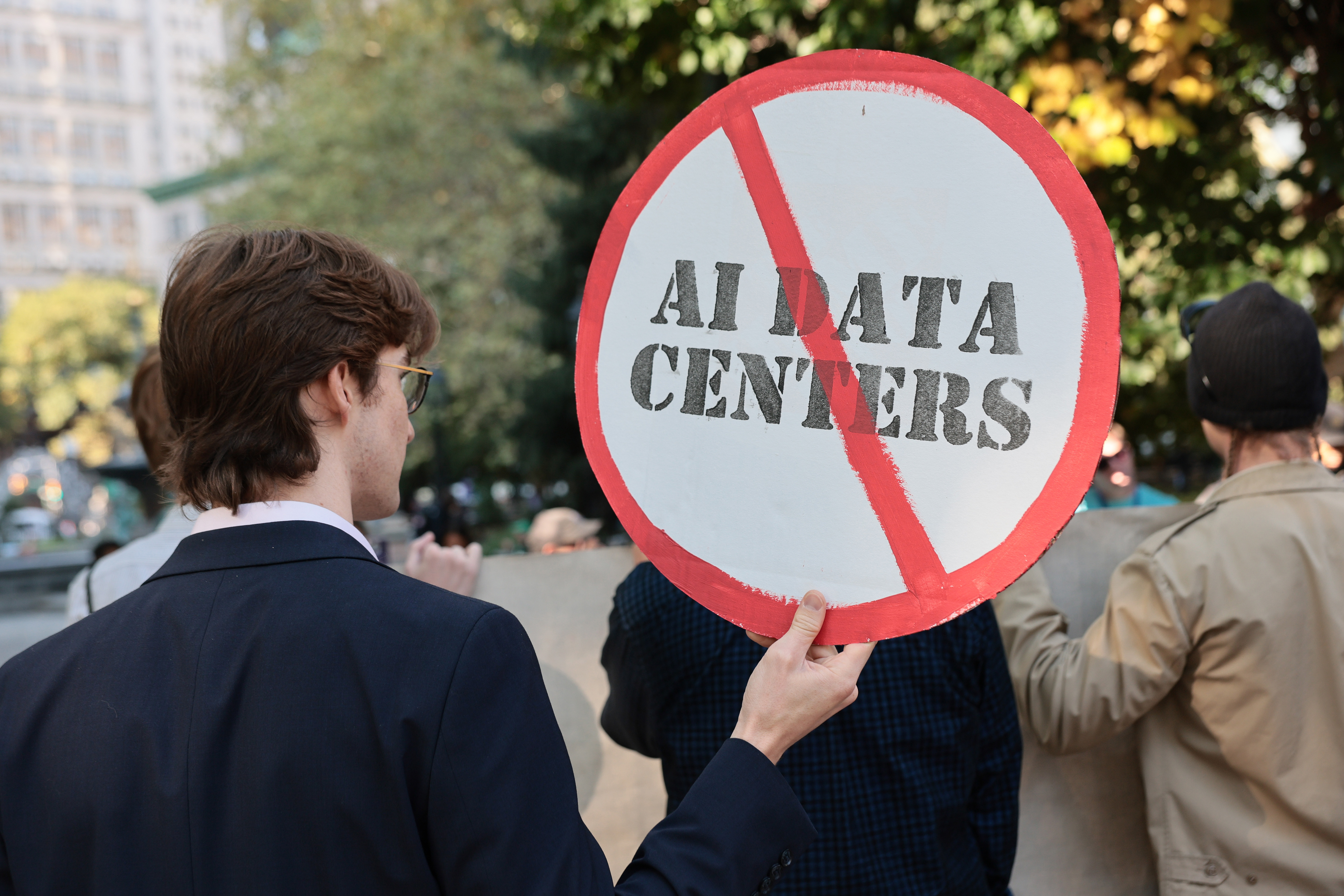
As far as public opinion goes, artificial intelligence is not a bed of roses. With the Nov. 3 elections looming nationwide, an issue that was barely a blip a year ago has become a full-blown backlash and a likely spoiler in the midterm elections. A new poll from ABC News, the Washington Post and Ipsos found that a majority of Americans (57%) believe AI is bad for society, with many more pointing to its dangers than the potential benefits the tech could bring. An even larger number of those polled (66%) are opposed to the construction of new data centers in the US, and more (72%) would be opposed if it were in their community. Opposition to AI crosses party lines. The technology has faced a surge in public disapproval this year, putting political candidates on blast and potentially affecting outcomes in key races, political and polling experts told CNET. Ambivalence about AI also feeds into negativity toward data centers, which have, in a short time, become a rare bipartisan issue everyone’s talking about, according to Christopher Lee, partner and senior political strategist for Foresight Strategic Advisors. Lee, who has closely followed election trends in southwestern states such as Nevada and Arizona, said the issue of data centers — massive AI server and compute farms that pilfer electricity and water resources — is going to “hammer” some candidates, especially those who weren’t transparent with constituents in the past about the cost to communities. If a politician voted for the construction of a data center earlier this year, their “political career is going to run into a stone wall,” he said. Reading the room The ABC News/Washington Post/Ipsos survey asked a wide range of questions about how Americans will vote in the midterms and what they think of the political parties. Alongside the economy, immigration and the war against Iran, the AI rollout is a critical issue. As noted by CNET reporter Katelyn Chedraoui, AI regulation and data center construction have been the subject of controversy, protests and increased legal action in communities. The poll confirmed as much: 67% of respondents felt the government isn’t doing enough to regulate AI, with risks including widespread job losses, psychological dependency, economic inequality and even human extinction. Fears and negativity toward AI also extend to the election process itself, with AI election interference among Americans’ top 10 fears for 2026. A national PR campaign funded by tech leaders and supported by the Trump administration, meant to tout the alleged benefits of data centers, such as job creation and technological advancements, doesn’t seem to be having the intended effect. Some politicians, especially those running for congressional seats, seem to be better at reading the room. According to Lindsey Cormack, an associate professor of political science at Stevens Institute of Technology and co-host of the podcast Government That Doesn’t Suck, many candidates are paying close attention to how they communicate about AI developments, with a particular focus on the problems they present rather than the benefits they provide. “It’s difficult to persuade people with promises of economic development when they’re worried about their electricity bills or water supply,” she said. Cormack, creator of the congressional newsletter archive DCinbox, has tracked a sharp rise in lawmakers linking data centers to consumer energy costs. In an email to CNET, she noted that between January and September 2025, just 5% of Republican newsletters discussing data centers mentioned electricity bills or ratepayers (4 of 76). Over the same period in 2026, that figure surged to 54% (97 of 180). Democrats showed a similar focus, with 40% of their data center newsletters (71 of 176) raising the issue in 2026. The midterms won’t be the end of the battle. AI and data centers are “going to be an issue in 2028 and 2030 and way beyond that,” Lee said. Omar Gallaga has covered technology, digital culture and other topics for outlets including CNET, NPR, Wired, Texas Monthly, MSNBC, Consumer Reports, The Washington Post, the Los Angeles Times, The Atlantic and the Austin American-Statesman, where he was a longtime tech reporter, editor and podcaster. He lives in the Texas Hill Country. See full bio The Latest from Omar AI and Data Centers Will Impact Midterm Voting, According to Experts Investigation Reveals How TikTok Executives Ignored Internal Child-Safety Warnings Meta Blames Bot Traffic for No Kings Day Instagram Suspension
AI and Data Centers Will Impact Midterm Voting, According to Experts
Full Article
Original Source
Read the full article at Cnet →KhanList aggregates and links to publicly available news content. We do not host full articles from third-party sources. Always verify important information with original sources.