
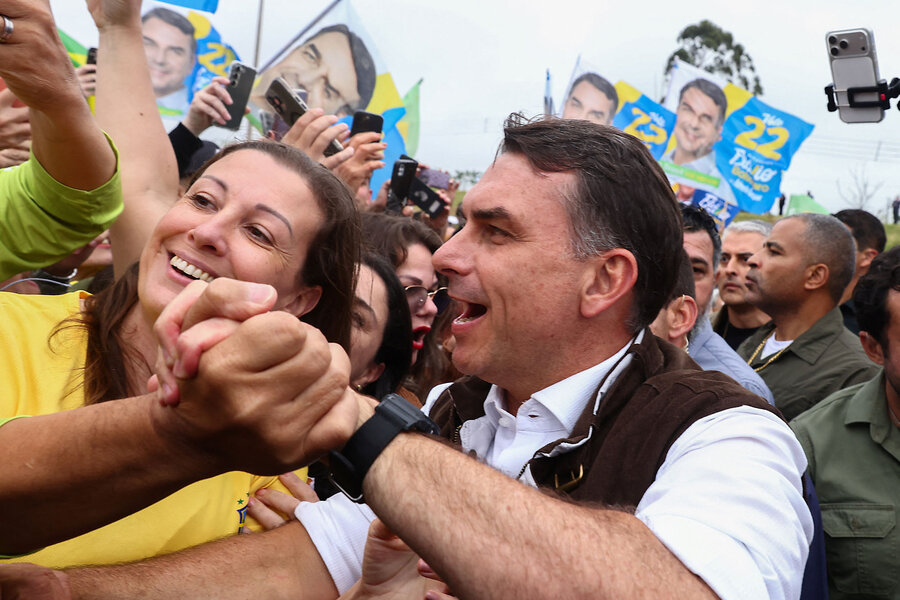
Rio de Janeiro | Oct. 17, 2026, 5:00 a.m. ET | 5 min read The hair, the nose, the smile. Flávio Bolsonaro, perched atop a sound truck at a recent campaign rally in Rio de Janeiro’s working-class suburbs, could at first glance be mistaken for his father, former President Jair Bolsonaro, who is currently under house arrest. He shouts into a microphone about declaring war on crime, a page taken from his father’s political playbook.The younger Bolsonaro then starts emulating his dad’s trademark finger-gun gesture, which used to mobilize adoring crowds who referred to the former leader as a “legend.” But he can’t quite pull it off and moves on.Together, these striking similarities and differences between father and son are key to Flávio Bolsonaro’s electoral strategy. He embodies the continuation of his father’s political project, while also representing change. It’s working for him. The far-right senator is on track to beat incumbent leftist President Luiz Inácio Lula da Silva in a presidential runoff on Oct. 25. In the first round, on Oct. 4, he won 47% of the vote, to the 45% earned by Lula, as the president is known here.Projecting a more moderate persona has helped the younger Bolsonaro’s appeal beyond the core Bolsonarista base. He’s reaching voters who now reject Lula and his Workers’ Party, but who were first alienated in 2022 by Mr. Bolsonaro’s coarse manners and the fresh memory of his chaotic government, says Guilherme Casarões, associate professor of Brazilian studies at Florida International University. Adriano Machado/ReutersBrazilian President Luiz Inácio Lula da Silva earned 45% of the vote in the first round of voting on Oct. 4. He will face Sen. Flávio Bolsonaro in a runoff on Oct. 25. “The father is very charismatic; he’s a people’s politician,” says Dr. Casarões. “Flávio doesn’t have those traits, so he ended up building an alternative image, of a kind of moderate, vaccinated Bolsonaro,” he says, using a descriptor that also refers to the elder Bolsonaro’s mishandling of the COVID-19 pandemic.“A family project”The eldest of Mr. Bolsonaro’s five children, Sen. Bolsonaro entered politics at the age of 21. He won a seat in the Rio de Janeiro state assembly in 2002, in large part through the help of his father, who had a core base of support among Rio’s military ranks. He served four terms as a state deputy before being elected to national office as a senator in 2018, the year his father won the presidency.He was little-known – and little-liked, even among Bolsonaro supporters – prior to being anointed as his father’s successor last December, says Camila Rocha, a political scientist at Cebrap, a Brazilian research institute. She has studied Bolsonaro voters for nearly a decade. Many people saw Mr. Bolsonaro’s sons as spoiled and immature due to family arguments that frequently spilled into public view, Dr. Rocha says. “Flávio was appointed by Jair, so that was that.”Despite being under house arrest for attempting a coup and banned from outside communications, the patriarch looms large over his son’s campaign – starting with Sen. Bolsonaro’s pledge, if elected, to seek an amnesty for his father. “On the day of the inauguration ... you will see Jair Messias Bolsonaro placing the presidential sash on me,” Sen. Bolsonaro told a cheering crowd on Oct. 10.The candidate’s family credentials are what matter to loyal supporters like Sheila Rosa, a member of the women’s chapter of the Bolsonaros’ Liberal Party. “We’re all here out of love for Jair Bolsonaro, and we stand firmly with his son, who will continue his legacy,” she says, after traveling 50 miles to attend a campaign event this month in Rio de Janeiro. Adriano Machado/ReutersAt a rally, presidential candidate Flávio Bolsonaro holds a portrait of his father, former President Jair Bolsonaro, who is currently under house arrest, in Goiania, Brazil, Sept. 27, 2026. Sen. Bolsonaro will not carry the torch alone. His brother Carlos and stepmother Michelle Bolsonaro, the former president’s third and current wife, were elected to the Senate on Oct. 4. A younger half brother, Jair Renan, and an uncle won seats in the lower house.“Bolsonarismo, as a movement, is intertwined with the idea of a family project,” says Dr. Casarões, who is also a researcher at Brazil’s Observatory of the Far Right.What’s the election about?If elected president, Sen. Bolsonaro will face the challenge of building an independent public persona, says Dr. Rocha, who distinguishes him from his father by referring to him as the “Bolsonaro who doesn’t swear.” He has a sparse legislative track record, heavily focused on public security issues and peppered with scandal.In 2020, prosecutors accused him of having run a salary kickback scheme in his state parliamentary office. (The case was closed after evidence was thrown out on jurisdictional grounds.) He has attracted scrutiny for his ties to Rio’s militias – mafia-like paramilitary organizations, run by retired or off-duty police officers – and for his accumulation of personal wealth. His declared assets more than tripled between 2018 and 2026, following the purchase of a 6-million-real (about $1.2 million) mansion in the capital city of Brasília, where he lives with his wife, who is a dentist, and their two teenage daughters. Sen. Bolsonaro is currently under investigation for corruption and money laundering over the financing of a biopic about his father, for which Daniel Vorcaro, a disgraced banker at the center of a massive financial fraud case, provided at least $10 million. Investigators are looking into both the origin of the funds and their alleged misuse. The senator denies wrongdoing.But these controversies haven’t hurt him “because the election isn’t about him,” says Dr. Rocha. “It’s about [the rejection of] Lula.”Take voter Thiago Acácio, who dismisses Sen. Bolsonaro as corrupt and “involved with militias.” Yet, he still cast his ballot for him in the first round “to get rid of this left-wing government.” Deepen your worldviewwith Monitor Highlights.Politics with respectGet political stories with respectful analysis.There‘s a world of new ideas in everyBooks newsletter.There‘s more to life, enrich yours withCulture & Learning weekly.Follow humanity‘s discoveries withScience & Nature stories in your inbox.Gain a spiritual perspectivefrom the stories in your inbox.Want to understand the deeper impact of critical events? Learn the Monitor‘s insight.Already a subscriber? Log in to hide ads. Sen. Bolsonaro’s proposals include a punitive response to crime (he defends chemical castration for rapists), and cost-cutting measures inspired by Argentina’s libertarian president, Javier Milei. He has sought to downplay concerns that Brazilians’ pensions and social benefits could suffer under a future government of his. In a Datafolha poll in early October, 46% of Brazilians said they would not vote for Sen. Bolsonaro in the second round.“The agenda he defends is not moderate; it’s the same as his father’s,” says Dr. Rocha. Sen. Bolsonaro embraces his party’s more radical line, already sparking concerns about the future of Brazil’s democracy with talk of “redemocratizing” the country and changing constitutional rules around the judiciary and presidential reelection. With a friendly Congress and a weakened Supreme Court, she says, “he will have a wide-open avenue to do whatever he pleases.” ALREADY A SUBSCRIBER? LoginReal news can be honest, hopeful, credible, constructive.The Christian Science Monitor was founded in 1908 to lift the standard of journalism and uplift humanity. We aim to “speak the truth in love.” Our goal is not to tell you what to think, but to give you the essential knowledge and understanding to come to your own intelligent conclusions. Join us in this mission by subscribing.
Ahead of Brazil's presidential runoff, meet Bolsonaro 2.0
Full Article
Original Source
Read the full article at Csmonitor →KhanList aggregates and links to publicly available news content. We do not host full articles from third-party sources. Always verify important information with original sources.