
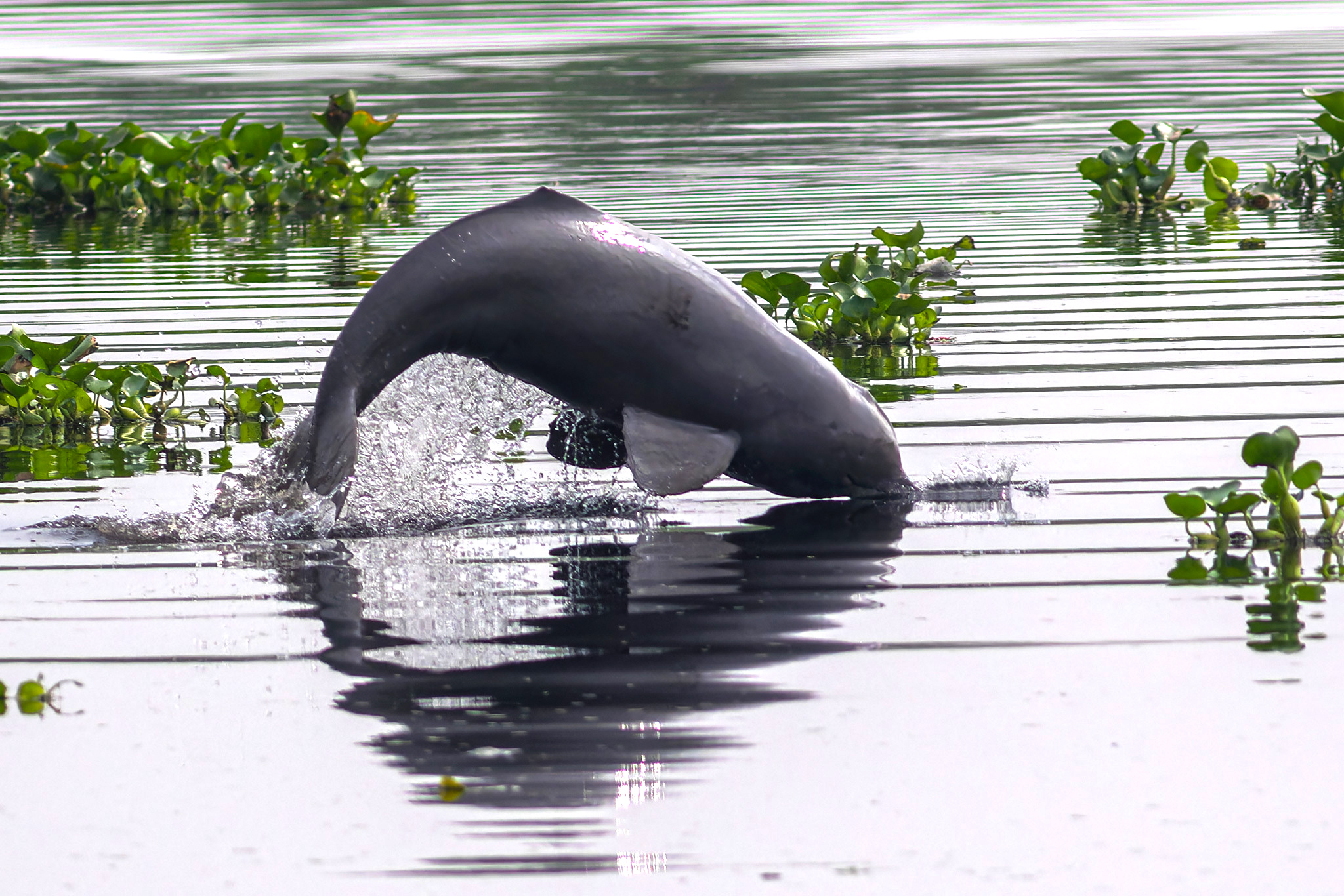
The Buriganga River in Bangladesh is one of the five most polluted rivers in the world, with heavy metal pollution from chromium, lead and cadmium.However, a recent survey found that around 20 Ganges river dolphins survive in this toxic river.More than 2,000 Ganges river dolphins were recorded across 4,900 kilometers (3,045 miles) across 45 rivers in Bangladesh in another survey.For river dolphins to survive in Bangladesh, the country needs to keep a check on the intense pollutions and on harmful fishing methods, conservationists say. The Buriganga River, which flows by Dhaka city, is one of Bangladesh’s most polluted waterways and ranks among the most contaminated urban rivers in the world. Every day, the 29-kilometre- (18-mile-) long Buriganga River absorbs toxic industrial effluent from hundreds of factories, continuous tannery discharges, untreated sewage and solid waste, leaving much of the river virtually lifeless for fish. However, in the Buriganga, where native fish species have essentially vanished, endangered Ganges river dolphins (Platanista gangetica) continue to persist. A recent study published in the Journal of Asia-Pacific Biodiversity found that around 20 dolphins live in the river. Researchers conducted the study for 12 months, from September 2023 to August 2024, and systematically surveyed a 27-km (16.7-mi) stretch of this heavily polluted river that skirts the southern edge of Dhaka. “The Buriganga is not a usual place for dolphins, where native fishes have largely vanished. Leaving the river full of invasive suckermouth catfish [Hypostomus Plecostomus, locally called sakar fish],” one of the researchers, Md. Aminur Rahman, told Mongabay. “When we found [the dolphins], we were amazed at how it was possible. Because the river is not livable for fish. Around the year, we didn’t track any dolphins only during two of the months, but all the other 10 months we tracked them.” The highest number of dolphins were seen in December, and throughout the winter season, and none were seen in October 2023 or between July and August of 2024. The dolphin groups averaged 4.18 individuals, higher than in earlier reports, and calves accounted for nearly 16% of the sightings, indicating that reproduction continues despite the extreme pollution conditions. A Ganges river in the Buriganga River’s Bosila area. Image by Md Aminur Rahman. A recent survey found that around 20 Ganges river dolphins survive in the polluted Buriganga River. Image by Md Aminur Rahman. Heavy metal pollution turns the Buriganga toxic A 2025 study on Buriganga River’s water pollution analysis shows that the river receives untreated industrial effluent from tannery waste, textile and dyeing factories, battery plants, metal-processing units, re-rolling mills, dockyards, and pharmaceutical industries. Other primary contributors to the pollution include city corporation sewage, solid waste and urban runoff. Key heavy metals found in water are chromium, lead, cadmium, arsenic, mercury, nickel, copper and zinc, which regularly exceed WHO and national safety limits in both water and sediments. During the dry season, dissolved oxygen frequently falls to near zero (well below the environmental standard of 5 milligrams per liter), biochemical oxygen demand and chemical oxygen demand soar, and sediments show severe contamination, with Pollution Load Index (PLI — a tool to measure and compare the degree of heavy metal contamination) values exceeding 1 at most sampling sites and high Potential Ecological Risk Index (PERI — a method to evaluate heavy metal pollution and its potential ecological danger) scores placing many locations in the high-to-very-high risk category, the study reads. The study also shows that these pollutants have collapsed native fish populations, triggered widespread biodiversity loss, and entered the food chain through bioaccumulation in fish, vegetables and water, posing serious risks of kidney damage, neurological disorders, developmental problems and cancer to the millions of people who live alongside or depend on the river. A Canada-based awareness nonprofit, Sea Smart, identified Buriganga as the fifth most polluted river in the world. Mohammad Abdul Aziz, zoology professor at Jahangirnagar University in Dhaka, told Mongabay, “The Buriganga’s condition is not suitable for most fish, yet some [types of] catfish are still present. Some catfish can breathe both in water and by taking air from the surface, and suckermouth catfish are among the most pollution-tolerant species. Right now, the Buriganga is full of suckermouth catfish. We believe the dolphins are hunting these fish.” He added, “If we want to conserve the dolphins in the Buriganga, the priority must be to stop the pollution. The number of vessels on the river is also excessive now. These vessels severely disrupt the dolphins’ natural movement.” (Left) The map of the Buriganga River showing anthropogenic stressors and establishments and divisions of survey segments. (Right) Core activity areas (red circle) identified on the basis of observed locations of the Ganges River dolphins in the Buriganga River. Images courtesy of Khatun, S. (2026). River dolphins in Bangladesh A recent survey jointly conducted by the Bangladesh’s Forest Department and WCS Bangladesh recorded 2,307 Ganges river dolphins living in the country’s various rivers. The survey covered around 4,900 km (3,045 mi) across 45 rivers between 2024 and 2025. They identified 25 dolphin hotspots. Along 305 km (190 mi) of the Turag, Buriganga, Bongshi, Surma and Kalni rivers, they found a total of 27 dolphins, despite the rivers’ heavy pollution. In 2012, the Government of Bangladesh declared three wildlife sanctuaries for endangered freshwater dolphins in the Sundarbans mangroves. The sanctuaries aim to protect two species of freshwater dolphins — the Ganges river dolphin and the Irrawaddy dolphin (Orcaella brevirostris). The Ganges river dolphin largely inhabits the Ganga and Brahmaputra river systems in India and Bangladesh. However, their presence is declining in Bangladesh for several reasons, including pollution and illegal use of gill nets for fishing. “Ganges river dolphins in Bangladesh are declining for several reasons,” Aziz said. “Illegal fishing in the rivers has increased, and the widespread use of illegal types of fishing nets trap and kill these dolphins. Back in 2013, we found dolphins in the Turag River during our study, but they are no longer seen there. The Buriganga dolphins sometimes move downstream through the Dhaleshwari River into the Meghna River and then return. Most of them stay around the Buriganga’s Bosila area.” He added, “To protect the country’s Ganges river dolphins, we must reduce river pollution and at the same time stop harmful fishing practices and other activities.” Banner image: A Ganges river dolphin in Bangladesh. Image © Ikbal H. Babu via iNaturalist (CC BY-NC 4.0). Banned but abundant, gillnets pose main threat to Bangladesh’s river dolphins Nine countries sign global pact to protect endangered river dolphins Citations: Khatun, S., Hamza, A., Rahman, M. A., Shraboni, Z. S., & Aziz. M. A. (2026). Population status, spatiotemporal distribution, and habitat drivers of endangered Ganges river dolphins in the Buriganga River, Bangladesh. Journal of Asia-Pacific Biodiversity. doi:10.1016/j.japb.2026.05.002 Akter, B. & Rahman, S. H. (2025). Heavy Metal Contamination in the Buriganga River, Bangladesh: A Review of Ecological Risk and Pollution. Jahangirnagar University Environmental Bulletin. Vol. 10, 93-108. Retrieved from https://juniv.edu/journal?department_id=45 Azad, M., Monifa, R. A. & Azad, M. (2024). Assessment of Buriganga River Changing Pattern with Climatic Effect and Detection of Landuse Changes Over 37 Years in and Around Dhaka City – an Overview Scenario of Dhaka, Bangladesh. doi:10.2139/ssrn.5056636 Bashar, M.K., Noro, K., Wang, Q., Tokumura, M., Mori, I., Raknuzzaman, M., Hossain, A. & Amagai, T. (2023). Spatiotemporal distribution and pollution assessment of trace metals in the Buriganga River, Bangladesh. J Water Health 1 June 2023; 21 (6): 815–825. doi: doi:10.2166/wh.2023.019 Feedback: Use this form to send a message to the author of this post. If you want to post a public comment, you can do that at the bottom of the page. Credits Topics
Against the odds, endangered dolphins survive in Bangladesh’s polluted river
Full Article
Original Source
Read the full article at News →KhanList aggregates and links to publicly available news content. We do not host full articles from third-party sources. Always verify important information with original sources.