
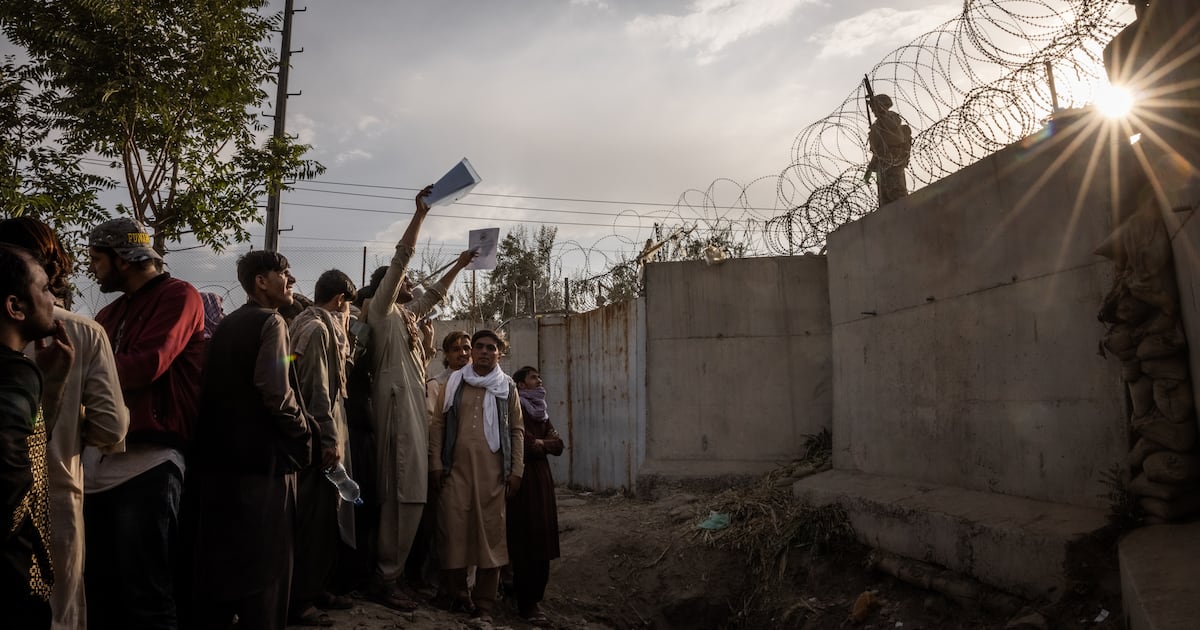
Shards of rock crunch-clink underfoot as a column of young men pick their way through a narrow mountain path, approaching a ridge line. Each carries a few belongings in a backpack bought in an Afghanistan frontier town. Heads are wrapped in scarves against the relentless sun. A gruelling 24-hour trek and nearly a fortnight of stop-start moves will deposit this batch of Afghan youths in the Iranian port city of Bandar Abbas. The people smugglers document this recent ordeal on video to prove they have delivered their charges. These Afghan migrants, who made their journeys this month, hope to work as labourers on the shores of the Strait of Hormuz for a while, before finding another smuggler to cross the Iran-Turkey border. Their willingness to risk their lives running the gauntlet of trigger-happy Iranian and Turkish border guards epitomises the plight of Afghanistan.The story of restored Taliban rule started with a different-looking exodus: the mass evacuation to western countries of hundreds of thousands of Afghans. READ MOREI also got out on one of the military flights the night after president Ashraf Ghani fled. As our convoy inched its way to the airport gate, crowds of desperate civilians pushed towards the perimeter like a scene from Dante’s Inferno. In the massive cargo bay of a C-17 military aircraft, I was one of the few Europeans among the hundreds of people tucking ourselves under the cargo straps, for what they call a “floor loading” flight.People queue to board a US miltary aircraft at Kabul airport in 2021. Photograph: Taylor Crul/AFP/Getty In all, some 300,000 Afghans fled to the West in the August 2021 airlift and subsequent official relocation schemes. Ironically, these evacuees far outnumbered the Taliban from whom they were apparently fleeing. And after five years of Taliban rule, the country continues to haemorrhage people.A former colleague, a Kabul University academic, shared his feelings with me as republican Kabul collapsed. In 2021 he was desperate to get out and lamented “the return of these brutes”. On one level, things worked out okay for him. The academic, his wife and three of their four adult children are settled in Europe. The youngsters are all working. My colleague, like many of the 2021 evacuees, is now eligible for a European passport. That is life changing as, under the Taliban, Afghans have seen their national passport ranked the most difficult one in the world to travel on.When we talked recently, the academic was keen to discuss latest developments in Afghanistan. Intellectuals of the new diaspora remain constantly in touch with their homeland, asserting they still have a stake. They have concluded, he informed me, that the Taliban are on the verge of provoking a nationwide popular uprising.I too have continued to research the Taliban and so am alert to the pitfalls awaiting anyone trying to explain the group. There is the orientalist trap of othering these turbaned men and rendering them reassuringly exotic. Denigrating the Taliban as mere proxies with no agency, as some Afghans do, is equally unhelpful.Perhaps what has happened over the past five years is best described as the Taliban imposing their version of tyranny. Tyranny is universally understood. Look closely and many Taliban moves resemble those of other contemporary foes of freedom. Afghans celebrate the fifth anniversary of the Taliban’s return to power in Kabul last Saturday. Photograph: Tomas Munita/The New York Times As the Afghan republic approached its nadir, I read the 20 lessons of Timothy Snyder’s On Tyranny The Taliban have built their emirate like a masterclass in imposing tyranny on a society whose people were once famed for their love of freedom. The Taliban emir, Hibatullah Akhundzada, famously banned girls from secondary and higher education and excluded women from most fields of work. Depriving half the population of their rights has been widely condemned as “gender apartheid”. But the emir has doubled down on the bans, brushing aside advice from many of his ministers and ignoring the thousands of Afghans quietly defying the decrees through any available loophole. The tyranny gains a sort of perverse legitimacy by demonstrating it can stick to its most unpopular and oppressive policy in the face of international condemnation. [ From the archive: Back in control of Afghanistan. Who are the Taliban 2.0?Opens in new window ]The Taliban justify their rule with a rudimentary ideology. This ideology establishes the tyranny. Afghans owe obedience to the emir, who rules at God’s pleasure. The system, because it implements God’s laws, is sacred. No one has the right to criticise the system and those who rebel forfeit their right to live. Taliban officials recite this ideology of obedience ad nauseam. Of course, millions of Afghans break the rules, whether they are officials indulging in corrupt practices or brave women insisting on going out to work.The Taliban have patched together an elaborate legal framework. They operate without a constitution but have replaced many of the republic’s laws. Some new laws, such the criminal code provisions on slavery, seem ridiculous. All are arbitrarily applied. The real law is Taliban power. Hibatullah Akhundzada heads the Rahbari Shura, the Taliban’s leadership council. Photograph: Afghan Islamic Press/AP Below Akhundzada, Taliban rule rests on a new nomenklatura. Only those who participated in the Taliban’s jihad, as fighters or officials, or pro-Taliban clerics, are eligible to work in the emirate and its security forces above the lowest grades. All perks of power are reserved for Taliban. While the members of this nomenklatura jostle for position, most of the population feels excluded.While the emir proclaims the Taliban’s ideological purity and devotion to God, leaders and the rest of the nomenklatura indulge in rank corruption and avarice.Although bona fide Taliban and allied clerics, who claimed victory, constitute only a tiny proportion of the population, each Talib has multiple relatives and clansmen to oblige. Afghans, excluded from the new system, have watched while these Taliban camp followers get accommodated with jobs, contracts and impunity.The tyranny pursues the visible submission of the population by demanding that citizens adhere to a quixotic but intrusive moral code – the rules of the vice and virtue ministry. It is worst for women who are supposed to cover up and use a family escort outside the home. Men are told how to maintain their beards and hair and are supposed to pray in the mosque. Enforcers have a long list of other infringements to go after if the population needs more reminders of who is in charge.A woman in the town of Ishkashim, in Afghanistan's northeastern Badakhshan province, in 2024. Photograph: Carolyn Van Houten/The Washington Post/Getty Hard power is exercised by the Taliban’s well-resourced secret police, the General Directorate of Intelligence (GDI). The GDI has carte blanche from the emir to detain, disappear, torture and summarily execute as it sees fit. Unlike previous iterations of the secret police, the GDI goes after Afghans.The number of citizens who must be killed to sustain tyranny increases exponentially with the extent of open resistance. Every week or so since the 2021 takeover, the Taliban have killed a former member of the security forces. The pace of killing picked up in summer 2026 as Taliban felt rattled by unrest in the north. [ Barred from education and rarely allowed out, female Afghans have been ‘erased’ from viewOpens in new window ]Tyranny needs an economic base and can extract resources in ways that would be impossible for a democratic regime. The $15 billion Afghan economy now primarily serves the private interests of the Taliban nomenklatura and their partners, plus the collective interest of the regime. Many Taliban have rapidly grown rich from extortion and grabbing a stake in every viable business. Tough tax collection nets them nearly 20 per cent of domestic product. But the regime remains indifferent to the poverty of the majority. After all, the emir’s top priority is religious education.Women in a street in Kandahar earlier this month. Officials from the department for the promotion of virtue and prevention of vice recently increased guidance on women's dress in Kandahar, encouraging the use of the full-body burqa. Photograph: EPA The Taliban do not receive the kind of budget support the republic secured from its backers. Nevertheless, international humanitarian assistance for the population continues, for now, at a reduced but still substantial level. The tyranny is prolific in its cultural output. Industrial-scale media content proclaims an Islamic utopia of justice, piety and national development. State-sponsored social media accounts, poets, authors and even new war memorials, justify the years of violent jihad and suicide bombing. A particularly problematic element in the tyranny’s media arsenal is the expat Afghan lobbyists. Taliban have co-opted a visible minority of the diaspora, comfortably settled in the West. Lobbyists repeat regime lines in the media and talk up living conditions in Islamic Afghanistan. Perhaps they naively dream of winning special treatment, or perhaps they act on an anti-elite grudge.The main focus of the tyranny’s cultural revolution is the education sector. A nationwide chain of “jihadi madrassas” subjects young men to religious education and indoctrination in Taliban ideology. Taliban have sworn to eradicate supposed western values from the modern education sector.Taliban arbitrary rule and the emir’s weird policies have fuelled an ever-growing list of grievances. My research suggests that economic grievances are most widely and acutely felt. Civilians complain of the lack of work and impossibility of doing business in the face of Taliban tax demands and extortion. Petty traders, rickshaw drivers and casual labourers are routinely beaten and prevented from working. The Taliban have come nearest to provoking an uprising in the north of the country by trying to deny locals their share in revenues from a chaotic mining boom.Taliban security officials at a rally as part of celebrations to mark the fifth anniversary of the Taliban takeover of Afghanistan, in Kabul. Photograph: Samiullah Popal/EPA The tyranny has curtailed freedom of expression. Media operate under censorship, threat of arrest and pressure to project the regime line. This has fostered a parallel national society in the diaspora. Diaspora Afghans earnestly involve themselves in support of activities in the homeland, such as clandestine education. Others comment, debate, criticise and jostle for prominence in a new hierarchy of those speaking on behalf of the nation. Afghans in the country talk disparagingly of those who ran away. But only the diaspora enjoys freedom of expression and action as the tyranny assiduously prevents the emergence of new leaders in the country.There is resistance to the tyranny, both civil and armed. Let it not be said that no Afghan took a stand. But I consider the protest demonstrations, brave public criticisms, underground defiance of Taliban rules and other forms of civil resistance as liminal. Actions are episodic and scattered, not building momentum. Afghans believe the decisive move against the tyranny lies in the future. Many wait for a sign that the forces opposing the Taliban have secured the backing and rear base that are widely considered to be prerequisites of success against tyranny.[ Fintan O'Toole: Cricket Ireland showed indifference to gender apartheid by hosting AfghanistanOpens in new window ]International dealings and geopolitics have not tipped the balance. The consensus international position demands women’s rights, political inclusivity and an end to terrorist havens. But the regime shrugs these off without consequences. Backing from fellow ideological regime Iran, recognition by Russia, a bit of Chinese investment and trade-focused engagement with Central Asia allow the regime to claim it is not isolated. But none of this really props up the Taliban. Even an on-again, off-again war with Pakistan has not persuaded the regime to mend its ways.Taliban security forces now exert a firmer grip on the national territory than did the republic’s forces at any stage in their 20-year struggle to protect the country’s democracy. During the republic’s last summer, the threat of imminent collapse was visible to anyone who cared to look. But the anti-Taliban resistance 2026 summer offensive pales in comparison to the Taliban 2021 momentum. The former’s high point – a remote district symbolically liberated for a few hours – did nothing to dent the ground reality of Taliban military dominance.And yet, Afghans do not accept the Taliban’s tyranny as the settled state of affairs. The real threat to Taliban hegemony is political and social, not military. Steady flows of migrants risking all to get out of the country because they cannot secure a livelihood under the Taliban is a tangible expression of no confidence in the system. The list of Afghan groups whom the Taliban have alienated is long and growing.Perhaps the possibility of redemption for Afghanistan lies in Afghans discovering collective strength, demanding a say in their destiny and confronting the tyranny. The outcome of people versus the tyranny is a problem of humanity rather than particular to Afghanistan. So, yes, Afghan girls’ schools may yet reopen and rights may be restored. But this is unlikely to happen through the emir changing his mind or through a United Nations Security Council resolution. For Afghans to regain their freedom those who have suffered under the tyranny must realise they do indeed vastly outnumber those who profit from it. Then they must find a way to mobilise.Michael Semple is a regional specialist on Afghanistan and Pakistan who has worked as an EU deputy special representative for Afghanistan and a UN political officer. He is currently visiting scholar at the Institute for Global Peace, Security and Justice at Queen’s University Belfast.
After five years of Taliban rule, Afghanistan continues to haemorrhage people
Full Article
Original Source
Read the full article at Irishtimes →KhanList aggregates and links to publicly available news content. We do not host full articles from third-party sources. Always verify important information with original sources.