
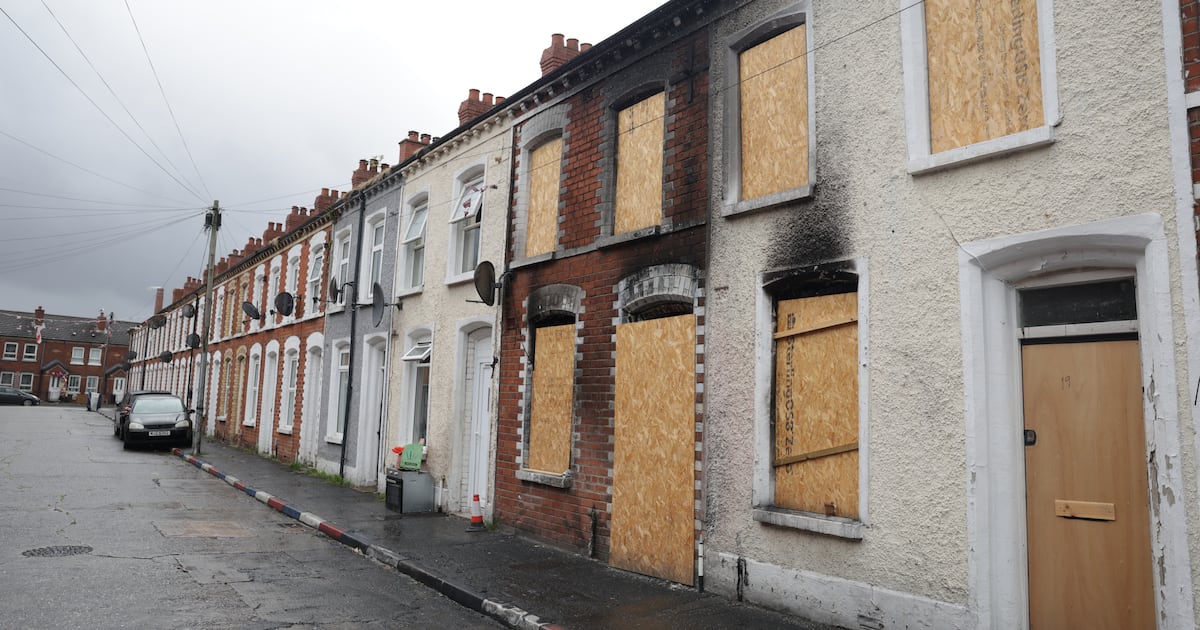
On the evening of Tuesday June 9th, Michael was at home with his family when a brick came through the livingroom window, shattering the glass of their terraced home in east Belfast and just missing his three-year-old son. “My child was standing in the livingroom,” says Michael, who asked for his name to be changed out of fear for his family’s safety. “He got nearly hit by a brick in the head.” The riots began a few hours earlier in response to an incident the night before – a Sudanese immigrant attacked a man in north Belfast with a knife. British far-right influencer Tommy Robinson and billionaire Elon Musk amplified the incident on social media, leading to calls for co-ordinated anti-immigration protests across the city. It brought a mob to Michael’s door. “Many people in a mask start coming to the street, and they start shooting the bricks in our windows,” says Michael, a Slovakian immigrant speaking in Belfast’s distinctive accent, absorbed from the 22 years he has lived in the city.“My missus got hit in the leg.” As the family hid upstairs, they saw riot police come to the end of the street, get attacked with bricks and petrol bombs and leave. Then the family smelt smoke. Michael says it was coming into the house because the window and front door were on fire.“I told my missus: ‘We need to go.’” With his wife and child, they ran through the back door, through alleyways and finally back on to the main street, finding themselves among the mob who had been attacking their home. “It was like horror, complete horror. I didn’t know what was going to happen, like if they were going to kill us or anything.” Michael’s family was not alone. Women who suffered during rioting targeted at migrants in Belfast in August. Many immigrants told The Irish Times they were too afraid to be identified in photographs. Photograph: Stephen Davison Elsewhere in the city, in a quiet housing estate, Ashley (not her real name), says she and her daughter spent almost an hour hiding under her bed waiting for police to arrive. A British-Kenyan single mother who had moved to Belfast three years before, she had just ended her hospital shift at 11pm and was going to bed when “the whole livingroom window came down”. “They threw bricks and beer bottles into the room. I switched off all the lights, we went under the bed, and I called the police.” For more than 40 minutes Ashley and her daughter hid in the dark. “All we could hear is people walking in the back garden, I think maybe they were waiting for us to open the door and try [to escape],” she says. “I was having a severe panic attack, my hands were shaking. My daughter, bless her, she went in the kitchen, got a knife, got our passports, and then came back to me. She said: ‘We need to protect ourselves.’ She’s 16.” When the police arrived at midnight, the two women were escorted from their home. As they left, Ashley saw the wall had been graffitied: “Muslims, get out of here.” Three months on, families affected by the riots still haven’t returned to their homes.Michael and Ashley are among at least 88 families officially recorded as having been made homeless in June, according to figures shared with The Irish Times by Northern Ireland’s social housing authority, the Northern Ireland Housing Executive (NIHE). But volunteers on the ground say there are more. Anaka Women’s Collective, a voluntary network that works with refugee and asylum seekers in the city, set up emergency support for immigrants on the night and says it helped more than 500 people in the weeks after, included 300 families. The NIHE says 39 of the 88 families it recorded as homeless have been moved to temporary accommodation. Of the remaining 49, a spokesperson says that it “does not have information” on the number who returned to their previous addresses. Elfie Seymour, an organiser with Anaka, says a number of families it was in contact with left Northern Ireland completely, handing in keys to the housing executive, while some left for the summer to consider their options. Now, as schools reopen, Northern Ireland’s immigrants are faced with a pressing question: is it finally safe to go home? Simmering racial tensions reached boiling point in the summer. Race-motivated attacks now outpace sectarian attacks, according to Police Service of Northern Ireland (PSNI) data, a first in an era of relative peace following 30 years of sectarian violence during The Troubles.The highest level of race-based violence since monthly records began in 2004 were recorded this summer, the third in a row that Northern Ireland has experienced such riots.Each time, a violent crime was publicly reported, allegedly involving an immigrant or person of colour – in Northern Ireland or elsewhere in the UK – and riots erupted, targeting the immigrant community as a whole. New figures from the PSNI show there were 512 race-motivated hate incidents recorded in June, including 317 crimes. A spatial analysis by The Irish Times of the demographic patterns behind the incidents found a majority of media-reported attacks on the night happened in predominantly Protestant working-class areas.Part of the reason the attacks occurred in loyalist areas is due to Belfast’s changing social geography, according to Peter Shirlow, director of the Institute of Irish Studies at the University of Liverpool. Immigration has been rising in the last few decades, with people born outside the United Kingdom and Ireland making up roughly 6.5 per cent of the population (124,000 people) in the latest census.In Belfast, Shirlow says, a lot of new immigrants rent in traditionally Protestant working-class areas.“What we’ve had in the last 20 years is a fall in the Protestant birth rate and a rise in social mobility,” he says. “So housing is available and housing is cheaper.“The riots happened in the places where there are higher concentrations of migrants and also because of the growth of racial tensions in those places.” Racial prejudice had been falling in Northern Ireland since the early 2000s. Yet, in a post-Brexit political landscape, there has been a resurgence of anti-immigration views. Polling data analysed by The Irish Times shows that, in Northern Ireland, indicators of prejudice are higher within the Protestant community than among Catholics. A poll last year by the Centre for Irish Studies found unionists were more likely than nationalists to believe immigrants had poorer qualifications and live in social housing, claims contradicted by official census and housing data.“There is a lack of unionist political engagement on the ground with working-class Protestants in general,” said Alasdair McDonnell, former leader of the SDLP. In the political vacuum, young Protestant men who have historically lower education rates and declining opportunities are easily radicalised, he said. “They’re effectively abandoned at the margins. As a result, they’re easy prey for the far right.” On some metrics, however, a large proportion of unionists were less prejudiced, outpolling nationalists.“There’s no doubt there’s more unionists on the right than nationalists on the right,” Shirlow says. “There’s a currency within loyalism which engages in racism.“But they are not homogenous. There are loyalists who are racist and loyalists who are anti-racist. [It] is historically divided on this issue.” That racism is now being inflamed by far-right international influences and misinformation online. “It’s not from their parents, not really from their peers,” says Shirlow. “It’s social media telling them they’re oppressed, they’re marginalised, they’re victims and that’s very persuasive to a lot of young men.”On June 9th, the day of the riots, the video of the knife attack went viral and plans for protests were shared in tweets by both Musk and Robinson, helping fuel the flames that set Belfast alight.“Racism exists everywhere,” says Dessie Donnelly, director of Rabble, a technology co-operative that monitors far-right activity online. “But if you look at far-right networks online – they are gaining more organisational traction in loyalist areas. It’s fertile ground.” A combination of online provocation and existing paramilitaries on the ground fuelled Belfast’s race riots, unlike other attempted far-right riots in other cities in Europe. “There’s the infrastructure for violence with the existence of paramilitaries,” says Katy Hayward, professor of sociology at Queen’s University Belfast. “And we have the muscle memory of rioting in Northern Ireland.” Loyalist paramilitaries are still active in East Belfast communities. A BBC Spotlight programme in 2020 cited PSNI/M15 documents that estimated there were more than 12,000 members. of loyalist paramilitary groups. Witness accounts described paramilitary presence on the ground that night, co-ordinating the violence. The day before the riots, posts in local Facebook groups had shared plans to close down roads, mostly in loyalist neighbourhoods, telling young men to don masks, wear black and tell local neighbours to turn off their front door cameras. There was a night of violence in Belfast following a knife attack that left one man critically injured. Video: Reuters/Enda O'Dowd/Andrew McNair “There was a level of orchestration,” says Brian Anderson, a methodist minister at the East Belfast Mission.Anderson received a call from his daughter on the night informing him his church was all over the news as a glider bus went up in flames right outside it. “Effectively they were burning outside our church,” Anderson says. “I noticed some young lads bringing trolleys and bins to barricade the roads. I could see a man orchestrating the road being barricaded who you would recognise as someone associated with local paramilitaries.” The PSNI’s response to paramilitary-led rioting has also been criticised. “We have the police response that is different from that you’d see in England or Scotland, which is tempered by experience here,” says Hayward. “In Northern Ireland the PSNI had been heavily criticised for managing riots in the past. So now what they tend to do is minimise risk to life but intervene as minimally as possible, given that their presence alone can incite violence. “The thinking for police is that order is best kept by getting everything on CCTV and making arrests later.” As of August 31st, three months after the riots, a total of 42 arrests were made, with 33 people charged, eight released on bail and one reported to the Public Prosecution Service. The policing strategy failed because it was designed for segregated sectarian communities, claims Shirlow. “If a bunch of Protestants or Catholic kids are rioting, you keep them in their respective area.” “That strategy didn’t work here because the violence was not across the interface but [targeted at immigrants] within their own communities. It does not work if you’re corralling people in the area where they’re attacking people.” Elfie Seymour, Twasul Mohammed and Michaela Rafferty of the North Belfast group Anaka Women's Collective. Photograph: Enda O'Dowd Amid the chaos on June 9th, a women’s collective stepped in.A group of 400 ordinary people, organised through WhatsApp messages by Anaka and other organisations, volunteered to go out in their own cars to evacuate families from homes under attack and set up a makeshift safe house in the Redeemer Central church.“We started to get messages from people who were terrified, stuck in houses that were being attacked, stuck in houses that were on fire,” says Elfie Seymour. “It was an extremely hostile environment.”Frantic WhatsApp messages described families being told by firefighters to stay in their homes while houses nearby burned, and police leaving areas under attack and not responding to urgent calls for help.“When we were supporting the families to get out of the houses a police officer turned to me and said: ‘Um, is there any chance I can get your number just in case there’s any other families that need your help?’ “That’s what we quickly realised, that no one was stepping in here,” says Seymour. “There was no co-ordinated response from the state to bring people to safety.” In the aftermath, charity workers criticised what they saw as a lacklustre state response to requests for emergency accommodation.For many immigrants who had their homes destroyed, cars burnt and homes looted of valuables now presenting as homeless and afraid to go to school or work, the lack of availability of social or even temporary emergency housing in Northern Ireland adds to the problem. Some 99.41 per cent of 83,000 properties available for social housing were occupied as of September 1st, according to the NIHE, with the remaining 489 properties in the process of being filled. If immigrants are offered emergency or social housing in loyalist areas, they are often too afraid to accept them.“Where concerns are raised about safety, intimidation or suitability of an area, we will consider those concerns carefully and work with the household and relevant statutory and voluntary partners to identify appropriate options,” a spokesperson for the housing executive told The Irish Times.But, Seymour says, the state simply has not done enough.Elfie Seymour of the North Belfast group Anaka Women's Collective. Photograph: Enda O'Dowd Families who fled their homes and requested emergency accommodation in the aftermath of the riots described moving from emergency accommodation night after night for the last few months or staying with friends or family and becoming part of a hidden homeless population.Anaka, which raised more than £250,000 (€291,000) in the wake of the riots to support migrants, says it has already spent £100,000 on providing accommodation via Booking.com and Airbnb rentals. The political response, particularly from unionist parties, has also been relatively muted.“There was a complete [failure] in the state departments to act with any sense of urgency or flexibility that people who were under attack needed,” says Seymour. Donnelly adds: “You know, they don’t have a sense that the state utterly failed communities. So what’s going to be put in place if this happens again?” The Housing Executive strongly denied that assertion, saying its teams were on the ground helping those affected and rehousing those in need. Three months on from the race riots, can Belfast’s splintered communities reconcile?Given the violence was concentrated in Protestant areas, many in Belfast’s immigrant community say they now believe only nationalist areas with Catholic-majority populations are safe, and are moving away from loyalist neighbourhoods completely.“They’re taught these narratives, because of their experiences in these areas, that Catholics are welcoming and Protestants are not,” says Seymour.“This isn’t Belfast. But unfortunately, that is the Belfast that people [who are being attacked] are feeling.“We need to get to the core of what is rotten here, and we need to change it so that we can tell a different story.” Methodist minister Reverend Brian Anderson witnessed much of the rioting that took place in Belfast in June. Picture: Enda O'Dowd story by Rachel Lavin In the East Belfast Mission, smoke still stains the buildings from the fires. Anderson admits the neighbourhood has changed since the riots forced many immigrants out. “I would be aware of the absence,” Anderson says. “The scar is that the population is more white and more indigenous than it was. Some of our refugee groups are smaller. Our relationships with the people who have stayed is deeper. “But there’s fear – East Belfast is just too fearful for them.” For someone like Ashley, the question of whether to stay or go has weighed heavily all summer. But with her daughter’s school year starting, she has made up her mind. “I’ve been here six years now, and it’s getting worse yearly,” she says.“But I am staying. We’ll see how far it goes.”
After Belfast burned: what happened to immigrant families after homes were attacked?
Full Article
Original Source
Read the full article at Irishtimes →KhanList aggregates and links to publicly available news content. We do not host full articles from third-party sources. Always verify important information with original sources.