
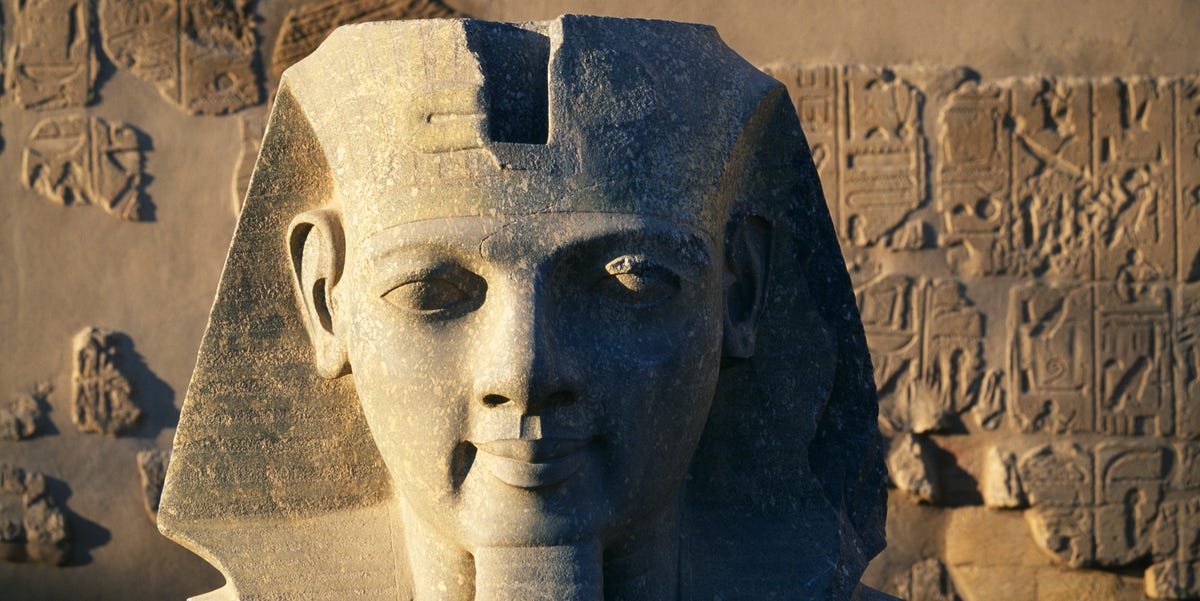
3 min readHere’s what you’ll learn when you read this story:In 1930, German archaeologists uncovered the lower half of a massive statue, estimating that it likely originally stood some 23 feet tall.In early 2024, U.S. and Egyptian archaeologists found the long-missing upper half in pristine condition—with traces of ancient pigment still visible.After formal approval, restoration crews reunited the two halves in early 2026. The statue now stands at its original position for the first time in millennia.In 1930, German archaeologist Günther Roeder unearthed the lower half of what would’ve been a massive, 23-foot-tall statue of Ramesses II—one of the most celebrated pharaohs throughout all 31 dynasties of Ancient Egyptian history. Roeder found the statue 150 miles south of Cairo in the Minya Governorate, near the modern-day city of El Ashmunein. In ancient times, this area along the Nile was known as Khemnu. It served as a provincial capital in the Old Kingdom of Egypt (2649–2130 B.C.E.), and was later called Hermopolis Magna when Romans ruled the Mediterranean.Many treasures of the region’s illustrious past were known to be buried in the surrounding desert, and while Roeder’s discovery proved remarkable, the rest of the enormous statue he found remained lost to time…for nearly a century.In March 2024, a joint Egyptian-American archaeological team announced that they'd finally found the missing upper half of Roeder’s statue. Speaking with Reuters, the experts from the Egyptian Ministry of Tourism and Antiquities reported that the upper half stretched some 12.5 feet tall and depicted Ramesses II wearing a headdress topped with a royal cobra. The discovery had actually occurred weeks earlier, when the team found the fragment lying face down in the earth.“One problem with Hermopolis is that it’s close to the Nile. After [the building of] the Aswan Low Dam, the water table became a huge issue. There was no guarantee that the stone would be OK,” Yvona Trnka-Amrhein, assistant professor of classics at the University of Colorado Boulder and co-leader of the team said in a press statement. “Sometimes sandstone is uncovered that is basically just sand or degraded limestone. It could have just been a lump of rock.”Luckily, after further excavation, the team confirmed that the statue was remarkably well-preserved and contained another amazing find—traces of blue-and-yellow pigment could be found on the statue’s surface. Hopefully, further analysis of this pigment will help researchers understand the context of the statue’s creation, as well as its original appearance.“We knew it might be there, but we were not specifically looking for it,” Trnka-Amrhein said in a press statement. “It was plausible that the rest of the statue might be there, but it was a total surprise.”Thankfully, the hunch proved correct. Egyptian co-leader Basem Gehad submitted a proposal to reunite the two pieces, and the Permanent Committee for Ancient Egyptian Antiquities approved it. Restoration work began in September 2025, and by early 2026 the statue was whole again—re-erected at its original position at the northern entrance of the temple at El Ashmunein, where it first stood more than 3,200 years ago.The fully restored colossus stands approximately 22 feet tall, weighs over 40 tons, and is composed of four main pieces—the upper and lower body segments plus three inscribed base stones laid on uncarved foundation blocks. It is the first complete colossal statue from Middle Egypt, and the first to be studied with modern archaeological methods.The team isn’t done. The discovery is part of a broader effort called “The City of the Baboon Project,” a collaboration between the Ministry of Tourism and Antiquities and the University of Colorado Boulder’s classics department. Surveys planned through 2026 and 2027 aim to identify the foundations of the temple pylon the statue once guarded—and to determine what else remains buried at Hermopolis Magna.Darren lives in Portland, has a cat, and writes/edits about sci-fi and how our world works. You can find his previous stuff at Gizmodo and Paste if you look hard enough.
After 96 Years, Archaeologists Finally Found the Missing Part of a Legendary Statue
Full Article
Original Source
Read the full article at Popularmechanics →KhanList aggregates and links to publicly available news content. We do not host full articles from third-party sources. Always verify important information with original sources.