
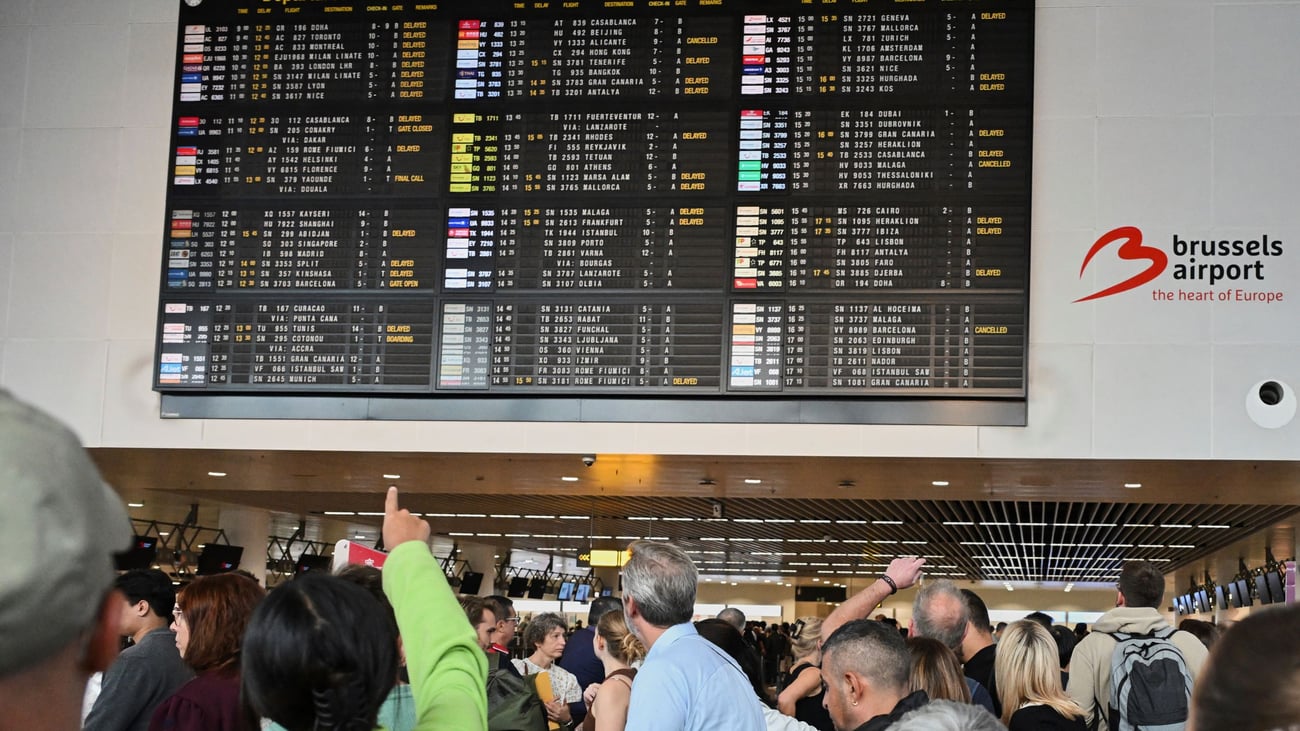
An advocate general at the bloc's top court wants a reexamination of what causes restrictions and whether carriers can limit their effects.(CN) — Airlines should have to explain more than who made them wait before refusing to pay delayed passengers, an adviser to the EU’s top court said Thursday.The Court of Justice of the European Union is reviewing a ruling over DelayFix’s claim against LOT Polish Airlines for $464 (400 euros) plus interest. A passenger transferred her compensation rights to the claims company, and a Warsaw court asked whether air traffic restrictions could excuse the airline from paying.Her July 25, 2023, flight from Izmir, Turkey, to Warsaw arrived three hours and seven minutes late. Weather-related restrictions over Hungary and Romania had delayed the plane’s preceding flight. Repairs in Izmir took another two hours and eight minutes. Subtracting the traffic-related time would put the delay below the three-hour compensation threshold established by the European Union.Advocate General Rimvydas Norkus recommended replacing the General Court’s January ruling, which allowed an air traffic decision to qualify for an exemption regardless of its cause, if it was beyond the carrier’s control — notably, where the airline had not contributed to it. Such opinions are nonbinding but are often followed by the court.Norkus said the underlying event had to fall outside normal airline operations and beyond the carrier’s actual control. An outside authority’s involvement could not effectively settle both questions without weakening passenger protection.“A clear distinction must be drawn between the cause of the disruption and the measure through which that disruption affects the actual operation of the flight,” he wrote in French.Airlines also need to show reasonable measures could not have prevented the consequences. Norkus found the earlier ruling’s errors serious enough to threaten consistent application of EU law and justify intervention.Claudia Bischof, a lawyer specializing in aviation law at Lindbergh Legal, said airlines should not escape having to pay up simply because someone else ordered a delay, a point she made in a 2023 article cited by Norkus. “An ATM decision may be the operational response to very different situations, ranging from routine capacity constraints to genuinely exceptional weather or security events.” She welcomed the opinion for requiring airlines to show why the delay was more than an everyday problem of flying.Piotr Gad, an advocate who represented DelayFix in the passenger rights proceedings, also welcomed the opinion’s preservation of the two separate tests: “Otherwise, there would be a risk that an operational decision issued by air traffic management becomes a shortcut to exemption from compensation, even where the underlying cause forms part of the ordinary constraints of air transport.”LOT Polish Airlines did not respond to a request for comment.Dominik Weiss, a partner and aviation lawyer at Flitsch Leuthner Leiter, preferred the earlier ruling’s clearer rule for carriers. “Airlines are bound by these decisions but often have no insight into the authority’s decisionmaking process and may therefore struggle to prove why a particular restriction was imposed,” he said. He stressed that being blameless did not necessarily mean an airline could avoid paying.Weiss also saw tension with newly adopted legislation listing traffic and airport capacity restrictions as potential exceptions. He expected Austria’s practice of examining underlying causes to remain relevant if judges followed Norkus. The adviser, however, read the reform as supporting individual scrutiny and noted that it did not apply to this claim.Norkus left room for exceptional events on earlier flights to excuse a later delay, provided airlines proved a direct link. Using the same plane was insufficient: Courts had to examine schedules, time between flights and opportunities to contain the knock-on effects.A 2024 reform gave the General Court responsibility for answering national courts’ questions in selected areas, including passenger compensation. The Court of Justice opened this special review on its first advocate general’s proposal.Ricardo Pazos, a senior lecturer in civil law at Comillas Pontifical University in Madrid, highlighted the procedure’s first use and its significance beyond aviation, since the same question of what event courts should examine could arise in other flight disruption cases. But he questioned how often looking behind a restriction would actually change outcomes in cases involving weather or runway spills.If the court follows the opinion, its will replace the General Court’s ruling. Whether the passenger receives compensation will be for the Warsaw court to decide.Courthouse News reporter Eunseo Hong is based in the Netherlands.Subscribe to our free newslettersOur weekly newsletter Closing Arguments offers the latest about ongoing trials, major litigation and rulings in courthouses around the U.S. and the world, while the monthly Under the Lights dishes the legal dirt from Hollywood, sports, Big Tech and the arts.Additional Reads
Adviser urges EU to clamp down on airlines avoiding passenger delay payouts
Full Article
Original Source
Read the full article at Courthousenews →KhanList aggregates and links to publicly available news content. We do not host full articles from third-party sources. Always verify important information with original sources.