
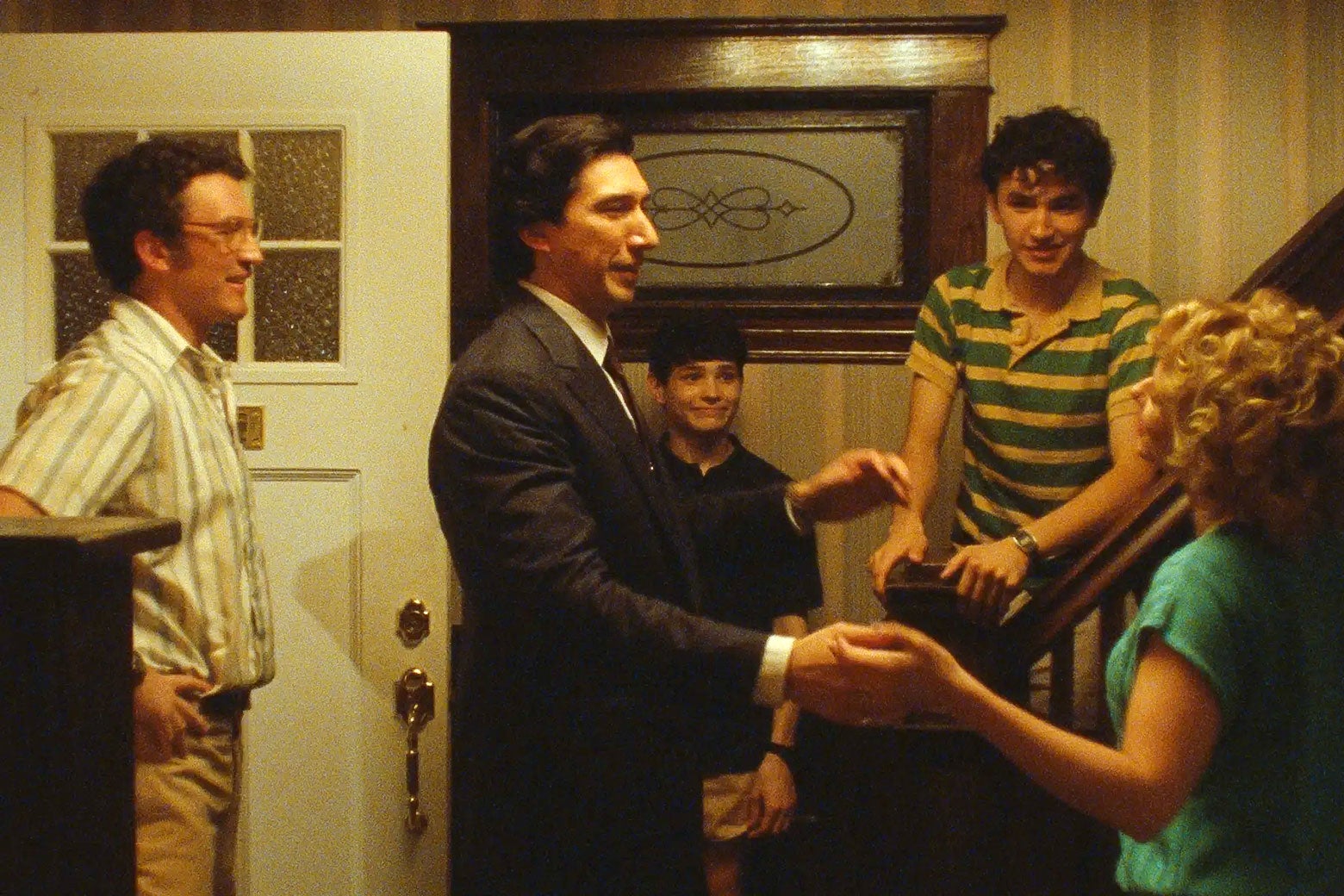
Movies The Great New Thriller That Should Finally Make Its Filmmaker a Household Name Paper Tiger is like a Scorsese crime epic but with a different sort of personal twist. By Enter your email to receive alerts for this author. Sign in or create an account to better manage your email preferences. Unsubscribe from email alerts Are you sure you want to unsubscribe from email alerts for Dana Stevens? Nov 20, 20265:50 AM Neon Sign up for the Slatest to get the most insightful analysis, criticism, and advice out there, delivered to your inbox daily. The epigraph that appears onscreen at the opening of James Gray’s ninth film Paper Tiger comes from the Aeschylus tragedy Agamemnon: “Let there be wealth without tears; enough for the wise man who will ask no further.” This story of two brothers whose unwise pursuit of riches ends in tears, not just for the siblings themselves, but for their extended family, unfolds like a combination Ancient Greek tragedy and neo-noir Hollywood gangster saga. Shot on grainy 35mm film against the seamy backdrop of Reagan-era New York, Paper Tiger unfolds with a mood of fatalistic melancholy that owes a debt to Martin Scorsese’s mob movies.But its cultural milieu—Jewish, middle-class, modestly aspirational—is very different from Scorsese’s, if rendered in equally specific and autobiographically informed detail. The brothers at Paper Tiger’s heart—Irwin and Gary Pearl (Miles Teller and Adam Driver)—aren’t bad men, or even especially greedy ones. They’re deluded strivers in the classic American vein, convinced, as so many were in the boom times of the 1980s, that they can move up a notch in the world and ensure the next generation does better than they did, if they can just find the right business opportunity. Gary, a former NYPD cop who now works as a security consultant and general freelance fixer, is positive that opportunity lies in the government-funded cleanup of Brooklyn’s Gowanus Canal, at that time one of the world’s most polluted waterways. The businesses contracted to drain and dump the toxic sludge that flows through the canal were once controlled by the Mafia; with the city’s Italian crime families weakened by RICO crackdowns, Russian companies of an equally shady nature have moved in to fill the void. In sharp contrast to his slick, big-talking brother, Irwin is a straight-arrow family man, an engineer who lives in an unassuming brick house in Queens with his affectionate, practical wife Hester (Scarlett Johansson) and their two teenage sons (Gavin Goudey and Roman Engel). To the Pearl family, Gary is a larger-than-life figure whose visits bring with them a touch of luxury and glamour. He does card tricks for his nephews, greets his sister-in-law with a hug that turns into a ballroom-dance-style dip, and one night drops by with a catered delivery from the famous Brooklyn steakhouse Peter Luger’s. But there’s an edge of danger to Gary’s allure. At his nephews’ request, he shows them a furtive glimpse of the gun he carries in an ankle holster, and after dinner he privately consults with Irwin about a dubiously legit scheme he has in the works: He wants to combine his connections at City Hall and his brother’s engineering expertise to form a consulting company that would help the Russians navigate the process of securing permits for their canal-dredging operations. Irwin’s specialty in his field is “risk assessment,” but he’s better at assessing the risks to a future Superfund site than he is at judging threats to his own family. Excited to show his sons his new work venture, he packs them into the car one night and drives them to the Gowanus location where he and Gary have recently met with a sketchy go-between named Alexei (Yavor Vesselinov) to sign the deal. There, Irwin witnesses something the Russians don’t want him to see, leading to a series of escalating reprisals that put himself, the boys, and eventually their unsuspecting mother in danger. While not a proper sequel to Gray’s 2022 coming-of-age drama Armageddon Time, Paper Tiger is similarly personal in its focus on a would-be upwardly mobile Jewish family in 1980s Queens, the time and place of Gray’s own coming of age. (Teller’s and Johansson’s characters, and their predicaments, were inspired by those of Gray’s parents.) This time, the level of action and suspense is amped up with a couple of violent set pieces that place us firmly in the thriller genre. A scene in which Driver’s Gary, armed only with a belt, goes ham on some Russian thugs is unsettlingly intense, as is a late chase scene through one of those marshy fields of tall grasses outside NYC where movie mobsters are forever meeting to dump bodies or settle scores. But what sets Paper Tiger apart from your average action movie is the time and care Gray invests in the domestic drama that underlies and informs the crime elements of the plot. Though she’s a stay-at-home parent with a deep investment in her sons’ future—she sits with them at night to supervise their homework, and sensibly objects to their father’s insistence on whisking them off to a deserted industrial neighborhood on a school night—Johansson’s Hester is a far cry from your standard-issue blend-into-the-background movie mom. A subplot involving a serious health scare that she keeps secret from the family lends her story, as well as the brothers’, a tragic dimension. And Johansson, so often seen in the role of invulnerable action heroine or smoldering sexpot, is startlingly persuasive as an unglamorous, self-effacing woman who sees her primary goal in life as providing support for her husband and sons. For all the showiness of Driver’s role as the volatile and doomed Gary—and for all the detailed, low-key work Teller brings to perhaps the meatiest role he has gotten to play since 2014’s Whiplash—it’s Johansson’s scenes that stayed with me for days after seeing Paper Tiger. That’s especially true of a quiet moment with Teller in which she masterfully plays two emotions at once: intense worry about her own medical condition and desperation to mask that worry so as to cope with the physical peril her husband’s naive blunders have trapped their whole family in. It would have been easy for Gray, who also wrote the screenplay, to make Hester a pure victim of the Pearl brothers’ hubristic schemes; instead, her marriage to Irwin is shown as flawed but resilient, with big blowups that resolve in mutual apologies. As much as it’s a movie about organized crime, Paper Tiger is an exploration of the rocky shoals of co-parenting. A scene in which Hester blows up over the fact that, once again, her valid opinion has been ignored will resonate with many a mother who isn’t on the Russian mob’s hit list. At times the almost fable-like simplicity of Paper Tiger’s story makes the plot seem to be hurtling too fast toward its fateful resolution. It’s not always clear over how long a period of time the story is taking place, and there is at least one significant plot question that remains unresolved. Still, the film has an operatic sweep that carries the viewer breathlessly from scene to scene. And as is always the case with Gray, a passionate cinephile who has shot all but one of his films on celluloid, the level of craft is exquisite. The cinematography by Joaquin Baca-Asay (who also shot Gray’s features We Own the Night and Two Lovers) evokes 1970s-era grit without becoming self-consciously retro, and Christopher Spelman’s brooding score is sparely but beautifully deployed. Gray’s work has long enjoyed a cult following among a certain segment of film fans without ever quite breaking into the mainstream. Paper Tiger, a searing family drama that packs the heft of an epic into the space of under two hours, may be, and definitely should be, the movie that changes that. Crime Movies New York City
Adam Driver and Scarlett Johansson’s Great New Thriller Is Like a Scorsese Crime Saga With a Twist
Full Article
Original Source
Read the full article at Slate →KhanList aggregates and links to publicly available news content. We do not host full articles from third-party sources. Always verify important information with original sources.