
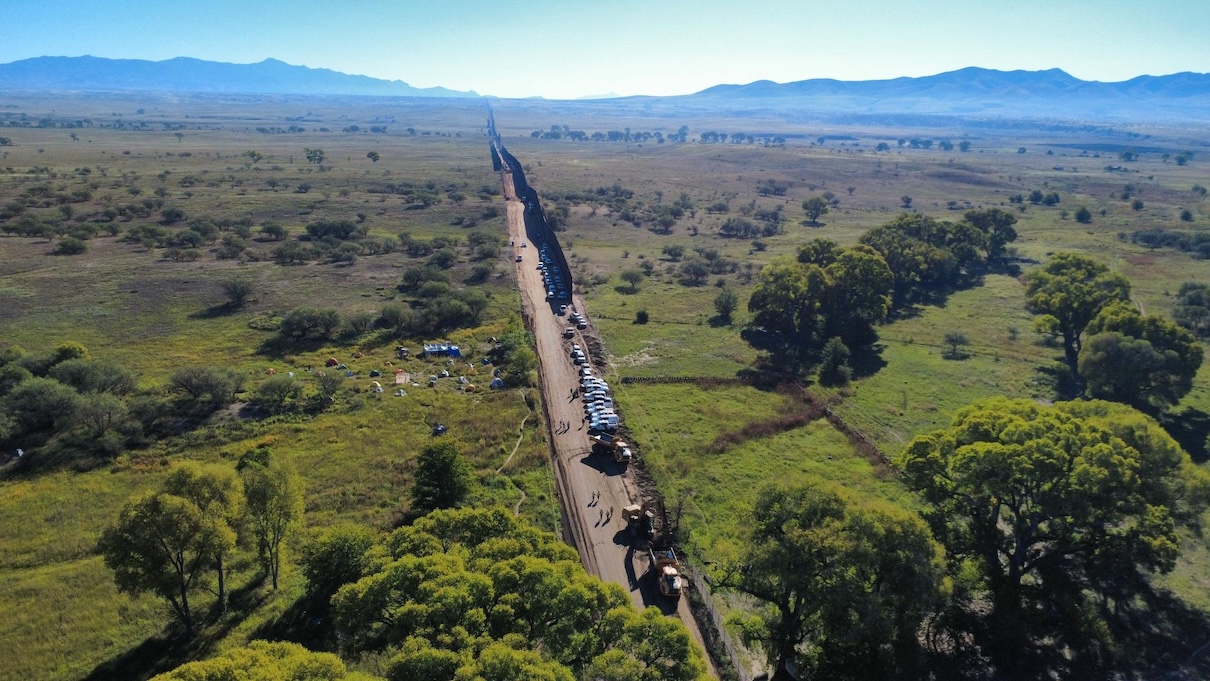
The San Rafael Valley in the U.S. state of Arizona is an important wildlife corridor, but these migrations will soon be blocked by a wall being constructed by the U.S. government to prevent passage of human migrants.Activists had been staging tree sits in a group of old cottonwoods adjacent to the construction until they were cut down this week, including a very large one dubbed “Grandmother Tree,” whose felling has caused furor on social media.“The movement that formed around it demonstrates why protecting biodiversity in the borderlands requires recognizing both ecological and social connectivity across the region,” the author of a new commentary argues.This article is a commentary. The views expressed are those of the author, not necessarily of Mongabay. A group of activists in the small border town of Lochiel, Arizona, U.S., is fighting to save 200-year-old cottonwood trees by stopping contractors from building a section of the U.S.’s new wall along its border with Mexico. One activist lived for over 70 days in the upper branches of an ancient cottonwood dubbed the “Grandmother Tree,” preventing construction workers from cutting it down while other activists used pulleys to bring them food and water. The protest was about more than protecting ancient trees: Activists were also fighting habitat fragmentation caused by the border wall in a landscape where biodiversity depends on ecological connectivity. The tree encampment began on July 28, after construction workers cut down three of the four cottonwood trees that were in the path of the wall. This double wall consists of two 30-foot-high (just over 9 meters) steel walls that run parallel to one another with a buffer zone between. Since then, helicopters, drones, U.S. Border Patrol agents, and local law enforcement have been surveilling the area, according to the activists at the encampment. I interviewed activists camped in the meadow adjacent to the tree, photographed the landscape, and participated in the daily morning rituals aimed at honoring Grandmother Tree and the land. There I learned that the movement has connected social and environmental issues since its inception. Many of the activists I met at the Lochiel protest are involved in No More Deaths, a humanitarian group that provides water and aid to migrants crossing the border, while other activists have organized in support of the Tohono O’odham Nation’s efforts to stop border wall construction on its Indigenous territory. Tree sitter in “Grandmother Tree.” Image courtesy of Meg Perret. On Aug.18, the tree sit became binational when a Mexican environmental activist occupied one of the cottonwoods in the adjacent state of Sonora. Although the activist was forcibly removed, local environmental activist Kate Scott told me that the temporary encampment was a strong signal of international solidarity. These cottonwoods have become potent symbols of international friendship because the branches of one in the U.S. touched those of another across the border in Mexico, just as ecological and human communities are connected across political boundaries. This grassroots movement is supported by members of environmental groups in both the U.S. and Mexico, including advocates from the Sierra Club, Sky Island Alliance, and the Madrean Archipelago Wildlife Center. According to Scott, the San Rafael Valley is known to be an important corridor for wildlife that cross the border, including jaguars, ocelots, and many more species whose movement across borders would be blocked by a double wall. Species that move through the San Rafael Valley depend on habitat across Arizona and Sonora, without regard for political boundaries. But the U.S. Department of Homeland Security waived dozens of federal laws, including the Endangered Species Act, which normally would provide protections for threatened species such as the western yellow-billed cuckoo. The REAL ID Act also amended federal law to give the secretary of Homeland Security broad authority to waive legal requirements in order to expedite the construction of border infrastructure. Protesters have used endangered species as political symbols in protest art and their demonstrations. Their signs have featured wildlife like jaguars adorned with messages like “migration is natural” and “migration is an earth right.” Artwork of wildlife displayed on “Grandmother Tree.” Image courtesy of Apánii. On Sept. 14, protesters dressed as endangered species, including jaguars and yellow-billed cuckoos, stood in the way of construction machinery and yelled, “We’re trying to make it across the border” and “We’re going to go extinct.” Three of the protesters were arrested on allegations of disorderly conduct but were released the following day. According to two anonymous activists I interviewed who were there on Oct. 5, border patrol agents established a perimeter around Grandmother Tree without showing protesters a warrant or court order, detained protesters, and cited others. The activists said that agents using a cherry picker truck removed the tree sitter before it was cut down. Then on Oct. 6, an activist again occupied the cottonwood in La Noria, Sonora, previously occupied by Mexican activists, establishing an ongoing encampment in the branches and stopping border wall construction. The activists have now called this tree “Abuela” (‘grandmother’ in Spanish) as its branches extend across the border and into the planned path of the border wall. The morning that Grandmother Tree was cut down, an anonymous activist on the ground told me that it was “not only a symbol of the movement, but she was teaching us” about the ability of the land to regenerate. One of the felled cottonwood trees had already grown new sprouts and the activists were able to make grafts from it to grow new ones. In the words of the activist, “for us, hope is not lost, because the land will regenerate.” So, for them, the cottonwoods are symbols of the resilience of the borderlands’ ecological communities. Felled cottonwood with others still standing behind. Image courtesy of Meg Perret. Just as the felled cottonwoods led to new life, the movement itself regenerated. Activists told me that Abuela symbolizes “continued resistance to the border wall which rips apart communities of humans, plants, and animals connected across borders,” and stands for unity “all over the world regardless of nation.” For them, Abuela signifies continued binational opposition to border militarization, in defense of both local communities and the environment. The loss of Grandmother Tree should therefore be understood as more than the destruction of one ancient tree. The movement that formed around it demonstrates why protecting biodiversity in the borderlands requires recognizing both ecological and social connectivity across the region. Just as the border wall fragments habitat across an ecologically continuous landscape, U.S. border policy divides local communities, whose relationships extend beyond borders. Meg Perret is an assistant professor at Texas A&M University currently writing a book about environmental opposition to U.S. border wall construction, and earned her Ph.D. at Harvard University. Banner image: Aerial view of Arizona border wall construction where tree sit protests have been occurring. Image courtesy of the author. See related coverage: Philippines is the deadliest country in Asia for environmental defenders, report finds Roads, infrastructure prevent tigers from settling in Indian tiger reserve Indigenous activist Kynan Tegar on Indonesia’s fires, and defending the Earth Credits Topics
Activists cite ecological, social connections in blocking US border wall construction (commentary)
Full Article
Original Source
Read the full article at News →KhanList aggregates and links to publicly available news content. We do not host full articles from third-party sources. Always verify important information with original sources.