
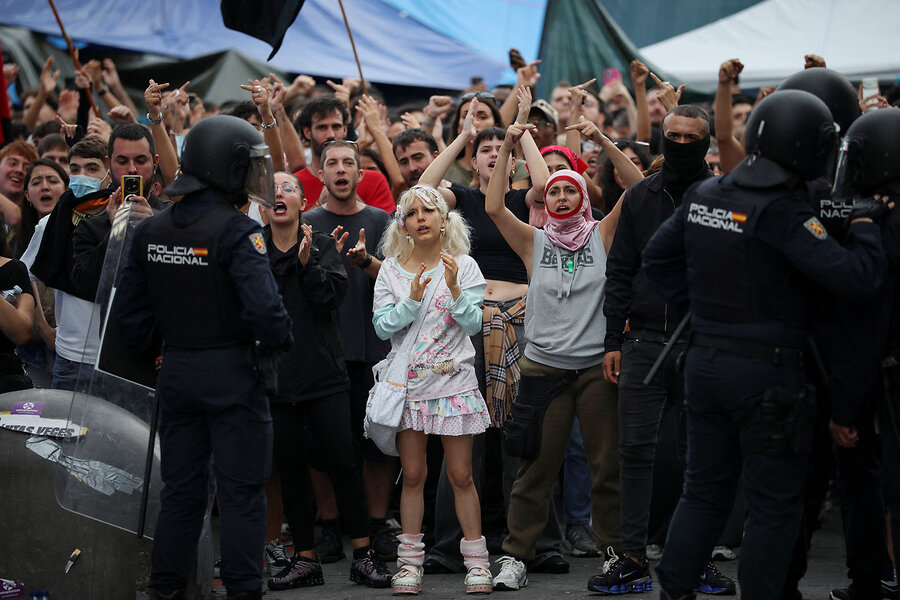
Berlin | Oct. 20, 2026, 3:29 p.m. ET | 4 min read The future of Europe is playing out on the streets of France.France is overspending, crashing toward a debt crisis that could throw the euro and the European economy into disarray. Yet its cities are mired in chaos and flames as protesters decry the lack of government funding for education.Similar scenes are playing out across the continent. Protests against the cost of living brought out riot police in Milan and forced snap elections that could topple the government in Spain. Days after 46 German economists released a letter saying deep pension reforms are crucial to the survival of the system, tens of thousands of Germans nationwide rallied to protest those reforms.Facing difficult choices on security, pensions, and social welfare spending, few European voters seem willing to make the sacrifices economists say are necessary. Some analysts blame voters themselves, saying they are unwilling or unable to see the larger picture. Some blame elites for a lack of leadership. But the common denominator is clear: People don’t make sacrifices for a system they think is broken. As trust in government falls, hard decisions are becoming harder to make.“Citizens are really bad at coming up with solutions, but really good at seeing something is wrong with the system,” says Javier Carbonell, a senior analyst at the European Policy Centre in Brussels. Abdul Saboor/ReutersParis Mayor Emmanuel Grégoire talks to journalists during a gathering against violence organized by the Association of French Mayors (AMF) in front of Paris City Hall, Oct. 19, 2026. The day before, clashes erupted during national demonstrations against the cost of living and rising fuel prices. While trust in government has been low in the United States for decades, polls suggest it is a more recent phenomenon in Europe. One survey suggests Germans’ trust in government declined from 75% to 55% between 2015 and 2024. In France, trust declined from 46% to 29% between 2022 and 2025. A record 45% of British respondents in 2024 said they almost never trust the government to put the needs of the nation first – up 22 points in four years. In such an environment, democracy’s flaws become more apparent. Plato and Aristotle were not big fans of democracy, notes British philosopher Julian Baggini. They feared the tyranny of the majority, with winners running roughshod over common sense and the rights of others. Democratic constitutions have hemmed in those instincts. But the real glue, he and others say, has been a consensus mindset – a commitment to political norms of cooperation and collegiality.“The nature of a democratic system is that it’s the art of compromise. It’s not about getting what you want,” Dr. Baggini says.Today, “there’s more of a perception that society has become a zero-sum game” of winners and losers.He points to changes in culture that have given voters a greater sense of entitlement. “In the ’50s and ’60s, most people never had an expectation that the world would bend to their will. Rather, there was a sense of mutual interdependence: ‘We have to stand together.’”But others suggest that voters are right to be skeptical. Elites bemoan the rise of the far right, but they fail to recognize that many voters are turning anywhere to fix what they see as a broken system, says Mr. Carbonell. The working class “has seen a big economic decline, and that is linked to frustration. [They say] ‘We are not part of the system.’” Part of this is linked to how democracies function.The rising frustration of young people is at least partly the result of demographic realities. With declining birth rates in the West, older people are becoming a larger part of the population. Those older people are also more reliable voters than their younger peers, leaving politically minded youth feeling more disenfranchised. The French protests are only the most graphic example. Nils Meilvang/Ritzau Scanpix/APDanish Prime Minister Mette Frederiksen answers questions after the Parliament's opening debate at Christiansborg Castle in Copenhagen, Denmark, Oct. 8, 2026. But there are also deeper structural challenges, such as the short-termism that comes from holding elections every four to five years. Yes, democratic institutions need to be preserved, but they also need to change with the times, says Seema Shah of the International Institute for Democracy and Electoral Assistance in Stockholm.“Institutions are not responding in ways that make us feel taken care of,” she says. “It is a deep-seated institutional thing. We need to update our systems ... from getting a driver’s license at the DMV to the Ministry of Justice handing down a new policy.”Yet there are signs that governments can make tough decisions – when trust is built. The Nordics routinely show the highest levels of trust, and many of them have already made tough pension reforms, for example. Denmark’s were particularly aggressive, creating the shortest window between retirement and the average age of death of any country in Europe. Deepen your worldviewwith Monitor Highlights.Politics with respectGet political stories with respectful analysis.There‘s a world of new ideas in everyBooks newsletter.There‘s more to life, enrich yours withCulture & Learning weekly.Follow humanity‘s discoveries withScience & Nature stories in your inbox.Gain a spiritual perspectivefrom the stories in your inbox.Want to understand the deeper impact of critical events? Learn the Monitor‘s insight.Already a subscriber? Log in to hide ads. It wasn’t easy, but it was possible because Danes think their system is working, ensuring quality education, healthcare, and social welfare. That makes it relatively easy to be a politician in Denmark, jokes Christian Albrekt Larsen, an expert on the Danish welfare state at Alborg University. Voters understand what needs to be done.“If I feel like I benefit from the system, then I want to save it,” he says. “I am willing to sacrifice something.” ALREADY A SUBSCRIBER? LoginReal news can be honest, hopeful, credible, constructive.The Christian Science Monitor was founded in 1908 to lift the standard of journalism and uplift humanity. We aim to “speak the truth in love.” Our goal is not to tell you what to think, but to give you the essential knowledge and understanding to come to your own intelligent conclusions. Join us in this mission by subscribing.
Across Europe, voters are calling out failing government. But they play a role, too.
Full Article
Original Source
Read the full article at Csmonitor →KhanList aggregates and links to publicly available news content. We do not host full articles from third-party sources. Always verify important information with original sources.