
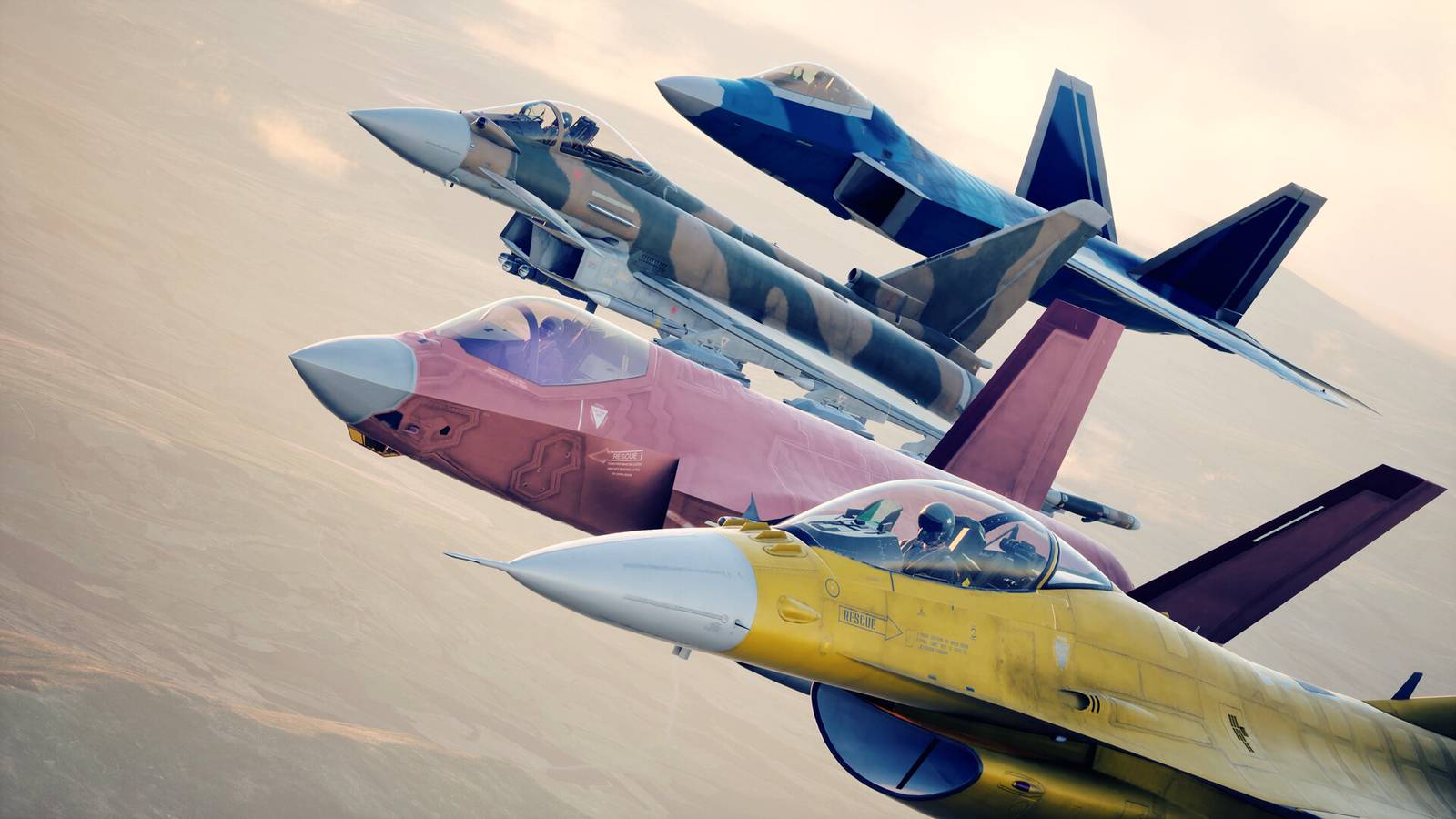
From the very first moment of Ace Combat 8: Wings of Theve, I’m enlisted in a war I can’t possibly hope to understand. Part of that is thanks to the flight combat series’ meticulously constructed fiction, but the confusion is also by design. The violent conflict between the warring continents of Sotoa and Usea isn’t supposed to make much sense, because real war rarely does. What reason does a nation have to launch an unprovoked orbital strike against a landmass on the other side of an ocean? Whose agenda are soldiers and civilians dying for? It’s easy to lose sight of those questions throughout the always-thrilling Wings of Theve. For the series’ first game in seven years, the newly formed development team at Bandai Namco Aces goes all-out for a spectacular war game filled with a diversity of aerial operations that test your flying skills every which way it can. Bombing runs against megatanks and speedy jet chases through the clouds often tempt you to stop asking what you, a pilot for the Federation of Central Usea (FCU), are fighting for. The answer is, of course, complicated. It’s hidden under layers of political deception and social media propaganda that’s gradually peeled away over the course of 30 dizzying missions. Even if some of that intrigue goes underexplored by the end of a dense story, it’s enough to make Wings of Theve a soulful epic that leaves enough room to picture a life beyond war between deadly dogfights. Getting your wings Wings of Theve’s utmost priority is polishing the Ace Combat series’ action to a reflective sheen. You’re tossed behind the yolk of various jets, each one with its own nuances to master, and sent out on a wide variety of military operations. Ace Combat’s strength is that it lies in a perfect middle ground between simulation and casual arcade action. It’s easy to pick up a controller and start soaring with your beginner-level control scheme turned on. I got my pilot wings easily in my first mission as I learned how to pepper enemy planes with machine gun fire, and get close enough to their six to fire off missiles. The complexity builds from there, but it will only feel insurmountable if you have a weak stomach. Within another mission or two, I learned how to make fast U-turns by flipping my jet parallel to the horizon and holding my control stick down to cut across the sky with grace. Later, I got the hang of carefully yawing left and right to keep a moving target in my sights. It’s a bit like learning a Forza game for the first time. As a casual player, your instinct might be to slam on the gas and never stop accelerating. With time, you naturally learn when to lay off the pedal and pump the brakes to cleanly clear corners. Wings of Theve delivers that same learning experience, pushing you to tweak your flying abilities one nuance at a time rather than overwhelming you with a whole control panel of options. Image: Bandai Namco Aces/Bandai Namco Entertainment Also reminiscent of Forza is the fact that every jet feels distinct once you nail down the movement. At first, it might feel like there’s little meaningful difference between an F-2A and an Su-33. The more I mastered flying, though, the more I could feel how a plane’s size and maneuverability completely changed my playstyle. By the 25-hour mark, I had go-to aircrafts across my arsenal of attackers, fighters, and multiroles that flew precisely the way I liked. When I tried to use a default plane gifted to you at the start of the game’s online component, it felt like I was controlling an alien spacecraft. That’s how meticulous Wings of Theve pushes you to be about your play style. It’s especially gratifying to nail down the specifics once you graduate to more involved dogfights. On a surface level, air battles only require you to let off a missile when a red lock-on target appears on an enemy plane or ground objective. Extra depth comes as you unlock different missiles and bombs through an extensive skill tree, pushing you to equip the right air-to-ground or air-to-air weapons for a specific objective. Hitting the attack button is easy, though; the real challenge is in positioning. You need to know when to fire off a missile, letting it loose at the precise moment to intercept a flight as it tries to outfly you. And on the flipside, you need to nail down your own evasive maneuvers to shrug missiles off your back, whether you’re hitting last-second loop-de-loops or escaping into the clouds to cut off an enemy’s visibility. It’s a technological flex made by people who want you to care as much about Ace Combat as they do. Those cat and mouse chases are more successful in the campaign, with its 30-minute missions, than they are in Ace Combat Online, Wings of Theve’s live-service component. I only got a chance to play online for a few hours before launch due to limited server availability, so the jury is still out on how strong the PvP and PvE play is or how reasonable the online cosmetic shop is. What I did notice in that short taste is that the multiplayer modes end in the blink of an eye. You only get a few minutes to gun down enemies in a round of Deathmatch, leaving you very little time to duel with another pilot in the same way you can in the campaign. If you get into a good, lengthy chase with an opponent, there’s a good chance you’ll waste the entire round doing so. There’s room to tweak Ace Combat Online to better play to the strengths of its flight (and to simplify its needlessly convoluted menus), but the fundamentals are strong across the board. Whether you’re an old pro or something stepping into a virtual cockpit for the first time, Wings of Theve successfully captures the nuances of flight while still keeping everything relatively approachable. Mission accomplished I imagine that the balance between casual thrills and careful navigation comes from Bandai Namco Aces’ clear love for the series. You get the sense that the developers want to welcome more players into its series rather than keep it locked away as an enthusiast audience. I can understand why when looking at Wings of Theve: It’s a technological flex made by people who want you to care as much about Ace Combat as they do. It didn’t take long for me to buy into that; Wings of Theve is a sublime sight right from its very first mission. I was astounded when I took my first flight, soaring through hyperrealistic clouds as condensation streaked across my canopy and warm sunlight glinted off my wings. Everything, down to the dense sound design and mostly smooth performance, makes it easy to forget that you’re holding a controller in your hands. My body naturally contorted to what I was seeing on screen as I caught myself involuntarily tilting my body 45 degrees every time I took a risky turn. Image: Bandai Namco Aces/Bandai Namco Entertainment What’s even more impressive is how Bandai Namco Aces works to keep that magic alive every moment you’re playing. Flight simulators, casual or hardcore, are a hard nut to crack. They can be repetitive and empty by design. How many ways can you make flying through a wide-open skybox interesting as you chase down pea-sized jets? Wings of Theve answers that question in as many ways as the developers can answer. It starts with deceptively strong level design, as detailed cloud formations and terrain make maps that are functionally the same feel entirely distinct. The team really shows its muscles in the campaign’s mission design. At 25 hours and 30 missions, Wings of Theve contains the series’ longest campaign by a country mile. Any fear I had about that length was wiped away as I started progressing through a remarkably diverse set of objectives. Within the first 15 missions, I went from protecting boats from enemy attacks as they made their way to shore, to taking down a massive plane with multiple propellers to disable, to swerving around a city to take out ground objectives while staying uncomfortably close to the ground. Not every mission in the first half of the campaign lands — a midgame chase sequence that requires you to stay very close to a speedy jet with absurdly sturdy armor is a momentum-killer — but they at least always challenge you to move in different ways. The very best missions are the ones that are best described as boss fights. In the story’s finest hour, my crew and I are tasked with taking down an enormous tank that’s rampaging through a city. I need to try to take down its weapons from a safe distance, lest I get chewed up on a risky approach, as my teammates bombed an opening in its side. The multi-stage fight had me cycling between all of my special weapons carefully, using long-range missiles to take out dangerous guns and then dropping bombs when it was safe to swoop over. All that happens as the ship crawls towards a point of no return, forcing me to nail my hairpin turns so I can get back on the attack faster each time I pass over it. That’s the level of strategic thinking Wings of Theve pushes you towards, and that’s only in one specific mission. Image: Bandai Namco Aces/Bandai Namco Entertainment That thrill starts to wear thin in the back half of the campaign, where familiar mission structures pop up again with only slight variations. The last leg of the story feels creatively stretched out, as you’re mostly left completing a gauntlet of timed high-score chases that struggle to escalate the stakes of a campaign that reaches its peak altitude far too early. More complicated missions that have you managing a battlefield on multiple fronts can be frustrating too, thanks to wingmen who hardly feel like they listen to the commands you issue them and NPCs that demand you to be in two places at the same time. Bandai Namco Aces doesn’t make the best case for supersizing the series’ historically tight campaigns, but there were enough highlights to keep my interest until the very end. That’s important, because you really need to stick with Wings of Theve to see the point of its story to the end. Fighting the misinformation machine Narratively, Wings of Theve is a lot to take in — especially if you’re new to the series. It all takes place in Strangereal, a universe that’s similar to our own but very pointedly fictionalized. All the countries are made up, and the continents have their own weird geometry that makes it hard to map any fake country onto a real one in a clean way. There are some clear parallels you can draw to real-world conflicts, but the slippery fiction abstracts the war enough to put the focus on a more high-level dissection of blind nationalism. Everything springs up from the Sotoa-Usea war of 2029. Why exactly are they fighting? Well, I never thought to ask myself that, if I’m being honest. It’s a premise that I accepted at face value as I was recruited into the FCU’s ranks and shuffled in and out of briefing rooms. Wings of Theve carefully lures you in with its rah-rah patriotism as you set out on thrilling missions with your eccentric wingmen. It’s pure Top Gun; a cornball action flick right down to the delightfully cheesy one-liners and a soundtrack of sensational jams that get your blood pumping every time the needle drops. Free sign-up Get Polygon’s Wishlister newsletter A weekly cheat sheet to what you’ll eventually love to play. No buying, no commitment — just saving for later. Sign up free Free. Unsubscribe anytime. But Wings of Theve always reminds you that you’re experiencing the story through a tightly zoomed-in lens. You play as a no-name pilot who, after getting rescued by the FCU following a crash, inherits the title of “Wings of Theve.” That’s a nickname that belongs to a legendary war hero who has become a folk icon throughout Usea — some big shoes to fill. There’s just one problem: the story is all bullshit. The Wings of Theve is a propaganda invention designed to pump up Usea’s image across social media and project hope to a hopeless nation. It’s where Strangereal skews closest to reality by riffing on the myth of Ukraine’s Ghost of Kyiv, a fabled fighter pilot whose made-up exploits helped boost morale during the Russia-Ukraine war. That story of national deception, mixed with a dash of personal imposter syndrome, keeps Wings of Theve’s at times dry war tale intriguing. The thread gets a little lost in a very busy story bogged down by dense lore, but there’s just enough to remind you that you can’t trust everything you see and hear in times of war. You always need to question what’s a fabrication, who is fabricating it, and for what purpose. One moment that’s stuck with me more than any big set piece is an unexplained shot during a cutscene of someone digitally customizing a jet by typing AI prompts into an app. Its throwaway inclusion puzzled me for much of the campaign, but now I’ve come to see it as a defining symbol: It’s a clear moment where you see reality overwritten through a phone’s camera lens. The more reality seeps out from the fiction, the more Wings of Theve pushes you to interrogate what’s really fueling tensions between Sotoa and Usea. Whether that story is successful will likely depend on your tolerance for bright-eyed optimism. Rather than wallowing in darkness, Wings of Theve wants to imagine a hopeful future. It pictures a world where social media can overcome the misinformation era, where true heroes can scope out the real bad guys, and where we may some day see an end to senseless wars (well, aside from Ace Combat Online) between people that have more in common than they think. It’s a little over-the-top, edging into “We Are The World” territory by the conclusion. And that certainly can ring hollow in a game where the very first thing you see is a Lockheed Martin logo thanks to licensing deals, one of a few moments of cognitive dissonance, given where the story goes. Maybe at another time, I would have been quick to chastise Wings of Theve for its lack of bite. I’m sure some will rightfully question if a series that makes dogfighting and military operations look as cool as possible can offer any sincere wisdom. But at this moment, where despair is in high supply, I find myself willing to embrace Wings of Theve’s radical optimism. I want to believe in its conviction that our skies should not be battlefields, but a place of boundless freedom that welcomes all. Maybe there’s hope that one day Ace Combat could exist as a historical fantasy that feels as distant as Chivalry 2 does to medieval warfare. I know I won’t live to see that day, but I will keep flying towards the horizon until my engines give out. Ace Combat 8: Wings of Theve will be released Oct. 2 on PlayStation 5, Windows PC, and Xbox Series X. The game was reviewed on PS5 using a prerelease download code provided by Bandai Namco. You can find additional information about Polygon’s ethics policy here.
Ace Combat 8 Is a Triumphant Return for One of Gaming’s Best Series
Full Article
Original Source
Read the full article at Polygon →KhanList aggregates and links to publicly available news content. We do not host full articles from third-party sources. Always verify important information with original sources.