
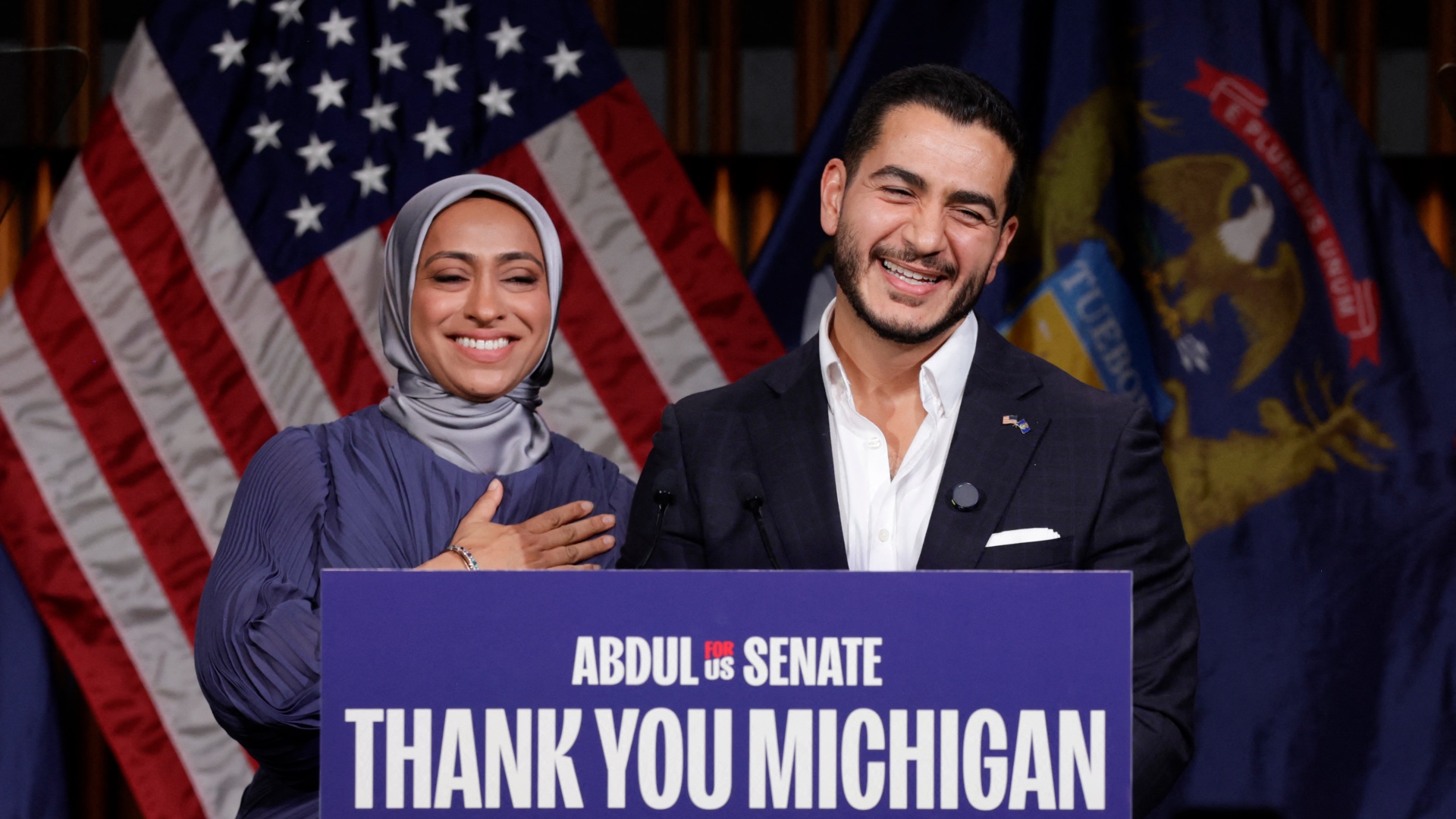
As a Palestinian American human rights activist, I have spent much of my life working to bring internationals to Palestine to witness first-hand what is happening, and to support Palestinian popular resistance to Israel's criminal occupation and apartheid. Palestinians have always given those who come to stand with them the same message: "Thank you for being here with us. But go back to your country, tell people what you saw, and change the policies of your governments that enable and sustain Israel's violence." On 3 November, Michigan elected Dr Abdul El-Sayed to the US Senate, defeating Mike Rogers by a comfortable margin of 52 to 46 percent. He has made history as the first Muslim American to be elected to the Senate, and only the sixth Arab American to win a seat in that chamber. El-Sayed's victory was part of a blue tidal wave that swept Democrats into control of both houses of Congress. New MEE newsletter: Jerusalem Dispatch Sign up to get the latest insights and analysis on Israel-Palestine, alongside Turkey Unpacked and other MEE newsletters These midterm elections, and the Republican losses they delivered, are consequential for restoring some measure of accountability and putting a check on the Trump administration's reign of terror. Among other things, the new Congress will have the opportunity, and the responsibility, to bring an end to the disastrous, illegal war on Iran. The war has killed thousands of Iranians and at least 23 American service members, while wreaking havoc on the economies of the US and countries around the world. Democrats must also use their new majority to rein in Immigration and Customs Enforcement (ICE), pursue legislation to dismantle the agency's enforcement apparatus and hold officials accountable for its abuses, unlawful arrests, deaths in custody and violations of constitutional rights. But Abdul's win was more than just another win for a Democrat. It carries enormous political and social significance for Michigan, the country and the world. It showed that rejecting the Israel lobby and being unapologetically pro-Palestine is not a liability in a midwestern swing state. Not only is it not a liability, but it is arguably what secured Abdul's victory. Abdul's refusal to capitulate to the political pressures and intimidation tactics that have silenced so many elected officials and candidates distinguished him from the political establishment and became a defining strength of his campaign. Without this position, and the excitement it generated, I am confident that Abdul would not have defeated Congresswoman Haley Stevens, whom Aipac backed with more than $30m, in the Democratic primary. Stevens went on to endorse Rogers days before the general election. The recognition test Significantly, El-Sayed was repeatedly pressed to affirm Israel's "right to exist", a question that has long functioned as a political rite of passage for American politicians, particularly Democrats. The expectation is not only that candidates recognise Israel as a country that exists, but that they affirm its legitimacy, including its identity as a Jewish state. Abdul challenged the absurdity of the media's fixation on that issue and the glaring double standard underlying it. He pointed out that politicians are never asked whether Palestine has a right to exist, or whether Palestinians have a right to self-determination. Palestinians have the right to live freely, equally and securely in their homeland. That right is not negotiable In September, a group of Michigan rabbis, cantors and Jewish community leaders launched the "Nonnegotiable Michigan" campaign, backed by the Zioness Action Fund. It called on Democratic candidates and party leaders to affirm five principles, including Jewish safety, the right of Jews to define their own identities, Jewish sovereignty in Israel, and "an affirmative vision" for the Middle East. In effect, it was an effort by frustrated Zionists to portray their Israel-first political agenda as a broader expression of Jewish voters' concerns about safety and identity, and to make adherence to that agenda a test of acceptability for Democratic candidates. There is, of course, nothing wrong with Jewish Americans insisting that their safety, dignity and participation in political life be respected. Those commitments should be non-negotiable, and Abdul repeatedly affirmed that they are. However, nothing he said, or could have said, would satisfy those determined to conflate anti-Zionism with antisemitism in order to shield Israel's settler-colonial project from criticism and accountability. As we continue working to change US policy and end American support for Israel's decades-long assault on the existence, rights and freedom of the Palestinian people, this question will remain central. The only acceptable answer is: No, Israel does not have a right to exist as a violent, settler-colonial, apartheid state that denies Palestinians their basic human rights and commits mass atrocities to maintain its domination over Palestinian land and lives. No state has such a right. Palestinians have the right to live freely, equally and securely in their homeland. That right is not negotiable. Fear and prejudice A victory for Abdul was also vital in confronting anti-Muslim and anti-Arab bigotry, which reared its ugly head in brazen ways throughout this campaign. For months, Rogers and his allies sought to make Abdul's Arab and Muslim identity a political liability. They accused him of having ties to Hezbollah, Hamas and the Muslim Brotherhood, insinuated that he supported the 9/11 attacks, and invoked the familiar Islamophobic spectre of a candidate who supposedly wanted to impose "sharia law" on the US. US elections: Republicans are betting on Islamophobia to win the midterms Read More » These attacks had no basis in reality. They were deliberate efforts to cast Abdul as foreign, dangerous and un-American. I found it sad and frustrating that Abdul, his campaign and his supporters kept having to reiterate that he was born in Michigan and was as "American as apple pie". This kind of othering is not new. Sadly, it has long been a feature of mainstream American culture, reinforced through political rhetoric, popular media, entertainment and public discourse. Arabs and Muslims have routinely been portrayed as violent, backward, fanatical and inherently hostile to western values. That portrayal has served a political purpose: to dehumanise entire populations and make foreign wars for oil palatable by creating a convenient enemy against which an idealised American identity can be defined. The promotion of a supposedly shared Judeo-Christian culture has also helped cement a political alliance with Israel, presenting support for the Israeli state as a natural expression of western and American identity, while casting Palestinians and other Arabs and Muslims as outsiders who threaten that identity. This, in turn, has served Israel's efforts to portray itself as the perpetual victim of irrational Arab and Muslim violence, fighting to defend shared liberal values. 'The bad guys lost' In the words of Senator-elect El-Sayed, "the bad guys lost". Michigan voters rejected a campaign built on fear and prejudice, but we cannot mistake that victory for having defeated the hatred behind it. On election day, while wearing my "Women for Abdul" shirt and handing out campaign literature outside a polling station in Macomb County, I was confronted by a middle-aged white man leaving in his car. "Why are you supporting that Muslim terrorist? Do you support little girls being raped? We don't want sharia law here," he shouted. He had presumably already voted, so I was not going to win a vote for Abdul, but I nevertheless considered it important to confront his misguided, hateful rhetoric. I turned to him and asked why he would make such blatantly bigoted, anti-Muslim statements, and we talked for about 10 minutes. He eventually drove off, but not before thanking me and flashing a heart sign with his fingers. I have no idea whether I changed his mind, but the encounter was a reminder of how deeply ingrained these prejudices remain, and how important it is to challenge them whenever and wherever they surface. Michigan voters saw through these attacks, but the people who made them have not gone away. The president who called Abdul a "jihadist" and wanted him to pass through a metal detector, and the vice president who called him a "psychopath", will both still be in office in January. The work of confronting the hatred, bigotry and othering directed at Arab and Muslim communities must continue, and I hope that Abdul's victory and his service will buttress those efforts. For now, Abdul's election sends an important message to a generation of young people in Dearborn, Hamtramck, Detroit and across the country: that they belong, and that they can aspire to the highest levels of public service without hiding or apologising for who they are. The 'unelectable' excuse For me, it was also essential that El-Sayed win because his victory would deliver a serious blow to the "unelectable" excuse that establishment Democrats have long used to sideline progressive candidates, protect the status quo and justify their unwillingness to live up to their own rhetoric. The argument against Abdul during the primary was that he could not win a general election because he was too progressive for a purple state like Michigan. Challenging the Israel lobby and ending US complicity in Israel's abuses is fine in theory, but not when doing so risks upsetting powerful political interests That argument conveniently ignored Michigan's own recent political history. In 2016, Bernie Sanders defeated Hillary Clinton in the state's Democratic presidential primary, demonstrating a strong appetite for a more progressive politics. The reason we lost the state and the country to Trump twice had less to do with voters embracing a conservative agenda than with frustration with, and rejection of, establishment Democrats. The problem was never electability. It was that truly progressive politics challenge the interests and assumptions of those who have too much influence over the Democratic Party. Medicare for All is fine in theory, but not now. Getting corporate money out of politics is fine in theory, but not when it threatens the donors who bankroll campaigns. Challenging the Israel lobby and ending US complicity in Israel's abuses is fine in theory, but not when doing so risks upsetting powerful political interests. In other words: we agree with you in principle, but we cannot afford to act on those principles if we want to win. This has become a self-fulfilling excuse for abandoning the very policies that could energise voters and build a broader political movement. The lesson of 2024 The 2024 presidential election is a telling example. A poll by the Institute for Middle East Understanding and YouGov found that for every vote Kamala Harris might lose by supporting an arms embargo on Israel, she would gain five to seven. The organisation brought those findings to the Democratic National Convention in Chicago and delivered them to the Harris campaign. They were ignored. 'Despicable betrayal': Haley Stevens endorses Republican candidate over party nominee Abdul El-Sayed Read More » Democratic leaders chose to protect an existing policy and appease powerful interests rather than respond to the electorate. The consequences extend beyond one issue or one election, deepening the alienation of voters who have repeatedly been told that their concerns and values mattered, only to discover that they mattered less than the demands of major donors and political insiders. El-Sayed's victory does not guarantee the changes we need, but it expands what is politically possible. I wholeheartedly supported him, not because I agree with everything he has done, but because I believe he will carry these fights into the Senate. I return to the message Palestinians have given us for decades: go home and change your government's policies. I have spent most of my adult life trying to do that from the outside, in the streets and in the courtroom. We also have to be in the halls of power. Abdul's election gives us another important voice on the inside - and strengthens the movement working to turn our demands for justice into meaningful political change. The views expressed in this article belong to the author and do not necessarily reflect the editorial policy of Middle East Eye.
Abdul El-Sayed's victory proves supporting Palestine is no electoral liability
Full Article
Original Source
Read the full article at Middleeasteye →KhanList aggregates and links to publicly available news content. We do not host full articles from third-party sources. Always verify important information with original sources.