
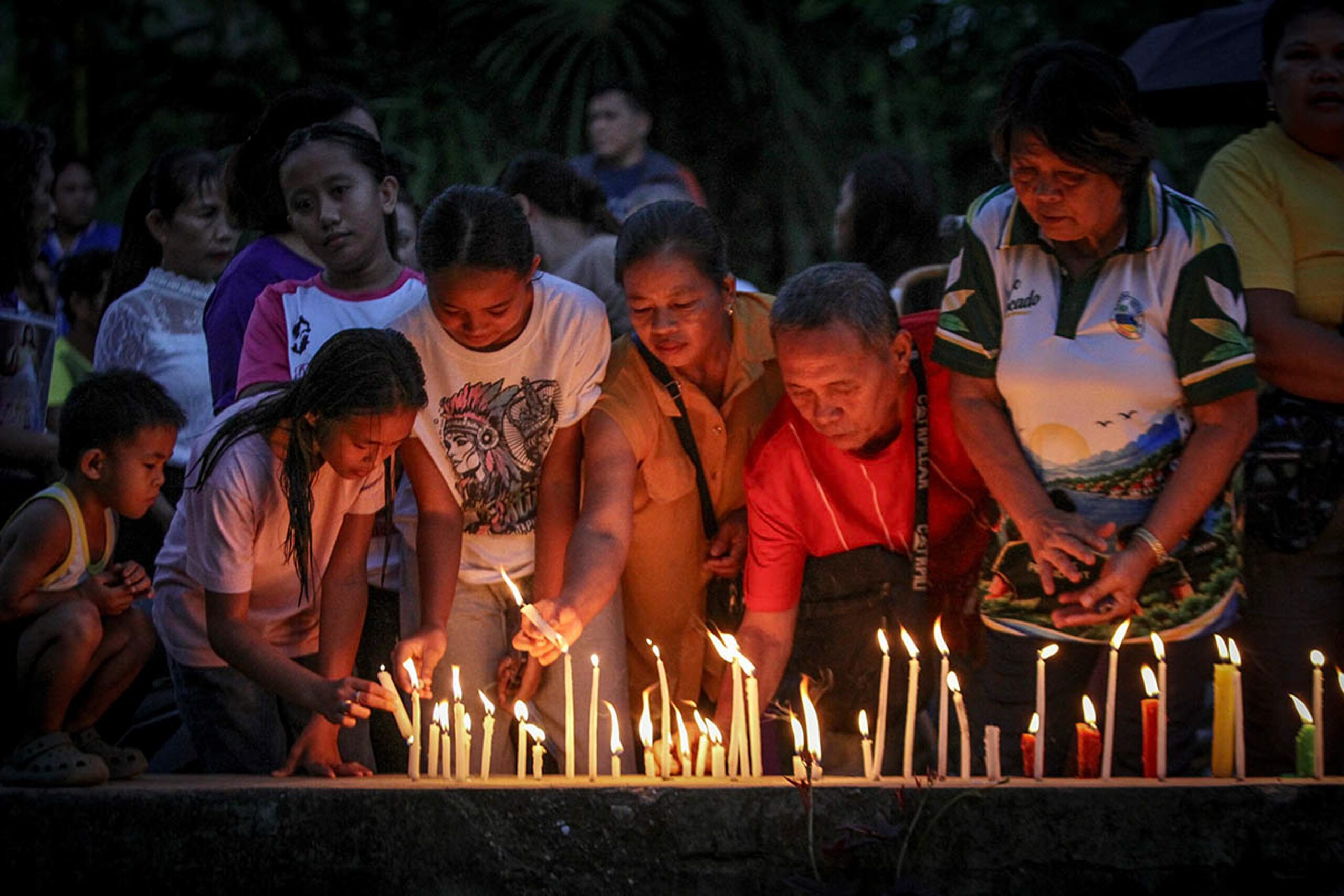
Gina Paumba, a resident of Talisay City, lost her home and over 20 years of her family's life due to Typhoon Tino, which caused significant flooding and destruction in Cebu. The provincial government is working on recovery efforts, including rebuilding infrastructure and providing financial assistance to affected families, but challenges remain in housing displaced residents. On the first anniversary of the disaster, survivors commemorated the event with a protest highlighting ongoing issues of government neglect and the need for justice for the victims. This is AI-generated. Read the article for full context. Report any errors. CEBU, Philippines – Talisay City resident Gina Paumba wakes up every morning to a reminder of all that Typhoon Tino (Kalmaegi) took from her. More than 20 years of her life on land her family owned, including 7 years of building a home she would have passed down to her grandchildren, were lost overnight on November 4, 2025. “Gikan sa 2005 katong naabot mi diri, kato pa ko kasugat og tubig nga gikan didto abot dinha. Mao to ang pinakakuyaw nga baha nga among nasaksi,” Paumba told Rappler on Tuesday, November 3. (Since we arrived here in 2005, that was the only time we saw the water reach here and there. That was the most dangerous flood we’ve ever witnessed.) As early as the afternoon of November 3, 2025, Paumba’s family, along with their neighbors in Sitio Bogo, Camp 4, Talisay City, were already advised to head for evacuation centers. Paumba’s home was located on the edge of the sitio along the upper part of the Mananga River. When the river began to swell, they were the first in their neighborhood to know. Her family didn’t sleep on the eve of November 3—not because the howling winds made the shanties in their neighborhood collapse one after the other—but because all their belongings would be gone if they hadn’t kept watch of their house. They had not yet retreated to the Camp 4 Elementary School. It was only when the ground below their house finally caved in that they evacuated. “Nagdako akong mga anak ana dihang balaya (My children grew up in that house),” Paumba shared. WHAT’S LEFT. Gina Paumba looks at the ruins of her old home found near the Mananga River in Talisay City, Cebu, on November 3, 2026. She and her family now live in a makeshift house, built from a mixture of scrap materials and other supplies provided through government assistance and donations. They were able to get housing aid worth P10,000 from the National Housing Authority, P8,000 cash aid from the Talisay City government, and a P5,000 donation from a private foundation. Paumba said she was very thankful for the help yet could not help but be bothered by how much Tino’s damage cost their family. For a family of 10 who work primarily as rag makers earning P12 per rag, what they make now will never be enough to cover what they lost, Paumba lamented. The Paumbas are only one out of 157,000 families in Cebu who lost their homes to the floods caused by Tino’s downpour. Recovering what was lost Data from the Cebu provincial government show that the typhoon left 143 fatalities with 45 people counted as missing. Around 160,000 houses, 22 bridges, and 28 roads were damaged. Cebu Provincial Planning and Development Officer Elizar Sabinay Jr. told Rappler in an interview that the province has gradually recovered, specifically on rebuilding public infrastructures. “We’re diverting our attention now to supporting infrastructures such as roads. It’s where the province has direct control,” Sabinay said. Schools, according to the planning officer, are among the top priorities for rebuilding because the school buildings also serve as evacuation centers. Data from the Department of Education show that at least 1,022 schools were damaged by Tino. Sabinay shared that the province is looking into developing existing schools into “smart classrooms” that utilize solar-powered systems and have their own water catchment infrastructure. The recurring challenge, Sabinay stressed, is how the province will house the remaining displaced residents. Multiple considerations like the recovery of flood plains and river easements, urban congestion and distance/access to social services limit where local governments can establish new resettlements, he said. STILL REBUILDING. A year after Typhoon Tino, residents in Barangay Cotcot, Liloan, postpone civil works for a solemn Mass commemorating the first anniversary of the disaster, on November 4, 2026 “The province’s role now is to secure the commitments from the national department secretaries… the whole cost of the damage is [massive] but the release of funding is still [only] 10% from the commitments,” the planning officer said. For a full recovery, the province would need at least P11 billion for roads and bridges, slope protection structures, health centers and schools. According to the Cebu Provincial Disaster Risk Reduction and Management Office (PDRRMO), the province has provided around P21.98 million worth of food and non-food items to affected communities, and allocated P142.25 million for financial assistance for more than 14,000 displaced families. At present, the provincial government is funneling P206.6 million for infrastructure projects in heavily affected areas in the towns of Compostela and Balamban, which reported a high casualty count. ‘What we do is our responsibility’ Reflecting on the pain brought by the typhoon, families in Cebu commemorated the first anniversary of the disaster with an early morning penitential walk in the neighboring towns of Liloan and Compostela. The quiet celebration was followed by a 10 am protest in in front of the Department of Public Works and Highways (DPWH) Cebu City District Engineering Office, where activists and bereaved families placed small wooden crosses symbolizing lives lost over alleged government neglect and corruption. “Wala gihapon makab-ot ang hustisya para sa mga biktima sa Bagyong Tino (Justice has not yet been delivered for the victims of Typhoon Tino),” Jaime Paglinawan, coordinator of BAYAN Central Visayas, told reporters during the protest. GRIEF. On the first anniversary of Typhoon Tino’s devastation, survivors plant small wooden crosses symbolizing lives lost over allegations of government neglect and corruption, in a protest in front of the DPWH Cebu City District Engineering Office in Cebu City on November 4, 2026. Paglinawan stressed that many public officials linked to the flood control scandal still don’t have cases filed against them, while thousands of displaced families have to deal with cash assistance barely enough to compensate for what they lost to the disaster. “What hurts most is that the poor are blamed for the floods, as if they are dumping all the garbage and living along the banks of rivers, and that they deserve to be displaced,” Paglinawan said in Cebuano. “The real issue is being covered up, which is that our mountains are being quarried, development is taking place in the uplands, our drainage system is a failure, and the funds are being corrupted,” he added. In the end, for Tino survivors like Paumba, recovery will be a slow and painful process—one that will probably take more years of hardships and suffering, and perhaps, more days of waking up to what she had lost. And yet, despite all that was lost, Paumba said, she’s glad she has her family with her so she doesn’t have to do it alone. – Rappler.com
A year after Tino: Cebu survivors strive to reclaim all they lost
Full Article
Original Source
Read the full article at Rappler →KhanList aggregates and links to publicly available news content. We do not host full articles from third-party sources. Always verify important information with original sources.