
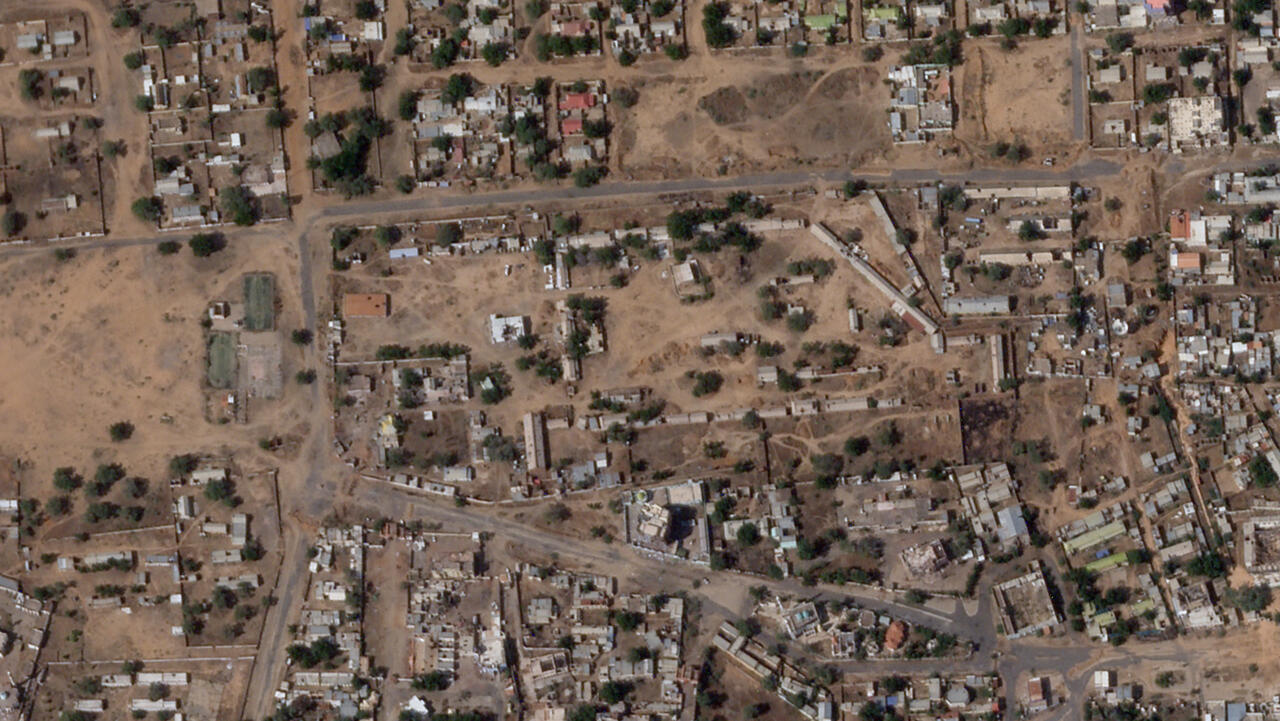
A year after paramilitary forces at war with the Sudanese army captured the strategic city of El Fasher, survivors and aid workers report that the capital of North Darfur state remains largely abandoned. Some residents are too scared to return, while thousands are still missing – many held in deplorable conditions in overcrowded prisons. On 26 October, 2025, after 500 days of siege, El Fasher fell to the Rapid Support Forces (RSF), an armed group that has been fighting Sudan's army since April 2023. It marked one of the darkest chapters of the conflict. The paramilitaries pledged to "cleanse" the city and explicitly called for the elimination of non-Arab communities – notably the semi-nomadic Zaghawa and the Fur, Darfur's largest ethnic group. International investigators have found evidence of widespread atrocities, including mass killings and sexual violence. The United Nations has estimated that some 6,000 people were killed, but researchers studying satellite imagery suspect the death toll is much higher – in the tens of thousands. According to the International Organisation for Migration (IOM), nearly 100,000 people managed to flee. Thousands more civilians are missing, having died while trying to escape or been captured by the RSF. In January, under the supervision of the city's new authorities, humanitarian organisations were able to visit El Fasher for the first time since the paramilitaries seized control. They described "a ghost town, with few civilians remaining". Contested repopulation "My house was destroyed," says Salwa, who did not want to be identified by her full name. Born in El Fasher, she fled a few days before the city fell. "They smashed everything and threw all our things into the street. My father's house is still standing, but they've put people we don't know in it." Like many residents who fled, she believes the new authorities are seeking to replace the city's original inhabitants – mainly Zaghawa and Fur – with members of nomadic Arab tribes, from which the RSF draws its leadership and most of its fighters. Sudan's RSF paramilitaries accused of crimes against humanity in El Fasher A screengrab from a video shared on the Rapid Support Forces' social media shows RSF fighters celebrating in the streets of El Fasher after capturing the city on 26 October, 2025. © AFP - - "They're bringing in people from outside and giving them our homes. They're even giving them documents to prove they're the owners. These people will never leave. On top of that, they're filming them for propaganda and claiming that the residents of El Fasher have returned." Tasis, a coalition of civilian and armed groups led by the RSF and governing in parallel from the city of Nyala in South Darfur, has called for displaced residents to go back to El Fasher and says it is helping civilians to return. "These aren't residents of El Fasher, but people who were brought in to repopulate the city," Salwa protests. Lingering trauma Solidarités International, a French humanitarian organisation that has returned to work in El Fasher, estimates that between 40,000 and 60,000 people have either returned or come and go regularly, out of a pre-war population of at least 300,000. "They come to seek aid, to see their neighbourhood, their home. They've heard that an NGO is here, that the paramilitary-linked government's humanitarian aid office is organising food distributions," Renaud Douci, the organisation's field coordinator in Sudan, told RFI. But returnees are often put off by what they find, he said. "When the market where you used to get food is now a meagre affair with a few stalls and exorbitant prices, those aren't conditions under which you can return with your family." Others are kept away by the memory of the siege. "For now, because of the trauma and violence of those 500 days, people don't feel at all ready to return," Douci said. Women victims of Sudan's war bear scars of 'indescribable' violence A displaced woman in Tawila, Darfur, pictured on 28 October, 2025, after fleeing El Fasher following the city's fall to the Rapid Support Forces. © AFP Laura Mills, a researcher at Amnesty International, shares his assessment. "Only a fraction of the population has returned; people are too afraid," she told RFI. "Humanitarian workers tell us there are pockets of houses still standing. And between each pocket, the streets are deserted. The city is still abandoned." For her, the hesitation is understandable. "The residents of El Fasher are traumatised by what they've been through. Why would they return when the paramilitaries are still there and have never been held accountable for their actions? Why return when you risk being arrested and tortured at any moment?" Prison of horror The RSF took thousands of people prisoner during the capture of El Fasher: not only members of the armed forces but civilians – soldiers' families, teachers, doctors, journalists, civil society activists and others they accused of supporting the Sudanese army. Ibrahim (not his real name), a journalist with El Fasher Radio and Television, was taken by the paramilitaries a few weeks before the city fell, according to his wife, who wanted to remain anonymous. "One morning he went out to look for food, because at the time there was nothing left to eat. He left in the morning and didn't come back that evening or the next day," she told RFI. A Sudanese man who says he was imprisoned and tortured in RSF prisons before fleeing El Fasher sits in a makeshift shelter in the town of Tawila in the Darfur region, 2 March 2026. © AFP - - His wife believed he was wounded or dead until she learned that he had been captured by the RSF and sent to Dagris, a notorious prison outside Nyala that has been described as a "site of horror". "The conditions were terrible," she said. "The detainees were crammed into small cells. Sometimes they would go entire weeks without seeing the sun. Occasionally, they'd be taken outside so they could air their belongings, dry their clothes and get rid of insects and fleas. And their toilets were right inside the cells. The sanitary conditions there are disgusting." Sick, emaciated and having lost his sight in one eye, Ibrahim was finally released nine months later upon payment of $2,000. Numerous accounts report demands for ransom are common. US has 'alienated' Sudan's army in 'complex war', analyst tells RFI 'They took my family' According to human rights organisations, between 13,000 and 19,500 people were being held at Dagris earlier this year – several times the prison's official capacity of 4,500. Zamzam, a journalist originally from the El Fasher region who now lives in exile, says her relatives were among them, arrested as punishment for her coverage of the conflict. "The RSF contacted me to tell me to stop writing, they even offered me money. But I refused, so they took my family," she told RFI. Her cousin, a doctor at a hospital in El Fasher who chose to stay throughout the offensive, remains incommunicado. Zamzam has heard only that he is working in construction. "They use prisoners as labourers in construction, to do laundry, to clean the homes of RSF fighters' families," she claimed. Sudan’s war reshapes loyalties as civilians see ‘no option’ but the army Conditions at Dagris prison are inhumane and in some cases life-threatening, according to Mohamed Faisal, a member of the Sudan Doctors Network. "The detainees have no rights and no contact with their families," he said. "The cells are overcrowded. There are lots of diseases, such as cholera and dengue fever, and we are seeing a sharp rise in mortality. A few months ago, there were four deaths every week. And when prisoners die, their families aren't even notified." An estimated 73 medical personnel are being held in Dagris and Kober, another prison in South Darfur, the network believes. Several journalists are also detained, including Muammar Ibrahim, a correspondent for Al Jazeera's Arabic news channel who had been covering the conflict since it began in April 2023. Today, Darfur is almost entirely under the control of the paramilitary forces. The fighting has shifted to the Kordofan region, where the UN has warned El Fasher's grim history could be repeated. This article was adapted from the original version in French by Alexandra Brangeon.
A year after the fall of El Fasher, Sudan's war has left a ghost town in its wake
Full Article
Original Source
Read the full article at Rfi →KhanList aggregates and links to publicly available news content. We do not host full articles from third-party sources. Always verify important information with original sources.