
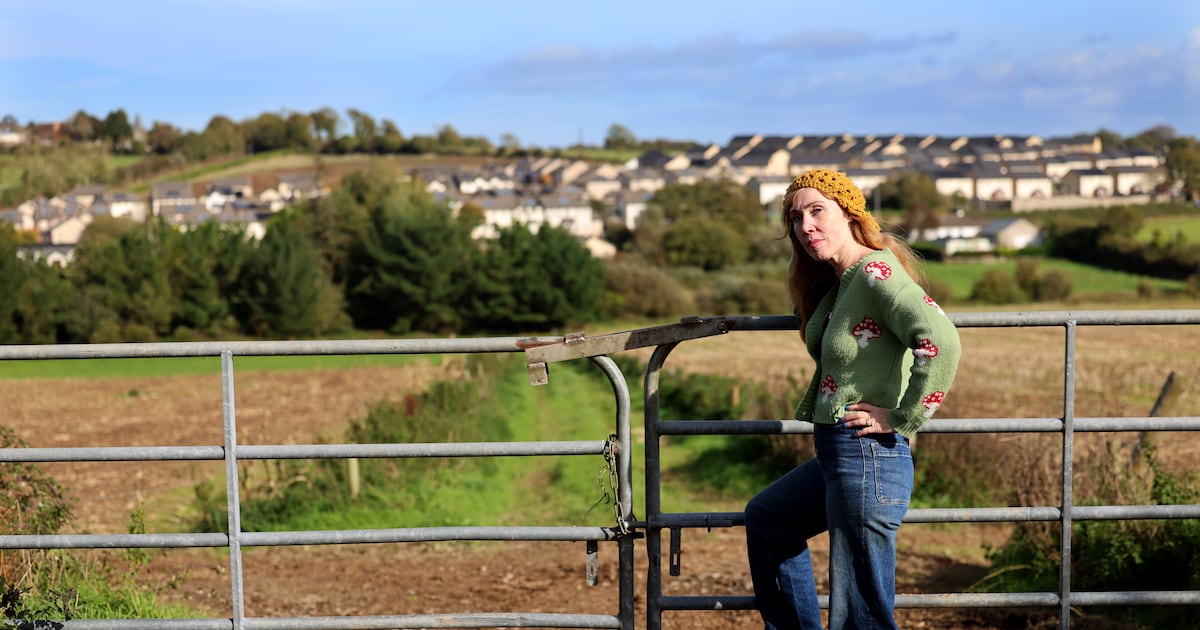
Behind the shrubbery at the foot of Danny Brennan’s garden, a small stream reveals itself, crossable via a thick branch that the 87-year-old uses as a bridge when he walks his dog.Ducking under an electrical wire on the other side, Brennan points to the rolling hills surrounding the defunct cheese factory in Kilmeaden, Co Waterford, which closed in 2005. Now, a 108-hectare data centre campus is proposed for development on the site.“I think they should never have been brought here,” Brennan says of the plans. “This is agricultural land and they’re claiming that it’s suitable for development [as] industrial land … For the last 50 years that I’ve lived here, this has been cows on it most of the time, the dairy cattle, for milk for the cheese factory.”“I don’t know anybody that really wants it, maybe one or two people might have said that it’ll give a lot of employment,” Brennan says. “But it’s not going to give employment, because [as with] other places where they have installed them – it’s kind of self-maintained.”READ MOREIt is hard to miss Brennan’s house on the drive through Kilmeaden, where he has lived with his wife Eithne since 1960. Pinned to the gates outside its pink walls is a large placard that reads “Stop industrial Kilmeaden”. The sign refers to “three data centres, 16 gas-powered turbines, 43,056 PV solar panels” alongside the message “Say NO!”.These are part of the infrastructure laid out in a planning proposal submitted to Waterford City and County Council in September of last year. Also mentioned is a “village centre” with a gym, cafe, health centre, pharmacy and office space. The application was submitted by a subsidiary of Irish company Echelon Data Centres, and a local property developer, Kent Homes.A spokesperson for Echelon Data Centres said, in a statement, that the company was “committed to delivering digital infrastructure responsibly and sustainably”.“All our facilities are designed and developed in line with regulatory guidelines and in consultation with community representatives,” the statement continued. “They create jobs, support the national grid, help bring large-scale renewables on stream, and drive economic activity in communities throughout Ireland.“A planning submission for a technology park on a brownfield site in Kilmeaden, alongside new residential housing and community amenities in the village, is still under consideration by Waterford City and County Council. It would not be appropriate for us to discuss the application further at this stage.”Eithne and Danny Brennan, with their dog Jen. Photograph: Dara Mac Dónaill / The Irish Times Data centres have been in Ireland since the 1990s, growing in significance since the advent of smartphone technology over the past two decades. As of June of this year, Dublin-based data consultancy Bitpower estimates, there are 109 operational data centres in the country, with eight more facilities under construction and a further 51 having received planning approval. Data centres are synonymous with “the cloud”, a global network of remote servers that store, manage and process data on the internet so that personal devices do not have to. They are large, physical facilities housing racks of servers, networked computers and other data storage infrastructure.Essentially, everything done online involves an interaction with a data centre, from streaming music and TV to reading this article. The servers themselves require a vast amount of electricity to run, as do cooling systems required to keep them operational. Ireland’s temperate climate is one of the factors that make it an attractive location.Kilmeaden is a small, rural village with a population of 334 according to the last census, though a couple of housing developments in recent years, built by Kent Homes, have added to that total. Several thousand people reside in the surrounding area.“You could look at it as a satellite village for Waterford,” says Mary Sue Connolly, who grew up on a family farm in Kilmeaden, “but it’s far enough away that’s it’s still rural. People have moved out of Waterford, people who don’t want to live in an urban environment, to Kilmeaden to get away from the city life.”Local resident Mary Sue Connolly at the proposed site of data centre in Kilmeaden, Co Waterford. Photograph: Dara Mac Dónaill/The Irish Times Connolly spent 20 years living in New York before returning to the village. She is a central figure in the Kilmeaden Against Industrialisation campaign, which is driven by a core group of seven or eight people. She cites the new houses as evidence that “this is not Nimby (Not In My Back Yard) territory”, and insists locals have no problem with new infrastructure in general. Connolly says no one objected to the new housing developments.On a local level, noise, emissions, light pollution, strain on water services and depreciation of house value are among the concerns voiced by opponents to the data centre campus.[ How Ireland feels about data-centre construction revealed in new Irish Times pollOpens in new window ]Another member of the campaign group, Jane O’Brien, was raised by her grandparents, who live on a road that bisects the land proposed for development. A dozen or so houses are dotted along the road, and a number of its residents are in their 80s.“I get emotional [because] it means a huge amount to me,” O’Brien says. “I would love to say I would be in a position to buy that house [in the future] and raise my kids there, where I’ve had such amazing memories. But who wants to live beside that? I can’t.”Both she and Connolly are concerned about national implications too. According to the Central Statistics Office, data centres accounted for 23 per cent of total metered electricity consumption in Ireland in 2025, up from just 5 per cent in 2015. Projections for 2035 suggest data centres “and other new technical loads” will account for a median level of about 35 per cent of all the electricity demand in the State, the Oireachtas was told last month by Jim Gannon, the commissioner for the regulation of utilities.Mary Sue Connolly and Jane O'Brien, Kilmeaden residents opposed to a proposed building of data centre’s in Kilmeaden village, Co. Waterford. Photograph: Dara Mac Dónaill / The Irish Times “Everybody is struggling right now across the country to pay their electricity bill, to live, to survive,” O’Brien says. “You’re looking at data centres that are paying half the rate that we are for electricity as a population, which is a farce when all they’re doing is making big profits.”Speaking in Washington last year, Taoiseach Micheál Martin said what he described as the “demonisation of data centres” needed to end if Ireland was to be able to keep up in the tech and artificial intelligence (AI) sector. “We do need to step up. We can’t just postpone AI ... We can’t declare a moratorium on AI. We’d be left well behind if we do that.”[ Garry Connolly, the man lobbying for data centres in Ireland: ‘Disparaging them means you’re effectively demonising the big tax takes’Opens in new window ]The United States has seen a continuing wave of protests against data centres, with what broadcaster-turned-entrepreneur Mark Little described as “the biggest wave of civic activism I’ve seen possibly since the 1960s” in a recent interview with The Irish Times. On a Saturday in mid-July, opponents to the facilities held 142 protests across 42 US states. There, about 6 per cent of the national electricity supply is devoted to data centres, according to the 2026 Global Data Center Report, compared with Ireland’s 23 per cent.Minister for Enterprise, Tourism and Employment Peter Burke, following the publication in June of a Government-commissioned KPMG report called The Value of Data Centres to Ireland, said it provided “clear evidence of the critical contribution that data centres make to the Irish economy”. A recent study carried out by academics in Maynooth University (MU), University College Dublin (UCD), and Universitat Autònoma de Barcelona (UAB) suggested the economic benefits of Ireland’s data centre sector had been exaggerated.Researchers said the KPMG report’s claim that data centres underpinned more than 876,000 jobs in Ireland was “based on spurious methodology”. As the original report itself noted, only 3,300 people were directly employed by data centres in Ireland in 2024.The Department of Enterprise, Tourism and Employment this week defended the report, saying it was independently prepared by KPMG and that its methodology, assumptions and findings were published in full and available for scrutiny and debate. “Like any piece of research, its conclusions may be challenged and discussed, and the Department welcomes academic engagement on these issues.”The Department said the academics’ report “focuses primarily on the direct economic activity associated with the operation of data centres and takes a more limited view of the wider economic activity that can be attributed to data centres.“The KPMG report, by contrast, considered both the direct economic contribution of data centres and their role as critical digital infrastructure supporting wider economic activity and Ireland’s attractiveness as a location for investment.”Under the Commission for the Regulation of Utilities (CRU) connection policy, new data centres in Ireland must meet at least 80 per cent of their annual electricity demand with renewable energy within six years.A technical response to the planning application for the Kilmeadan data centre campus was carried out by engineering consultant Homan O’Brien. It found that the anticipated annual electricity demand associated with the development was approximately 1,781GWh. A proposed solar farm on the site, it added, would generate approximately 35.7GWh.Essentially, although more than 43,000 solar panels are planned for the Kilmeaden site, their output would constitute just 2 per cent of its annual electricity demand. The expectation is that Tonn Nua, a large, offshore wind farm set to be developed 12km off the Waterford coast, will prop up the data centre’s energy requirements down the line.[ ‘No stopping it’: Noise from Dublin data centre causing ‘a lot of annoyance’ for residentsOpens in new window ]When he defended data centres in Washington last year, the Taoiseach also acknowledged the facilities could contribute to climate problems because they consumed a large amount of energy. But he added that Ireland would be able to produce more climate-friendly energy, through offshore wind, in the coming years. Back in Kilmeaden, Connolly describes the proposed solar farm as “tokenism”. An environmental group, Friends of the Irish Environment, has said “fundamental questions” around the development of the data centre were yet to be answered. In particular, they pointed to a lack of clarity about how the remaining 98 per cent of the development’s electricity demands would be met. “This is an enormous new electricity demand,” said the group’s director, Tony Lowes. “The applicant’s own figures show that 98 per cent of its power would have to come from elsewhere. Yet the response still relies on future grid connections, future renewable contracts and future electricity-system decarbonisation rather than secured and assessable measures.”Danny Brennan in his back garden, which meets the perimeter of the proposed site of a data centre in Kilmeaden, Co Meath. Photograph: Dara Mac Dónaill/The Irish Times Signs such as the one outside Danny Brennan’s house are commonplace throughout Kilmeaden. More than 500 submissions have been made in relation to the planning application in the village over the past year and Waterford City and County Council is due to make a decision on the development by Monday, October 19th.In Killala, Co Mayo, author Sally Rooney was among a cohort of successful objectors to a proposed data centre earlier this year. Planning permission for the development was overturned in September on the grounds that it breached national climate policy.Rooney, who lives in Mayo and has written bestselling books such as Normal People and Conversations with Friends, argued the data centre would be a wasteful use of electricity whose generation would require burning of fossil fuels. Jane O’Brien says there is a greater volume of support for the protests in Kilmeaden than there was in Killala.“We’re praying and hoping the council will listen to us, but it’s hard when you’re looking farther up the ladder and you see Government policies at the moment,” she says. “You’re looking at a country that’s already been sold out to big tech for profits.”She references a separate report by the social policy think tank Tasc from April of this year, which said that nearly 90 per cent of data centres in Dublin were located in economically deprived areas.“Now, the pressure is on because Dublin isn’t able to cope with the amount of them,” O’Brien says. “If it comes to our rural community, whose rural community does it hit next?”Waterford City and County Council said it is not in a position to comment on live applications.One of Ireland’s biggest data centre hubs is Blanchardstown in Dublin 15. Amazon and Meta are among the companies with facilities operating in the suburb and nearby Clonee, which is across the county border Meath. In the two counties, data centres consume about 50 per cent of metered electricity, according to figures from the CRU.Meta's data centre in Clonee, Co Meath. Photograph: Niall Carson/PA Wire Anne Sheeran, originally from Rathmines in Dublin, has been living in Blanchardstown for 48 years. During that time, its population has exploded. “There was nothing here when I came,” she says. “A lot of [the change] is for the better.”Now 83, Sheeran has two daughters working in “AI and technology”, so she can see the benefits of the sector to Ireland. She is hesitant to offer a strong view on data centres.“I’m just talking for myself and friends,” she says. “Their electricity and all that type – energy bills, gas and heating – it’s all gone up very, very much. Some people are saying [data centres are] using a lot, and that’s why it’s gone up for the ordinary working person.”Tighearnan Noonan, who works in the Blanchardstown library, says the number is too high. He mentions another takeaway from the report involving academics in MU, UCD and UAB: that with the capital invested in data centres between 2019 and 2024, nearly 50,000 homes could have been built in Ireland.“We get people coming in [to the library] talking about the increase in electricity prices, issues they may have with budgets, the increased cost of living and the housing crisis,” Noonan says. “We have a lot of patrons who would be homeless and would come in here to get out of the elements. Those people could’ve been housed for the same cost that was given [to data centres].”On a local level, Noonan says that once the buildings are constructed, “the jobs don’t come”. He believes that a warehouse of the same size as a data centre could employ hundreds of people.“Also, as a staff member in a library, I find AI in data centres abhorrent,” Noonan says. “This is essentially a repository of human information; AI does nothing but steal from it.”IDA Ireland executive director Donal Travers said: “Ireland is a stable, trusted and pro-enterprise environment for the world’s top companies to run their global businesses, and data centres are a critical part of this. “We depend on data centres to run our banking system, to secure our supply chains, and in our homes, to deliver our consumer entertainment.”Travers said Ireland’s level of data centre investment was a result of the positive environment that Ireland has built for data centre infrastructure investment over the last 30 years. “They have added huge value to Ireland’s economy, not just in the export of critical software and IT services, but in the multi-billion euro sub supply that comes from their construction and operation, much of which is done by Irish companies that have in turn built global export businesses.”Travers said Ireland’s energy regulator had laid down very clear guidelines for how new data centres will connect to Ireland’s grid – “these, and other regulations, set a very high bar for data centres to operate by”. He said data centre operators were fully supportive of all regulatory requirements in the locations where they operate. “In addition, Ireland has set very ambitious targets when it comes to the build and adoption of renewable energy, both onshore and off the coast of Ireland. These renewable investments, which will ultimately help to decarbonise Ireland’s grid and reduce the cost of electricity, depend on large-scale electricity demand, much of which is provided by data centres.”
A village revolts against a data centre: ‘Who wants to live beside that?’
Full Article
Original Source
Read the full article at Irishtimes →KhanList aggregates and links to publicly available news content. We do not host full articles from third-party sources. Always verify important information with original sources.