
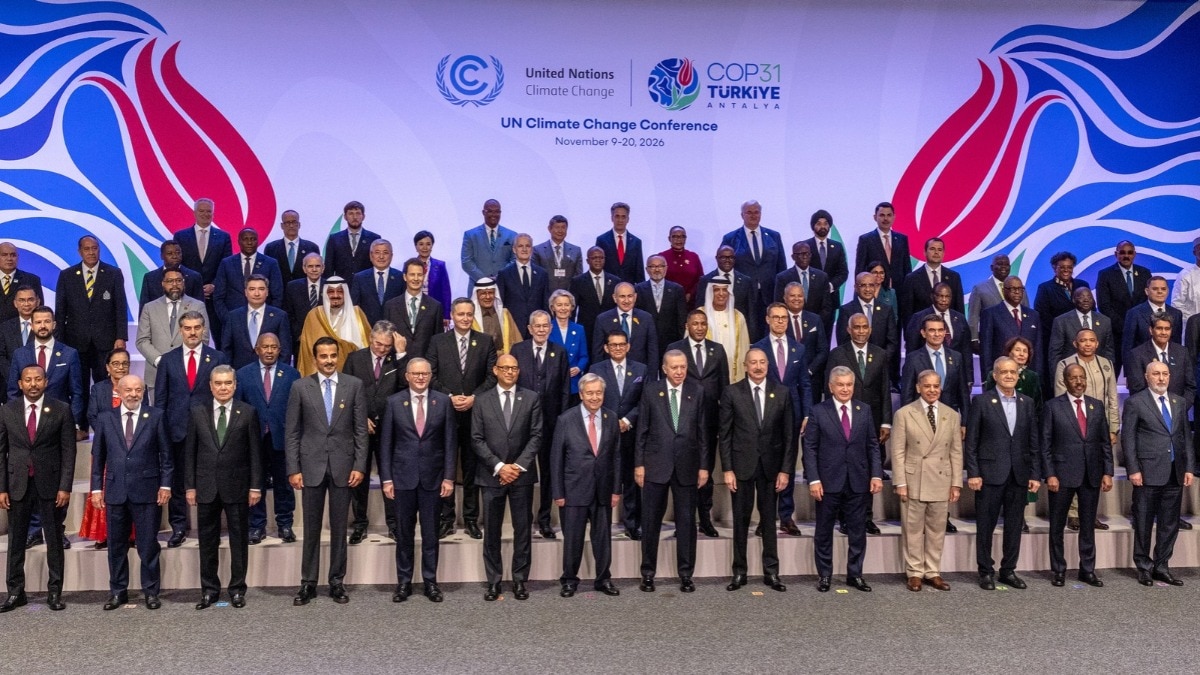
Every November, almost 200 countries meet for two weeks to argue over who should do what about climate change, and who should pay. This year’s meeting, the 31st UN Climate Change Conference or COP31, is in Antalya, Turkey, beginning November 9. Four days in, India has one small win, one clear loss, and is staying away from the host’s showpiece promise of ‘35-35 electrification’.India’s argument at these summits has been the same for years. Rich countries grew wealthy by burning coal, oil and gas for two centuries, so they should cut emissions faster and help pay for poorer countries to do the same.India has a short list. It wanted a formal process to pin down what rich countries owe. It wanted no new emission targets imposed from above. And it wanted yardsticks for measuring how well countries prepare for floods, heat and drought kept voluntary, so they cannot be used as conditions for receiving money.Environment secretary Narendra Bhooshan, delivering India’s opening statement, said just transition and adaptation remain significant challenges for the Global South, where they are tied to the challenge of development itself. India also wanted trade discussed. The European Union (EU) has begun charging a carbon tax at its border on imports such as steel, aluminium and cement, based on the pollution caused in making them. India and other developing countries see this as a trade barrier disguised as climate policy.On day one, developing countries notched a win. Despite EU objections, the ‘Climate Finance Work Programme’ has been formalised as a two-year process to discuss the money rich countries are legally obliged to provide under the 2015 Paris Agreement—the global climate treaty.Ajay Mathur, former head of the International Solar Alliance, put India’s view plainly: “If we want to hit $300 billion in adaptation finance by 2035, we need a clear baseline and a monitoring mechanism that reflects real needs on the ground.”But two other proposals were dropped—one on tripling money for adaptation, meaning protection against climate impacts already happening, and the other on trade measures such as the EU’s border tax.“Trade will not be on the formal agenda,” mit ahin of Sabanc University’s Istanbul Policy Center, had predicted before the summit, calling it “the elephant in the room”.Mathur asserts that climate action should not be used as a cover for green protectionism.India itself has been hard to spot at COP31. It has no national pavilion, the stall where countries showcase their work, while Pakistan, Bangladesh and Nepal do. Union environment minister Bhupender Yadav will arrive only in the second week. Prime Minister Narendra Modi did not attend the two-day world leaders’ gathering on November 11-12.Host Turkey wants COP31 remembered for one number: 35. Today, electricity supplies about 23 per cent of all the energy the world uses. The rest is fuel burned directly in petrol in cars, gas in kitchens, coal in factory furnaces and so on. Turkey’s ‘35-by-35’ pledge asks countries to push electricity’s share to 35 per cent by 2035. In practice, that means more electric vehicles, electric stoves and electric furnaces.The pitch is as much about security as climate. War in West Asia has sent oil prices soaring, and countries that import fuel are hurting. “Real energy security means breaking this dependence. Clean electricity can do that,” UN secretary-general António Guterres told leaders.European Commission president Ursula von der Leyen signed on. “The world has now entered the Age of Electricity. Therefore, I support the 35-by-35 Global Electrification Pledge, and I encourage others to do the same,” she said.There is a catch, though. The pledge counts electricity however it is made, and does not require the extra power to be clean. About a third of the world’s electricity still comes from coal. An electric bus charged from a coal plant counts as progress.The pledge is voluntary, and India may not sign. “We are not going to sign any pledge. This is their agenda,” minister Yadav said in New Delhi last week, adding that India’s official position would be communicated at the summit. India’s opening statement in Antalya did not mention the pledge. India has historically stuck to its own national climate plan, which every country files with the UN, rather than join pledges announced at summits.Mathur said India’s record speaks for itself. More than 300 GW of solar, wind, hydro, nuclear and bio-power now feed the grid, he said, which is why “India’s attention now is less on new pledges and more on the capital needed to make this capacity work seamlessly”. “Developing countries like India would rather [have] that COP31 direct its energy into financing that build-out than into another voluntary target it has already met and surpassed,” he said.On finance, India has reaffirmed the Paris Agreement clause that requires developed countries to provide financial resources to developing ones. India wants that money to be public and cheap, not loans that deepen debt.Turkey’s answer is a scheme called the Climate Implementation Bridge, meant to help countries package projects so banks will fund them. ahin was blunt about its limits, saying it “has no new financial pledge and no new mechanism to actually provide finance”.The hard bargaining comes in the following days when ministers take over. Yadav will co-chair the ministerial sessions on cutting emissions with Germany’s environment minister. Aarti Khosla, director of Climate Trends, a research consultancy on environment and climate change, said: “This is not an ordinary COP, and we are not in an ordinary year.”Subscribe to India Today Magazine- Ends
A third of the world running on electricity by 2035? At COP31, why India isn't signing up
Full Article
Original Source
Read the full article at Indiatoday →KhanList aggregates and links to publicly available news content. We do not host full articles from third-party sources. Always verify important information with original sources.