
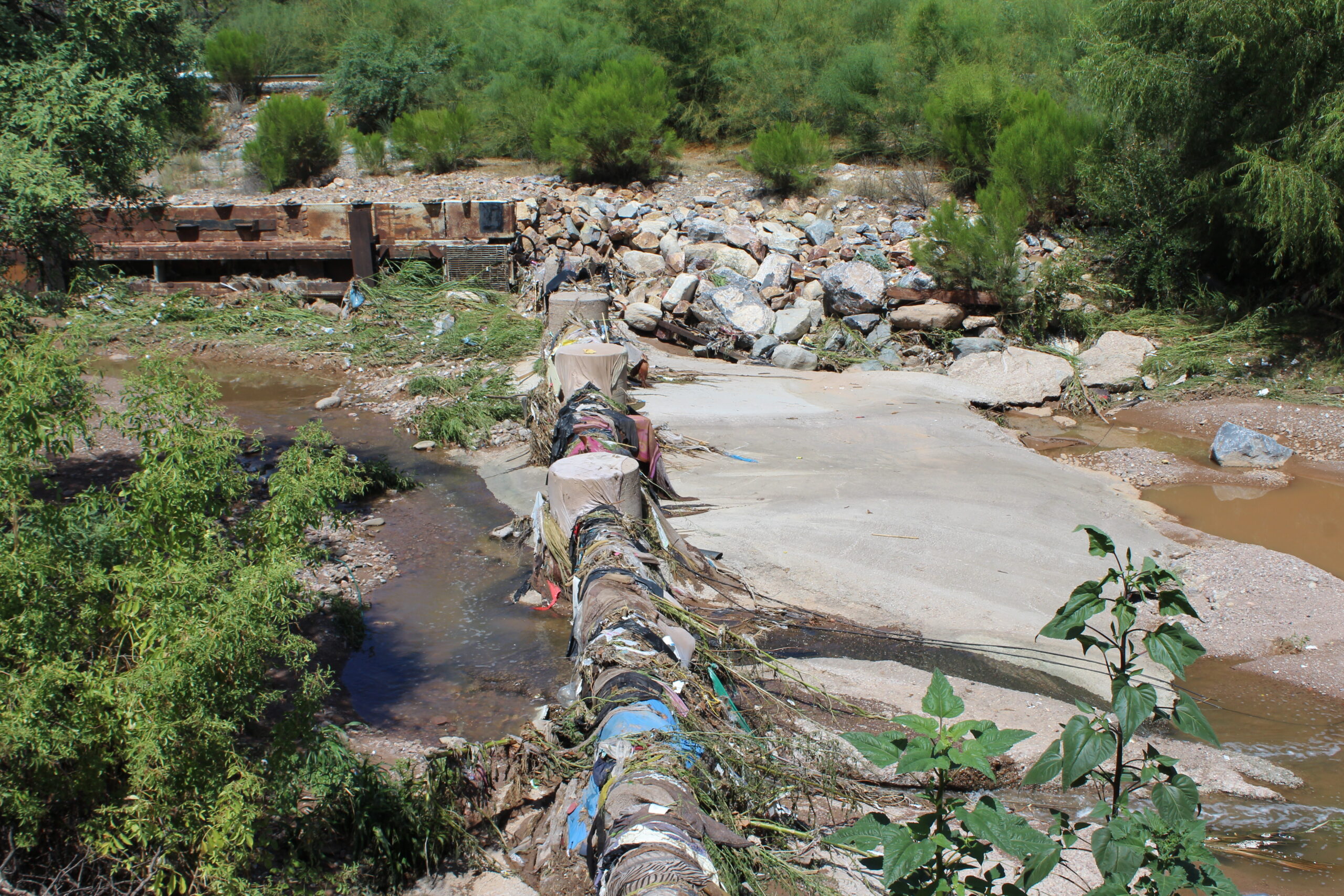
NOGALES, Ariz. (CN) — Robin Lucky walked along a narrow street just a few miles north of the U.S.-Mexico border. To her left, children kicked a soccer ball across dead grass.To her right was the Nogales Wash, which stinks of sewage as it carries trash and wastewater toward the Santa Cruz River.“The smell. The mosquitoes,” Lucky huffed as she looked out over the putrid concrete channel. “Nogales Wash is the unflushed toilet of Santa Cruz County.”Not all the waste in Nogales Wash can be smelled. This water is also rife with perfluoroalkyl and polyfluoroalkyl substances, also known as PFAS or “forever chemicals.” With few regulations on them, they’re basically everywhere, from the blood of nearly every person on the planet to 83% of tested waterways in the United States.PFAS are particularly concentrated around airports, military bases and mining sites. Arizona has lots of all three. PFAS do not break down and wreak havoc on public health, causing cancers and autoimmune diseases and disrupting hormones. Under President Donald Trump, the Environmental Protection Agency wants to further loosen rules on them.Now, critics in this Arizona border region fear a new heavy metals mine could make the situation even worse. At its Hermosa mine in nearby Patagonia, South32 was the first company to get federal approval under new fast-track “critical mining” rules.Besides the link between mining and PFAS pollution, Lucky, an activist opposing the project, fears drilling will release arsenic as well. South32 plans to extract zinc and manganese here — both heavy metals that can be dangerous on their own.“I guarantee we’re gonna have another disease cluster if we don’t start monitoring things,” said Lucky, president of local environmental advocacy group Calabasas Alliance.It’s not just locals here pushing back.The Center for Biological Diversity has sued federal regulators, citing the Endangered Species Act. State Attorney General Kris Mayes has also mulled legal action over what she describes as a public nuisance and a threat to health and safety.“We’re looking for any way that we can address this,” the Democrat told Courthouse News in October.The Nogales Wash runs nine miles between Mexico and Arizona, carrying storm runoff and wastewater from American-owned factories south of the border. (Joe Duhownik/Courthouse News)Mayes has called for a “careful, independent examination.” Although the Arizona Department of Environmental Quality already monitors PFAS across the state, it lacks adequate funding for a comprehensive review.“I believe a different legislature run by Democrats will fully fund ADEQ, so that it can do the kind of independent studies that we need,” she said just days before Democrats achieved control of both state chambers for the first time in 60 years.South32 did not respond to requests for comment for this story.As the company eyes starting operations in late 2027, it’s funded a University of Arizona health impact assessment on the mine. But critics fear the study won’t fully capture the extent of the risks.At a Santa Cruz County Board of Supervisors meeting in July, company President Pat Risner said arsenic levels are trending downward and that another toxic metal only tested high because of a lab error. He cited the company’s own testing. He also denied that metals could flow downstream through Patagonia and eventually into the Santa Cruz river.As president of the Calabasas Alliance, Lucky has been ringing the alarm about the Hermosa mine since the fast-tracked permitting process began in 2023. The all-volunteer group collects data on air and water quality to keep the community informed and pressure government officials to act.Risner has said the mine would bring millions in revenue to this rural region. Even if true, critics like Lucky say it’s not worth the damage the mine will do to public health and the environment.Many locals don’t know about PFAS. If they do, Lucky says they still might not understand the extent of the risk they pose to local health and the environment.“People think I’m crazy,” she said. “But doing nothing is not an answer.”Drone footage from August shows South32's Hermosa mining site. (South32's Hermosa Project/YouTube via Courthouse News)Santa Cruz County has some of the highest levels of forever chemicals in the country. With just around 50,000 residents, this county ranks first in Arizona and 10th in the country for PFAS contamination.According to the Arizona Department of Environmental Quality, at least 44% of public drinking water systems here have unacceptable levels of PFAS.Mass settlements from companies like DuPont and Raytheon have led to payouts for some cities. A lawsuit from the state is also working its way through the courts.While big cities like Tucson have the resources to build advanced water treatment plants and shut off contaminated wells, smaller communities like Nogales don’t.“It’s a tale of two cities,” Lucky said.Amid legal fights to address PFAS contamination, critics say South32’s Hermosa mine is a step in the wrong direction — one that could turn Santa Cruz County into a sacrifice zone.“That’s the question,” said Adriana Zuniga-Teran, a professor at University of Arizona’s Udall Center for Studies in Public Policy. “Do you want economic development or environmental health?”PFAS are used in a wide range of products: car parts, semiconductors, nonstick coatings, water-repellent fabrics and firefighting foams.Many of the PFAS in Nogales begin their life in Mexico, where American manufacturing companies have set up operations. Although the U.S. has largely phased out two of the most dangerous PFAS compounds, Mexico still allows them.The Nogales wash flows for about two miles in a concrete channel through Nogales, Arizona, before it returns to natural riverbanks. (Joe Duhownik/Courthouse News)Contaminated water comes into Arizona via the Nogales Wash, which starts just five miles south of the border, and via the International Outfall Interceptor or IOI, a 9-mile pipeline that carries wastewater.PFAS contamination “doesn’t follow the political boundaries,” she said. ”It comes back to bite you. Everything that happens on one side happens on the other side.”Although the border doesn’t stop PFAS, it does complicate efforts to regulate them. In charge of cross-border waters here is the International Boundary and Water Commission, an organization run jointly by the U.S. and Mexican governments.The commission has no funding for PFAS testing and is not responsible for flows into Nogales Wash, said Frank Fisher, a spokesperson for the American side. The Mexican side did not respond to requests for comment.At the state levels, Sonora’s Secretary of Environment and Natural Resources did not respond to requests for comment. As for Arizona, its constitution bars it from adopting regulations that are stricter than federal standards.“In terms of liability, right now it’s a hot potato,” Zuniga-Teran said. Stakeholders “throw it to the next one, and in the meantime we are all getting sick.”There’s little that can be done at the county or city level, either. In addition to lacking the funding to clean up PFAS, new federal proposals would exempt passive receivers like water utilities from liability if contaminated water ends up in their systems.Saulo Bonilla, a Nogales City Council member, says his city can’t stop pollution across the border in Nogales, Sonora.“If there’s PFAS going through the IOI, there’s not a damn thing the city of Nogales can do,” he said. “It’s considered international water.”Cracks in the Nogales Wash, which carries water from Mexico to the Santa Cruz River in southern Arizona, allow PFAS and other contaminants to leak into the wash from an underlying wastewater pipeline. (Joe Duhownik/Courthouse News)In Nogales, Mexico, local corruption allows business owners to flout Mexican environmental rules, Bonilla said.“It’s more an issue of people dumping their trash and waste,” he said. “Companies dump their porta-potty water.”To mitigate monsoon flooding, some municipalities in Sonora remove manhole covers to catch water in sewers. This reduces deadly flooding but overwhelms the wash and cracks the pipeline below, allowing PFAS to seep into the surface water.The IOI, which is owned by the U.S. federal government, faces similar problems. Zuniga-Teran says it’s been repaired in the past but calls this a “Band-Aid solution.”As governments debate responsibility and U.S. regulators fast-track a new mine, local activists like Calabasas Alliance have little recourse besides warning residents.Most community members don’t know how dire the situation is, Lucky said. She recalled a time she stopped an unaware family from swimming in the contaminated wash.“They were very thankful,” she said.Even as sewage and debris pile up in the Nogales Wash, trees and other vegetation here are seemingly thriving.Unlike humans, Lucky noted, these plants could be helped — not harmed — by high nitrogen levels in the water.“They adapt,” she said, but “we don’t. We get cancer and kidney disease.”The Nogales wash often overflows with flood waters, carrying debris and wastewater throught southern Arizona into the Santa Cruz River. (Joe Duhownik/Courthouse News)Subscribe to our free newslettersOur weekly newsletter Closing Arguments offers the latest about ongoing trials, major litigation and rulings in courthouses around the U.S. and the world, while the monthly Under the Lights dishes the legal dirt from Hollywood, sports, Big Tech and the arts.Additional Reads
‘A tale of two cities’: In rural Arizona county, activists fight back against forever chemicals
Full Article
Original Source
Read the full article at Courthousenews →KhanList aggregates and links to publicly available news content. We do not host full articles from third-party sources. Always verify important information with original sources.