
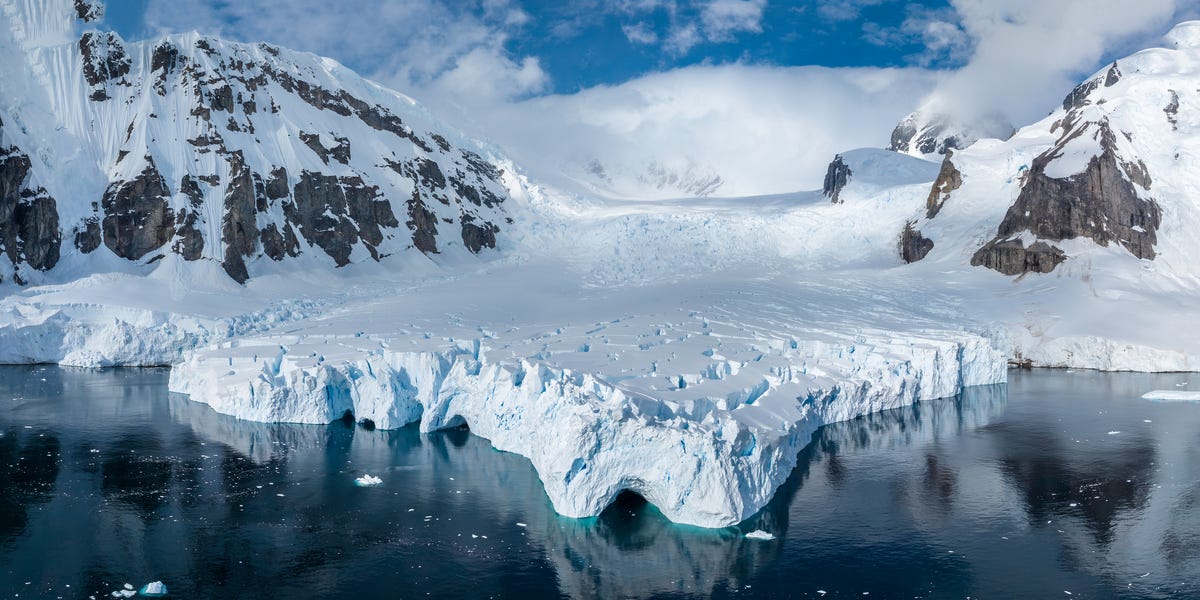
3 min readHere’s what you’ll learn when you read this story:Since 2021, East Antarctica has actually been gaining more mass, upwards of 700 billion tons of ice. A new study suggests that sustained warming of tropical waters, especially where the Pacific meets the eastern Indian Ocean, triggered increased precipitation over Queen Mary Land and Wilkes Land in East Antarctica.While it’s a reprieve from the continent’s steady mass loss over the past two decades, researchers caution it’s not a new normal for the frozen continent.A warming world brings with it many perilous side effects—wildfires, aridification, and food insecurity, just to name a few—but one of the most ominous is sea-level rise, the slow swallowing of coastlines and coastal cities by oceans around the world. For now, this doomsday scenario is locked away in ice sheets at the Earth’s poles, the largest being the Antarctic Ice Sheet, which covers roughly 5.4 million square miles. In fact, the ice sheet’s so massive that it contains enough water to raise global sea levels roughly 190 feet. To put that into perspective, only 10 or 20 feet would be needed to inundate New York City, for example.Thankfully, recent years have shown that the Antarctic Ice Sheet is actually growing, having gained nearly 700 billion tons of ice since 2020. Now, a new study published in the journal Nature explains this counterintuitive piece of good news. Pulling data from satellite observations, precipitation ice core samples, and atmospheric model experiments, an international team of researchers discovered an atmospheric teleconnection—weather phenomena linked across vast distances—between tropical sea surface temperatures (SST) and an increase of precipitation in the districts of Queen Mary Land and Wilkes Land in East Antarctica. This increased precipitation mass, driven in large part by long, narrow bands of concentrated water vapor known as atmospheric rivers, balances much of the sea ice loss that’s been happening in West Antarctica.“We found a previously underrecognized ‘tropical warm pool-East Antarctic Ice Sheet’ teleconnection pathway,” Institute of Oceanology of the Chinese Academy of Sciences’ (IOCAS) Yunhe Wang, first author of the study, said in a press statement. “Our research provides a theoretical basis for understanding Antarctic ice-sheet mass changes and conducting future research on the East Antarctic climate.”This discovery shows just how amazingly interconnected the planet’s climate truly is. According to researchers, a majority of this icy bulk-up in Antarctica can be traced to a tropical region where the western Pacific meets the eastern Indian Ocean. The sustained warming of this area from 2021 until 2023 triggered what’s known as a Rossby wave train, which are large-scale patterns of waves capable of changing weather patterns in mid to high latitudes. This formed a north-south dipole, creating low pressure along the south of Australia but high pressure along the East Antarctic coast and changing the flow of moisture in the atmosphere.East Antarctica’s mass increase has been tracked for years by satellites, including NASA’s Gravity Recovery And Climate Experiment (GRACE), which records changes in sea ice by detecting small variations in Earth’s gravity field induced by increased (or decreased) ice mass—a process known as gravimetry.A 2023 study published in the journal Environmental Research Letters tracked this mass gain from 2021 to 2022, and earlier this year, another study in the journal Communications Earth & Environment linked atmospheric rivers with the increase of ice mass in East Antarctica. But one of the latter study’s co-authors cautioned that Antarctica isn’t somehow immune to climate change’s warming impact.“Antarctica is finely balanced right now,” Danish Meteorological Institute’s Ruth Mottram said in a press release at the time. “Yes, the snowfall increase has pushed the mass budget into positive territory, but the flow of ice into the ocean is also accelerating. A few years with fewer atmospheric rivers could easily tip things back the other way.”Darren lives in Portland, has a cat, and writes/edits about sci-fi and how our world works. You can find his previous stuff at Gizmodo and Paste if you look hard enough.
A Strange Chain Reaction Is Causing Antarctica to Grow. The Scary Part Is What Happens When It Stops.
Full Article
Original Source
Read the full article at Popularmechanics →KhanList aggregates and links to publicly available news content. We do not host full articles from third-party sources. Always verify important information with original sources.