
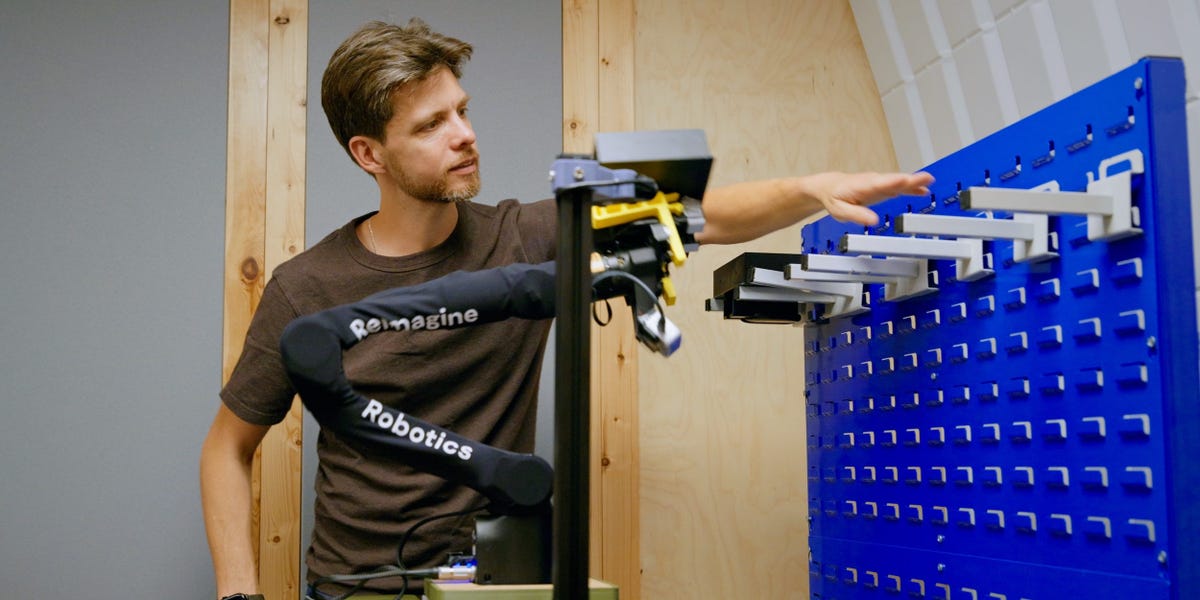
Jonathan Scholz, the cofounder of Reimagine Robotics, started Google DeepMind's applied robotics team. Reimagine Robotics A group of former Google DeepMind engineers has a potential solution to robotics' 100,000-year data gap: you.Jonathan Scholz, the CEO of Reimagine Robotics, told Business Insider that the startup plans to build robots that are actually useful by turning its customers into robot teachers.Scholz, who previously led DeepMind's applied robotics team, founded Reimagine last year with former Google colleagues Oleg Sushkov, Akhil Raju, and Misha Denil.The London- and Sydney-based startup emerged from stealth earlier this month and is backed by VC firms Fly Ventures and Firstminute Capital.In his first media interview since coming out of stealth, Scholz told Business Insider that Reimagine's mission of building robots that can be refined and taught in the field — a process known in the world of AI as "post-training" — stemmed from his experiences at Google. Show don't tell: Reimagine's robots are designed to be grabbed and manipulated. Reimagine Robotics After three separate robotics projects he built at DeepMind failed to get beyond the pilot phase, Scholz said he realized the issue was not the underlying technology, but how it was deployed in the real world."It clicked for me that it wasn't just a capability problem," he said. "What you really needed to do to get robots deployed out there was to make them usable and adaptable by the staff who actually understand the work."'Monkey see, monkey do'To bridge this gap, Scholz said Reimagine has adopted a "monkey see, monkey do" approach to learning for the company's fleet of robot arms and assemblers, some of which are mounted on surfaces while others move around on wheeled platforms.He said customers will be able to teach robots new behavior by showing them how to do a task, watching them attempt it, and then correcting them by physically manipulating the robotic arm. This approach aims to overcome a major challenge for robotics companies that has hampered real-world adoption: a shortage of training data.Unlike large language models such as OpenAI's GPT, which are trained on a vast corpus of online text, there is a relative lack of real-world data available to train the AI systems that underpin robots.Scholz cited the "100,000-year data gap," a term coined by UC Berkeley roboticist Ken Goldberg. The largest reported robot-training dataset contains roughly one year of experience. By comparison, Goldberg estimates it would take a person approximately 100,000 years to read and view all the text and images used to train leading AI models.Despite this gap, interest in robotics has exploded in recent years as investors bet that the field is approaching its own "ChatGPT moment."Much of this hype is focused on humanoid robots, with Tesla and robotics startups such as Figure and 1X all producing impressive demos of their bipedal bots and touting AI models capable of generalizing across a wide range of tasks.'An expensive paperweight'Reimagine is working with several manufacturing businesses to test its robotic arms. In one deployment, with a company that extracts critical materials from used hard drives, the startup says it cut the time it took to teach a robot a new task from one day to 10 minutes. Reimagine ultimately envisions a "downstream economy" of robot teachers and handlers. Reimagine Robotics Scholz said that employees working with the robots quickly took the platform and ran with it, coming up with their own use cases and training Reimagine's robots to perform new tasks. He added that this kind of hands-on supervision would be necessary to move robots beyond flashy demos and into the real-world workforce."If they have to call the whiz team robotics guys from wherever they are to fly in and fix it, they just won't be able to do it. It will become an expensive paperweight," Scholz said.In the long run, Scholz said he also expects the industry will see a "downstream economy" emerge, made up of robot trainers who will "bridge the gap" between manufacturers and factories by teaching robots to perform specific tasks and troubleshooting their way past any roadblocks."When I was at DeepMind, customers would have to call us up and we'd fly out and fix the robots. From their perspective, it would be great if they didn't have to call," he said. Read next Robotics The AI Data Grab Google More Startups
A startup founded by ex-DeepMind engineers wants to turn its customers into robot teachers
Full Article
Original Source
Read the full article at Businessinsider →KhanList aggregates and links to publicly available news content. We do not host full articles from third-party sources. Always verify important information with original sources.