
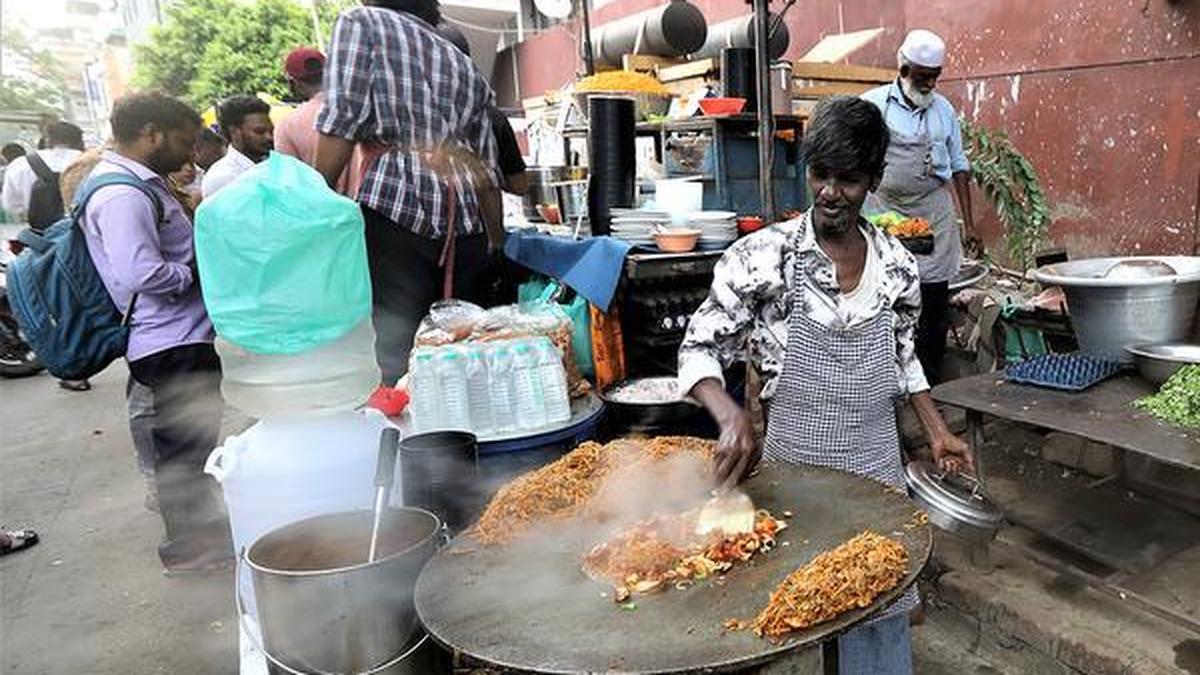
People marry into money. Adbul Rahman married into “Atho”. And the latter situation translates to money saved by the plates. “I have never had to pay for a plate of Atho after marriage,” Rahman chuckles.Rahman is the son-in-law of Abdul Ajeez, whose eponymous Ajeez Atho Shop at Arrababu Street off Rajaji Salai in George Town has the effect of a speed governor on an environment geared to movement and bustle. The milling crowd on Rajaji Salai contrasts with the stationary, slurping crowd around Ajeez’s shop. Customers, their work bags slung over their shoulders, tuck into plates of Atho as if it were their comfort food. Atho shops in this part of George Town present these two scenarios. Local residents “own” Atho as one would a home-grown dish, treating it as a gift from Madras; a good number of them are likely unaware of the Burma backstory. And those Indians who left Burma (now Myanmar) for Madras find that connection with the Burma of the past sustained through Atho’s popularity in this city. Through it, they also enjoy a sense of community among their own. Take these illustrations. Abul Ajeez Atho Shop at Arrababu Street off Rajaji Salai in George Town. | Photo Credit: SPECIAL ARRANGEMENT At Arrababu Street, Ajeez Atho Shop is at a vantage point enjoying clear visibility from Rajaji Salai but patronage does not derive entirely from that factor. Rahman observes that with Ajeez, selling Atho has never merely been a business. With parents having lived in Burma, and leaving it behind for India, specifically Madras, as repatriates following the coup d’etat in 1962, Ajeez views making and selling Atho as a bridge to his culture and people. This passion runs in the family. Rahman notes that his relatives operate similar Atho stalls in Trichy and Kutralam, further reinforcing food’s known status as a mark of culture and community.Legacy food should have secret recipes. Rahman insists there is no secret recipe; the true craft lies entirely in the balance of mixing and proportion. The shop caters to every craving with its main varieties: vegetarian, fried, and egg Atho, each customised to individual spice tolerances. Crucially, vegetarian and non-vegetarian preparation areas are kept strictly separate, ensuring no one’s dietary preferences are compromised.Ajeez operates from this spot for 20 years but has been in the Atho business for twice that number of years. After 40 years, he has found allies in his sons, Haider Ali and Yusaf. “On days my father-in-law is out of station or not well, his sons take care of the stall,” observes Rahman. And Rahman points out he does not assist in the running of the shop, just content being an avid Atho taster. And also volunteering to be a spokesperson, as he did for this interview. Rahman points out the stall has appeared on several media platforms and attracted many VIPs who visit the stall during the less crowded hours. Blurring of hierarchiesShahul Hameed is the boss, and he is 30 years old. Vincent Alphonse reports to Shahul at his Atho stall on Second Line Beach Road,and is more that twice his boss’ age, having been born in 1962. The usual hierarchical boss-worker relationship is missing. Deference to age does not entirely account for this behaviour. Shared histories and family connections explain it better. The forbears of both men are from Burma having come to Madras as repatriates following the 1962 coup. From repatriate families, Khadija Beevi and her husband started this shop 45 years ago and handed over its reins to their son Shahul. They have made sure their trusted lieutenant Vincent Alphone who has worked with them for 30 years, is by their son’s side assisting him. When his parents arrived in Madras from Burma in 1965, Alphonse was three years old, and his siblings were also children of tender years. An Atho shop at Second Line Beach Road in George Town | Photo Credit: SPECIAL ARRANGEMENT Probably due to the effect of shared histories and family bonds and age, Shahul lets Vincent do the talking. One thing Vincent holds close to his heart is the customers telling him how conspicuous his absence is on the days he is not present in the shop. The cart draws bankers, lawyers, and college students, serving them vegetable, chicken, and fried Atho, alongside mohinga noodles traditionally accompanied by soup and banana stem. Vincent however notes mohinga has never matched Altho’s popularity. Vincent says the secret of a good Atho moves far beyond its cooking process; it is in the mixing. Every component must come together correctly for the taste to emerge perfectly. He remarks fried atho is an entirely Indian twist to the Burmese dish. The cart employs around five people for smooth functioning. The sales dip during periods of religious abstinence from non-vegetarian food, but vegetable Atho sufficiently fills the gap and, Vincent says, has the highest demand. Vincent’s composed voice could not hide his immense pride as he spoke about how the shop received a Vijay TV award for Best Unavu (Meal) in 2012, an honour he credits to their taste. He adds that the shop holds an FSSAI certification, with employees having participated in food safety meetings. Further down Second Line Beach Road, another Atho stall, called Burma Atho Shop, carries the same sense of a legacy being passed on. Rahamathulla took over the business from his uncle who had learnt the art of making Atho in Burma. And he makes it the way his uncle taught him.Along the way, he has also tweaked Atho to suit local taste buds. His menu has grown to nearly 10 choices, spanning vegetable and fried Atho, including chicken and egg versions, with customers able to adjust the spice and flavours to their liking.For Rahamathulla, the craft remains in the mixing. Nothing is prepared in bulk; each plate is mixed individually according to the customer’s preference. It is a simple ritual that echoes what Vincent says about Atho that its secret lies not in any single ingredient but in bringing every component together in the right proportion. There is another mixing that happens: by practising the craft of making Atho, he enables Burma, Madras and Chennai to coexist, defying the limitations of time and geography.
A spicy dish from Burma naturalised in Madras
Full Article
Original Source
Read the full article at Thehindu →KhanList aggregates and links to publicly available news content. We do not host full articles from third-party sources. Always verify important information with original sources.