
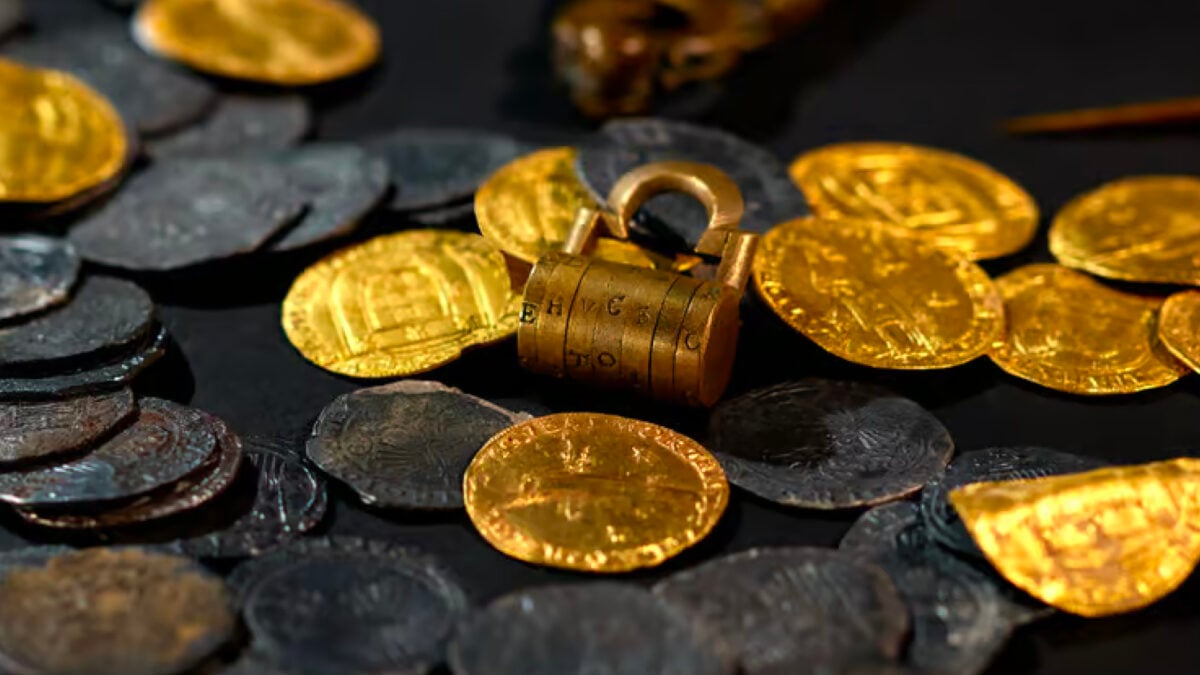
On the evening of December 28, 1583, the merchant ship Ann Francis was caught in a storm and wrecked near Port Talbot, Wales. The ship carried gold and silver coins, compasses, weapons, and padlocks—including one so well-preserved experts wondered if it could be opened like a regular lock. In a recent statement, a team of experts from Amgueddfa Cymru–Museum Wales and Cardiff University in the U.K. announced that yes, we in fact can open the padlock the way it was intended. The passcode for the brass lock is “A, N, C, E.” Remarkably, the researchers deduced the code from CT scans of the lock, without damaging the artifact, which dates back to the Elizabethan era. The lock was likely used to secure a small chest protecting items of significant value, as it was found near a collection of Spanish silver coins and two coin weights. “It took a few attempts, but after a couple days of work we were […] fairly confident that what we had was the correct code,” Alastair Willis, the museum’s senior curator for numismatics and the Welsh economy, said in a behind-the-scenes video on the project. “And as soon as I got that combination—as soon as I had the letters aligned—you could feel it straight away. It was slightly looser.” A stormy provenance The northern side of Sker Point, near where the Ann Francis was wrecked. © eswales via Wikimedia Commons (CC BY-SA 2.0) According to a blog by Amgueddfa Cymru, there’s surprisingly a lot we know about Ann Francis. The ship belonged to a father-son merchant pair—both named Francis Shaxton—who were also allegedly “notorious smugglers.” They were based in King’s Lynn, England, where the Ann Francis was headed after a trip to Spain to sell (smuggle) grain and other goods, although the Shaxtons claimed the ship was returning from Hartlepool. This may be why the wreck’s cargo contained mostly international currency: German talers, Spanish and Mexican silver, and Portuguese gold. In the video, Willis explained that the wreck was initially looted by locals when it washed up on Margam Beach, Port Talbot. Then, local landowners ordered investigators to create an inventory of the shipwreck. Court records from the time suggest there was somewhat of a legal dispute between Shaxton (junior), the looters, and the local landowners. Fragile but functional It’s less clear what happened between then and 1996, when metal detectorist Peter Hughes discovered the lost cargo of Ann Francis. Between 1996 and 2017, Hughes retrieved about 870 gold and silver coins, personal belongings, kitchen utensils, and more, alerting Amgueddfa Cymru to his discovery. The recently cracked padlock wasn’t the only lock in the collection, though many of the others were fragmentary, corroded, or missing letters, Sian Illes, the museum’s senior curator of medieval history, explained in the video. (From left to right) Peter Hughes, Alastair Willis, and David Williams examine the padlock (screenshot from video). Credit: Amgueddfa Cymru – Museum Wales “So the opportunity to open the lock [has] been limited,” she said. That’s why this particular padlock was so remarkable, as it “still has its working parts—all of the letters are really clear. […] I think it’s human nature; when you have a code to crack, that’s what you want to do.” “This lock still works—the rings still turn,” Willis added in the video. “You can still work out what the code is, and you can potentially unlock it.” A moment of inspiration But the team didn’t want to open the lock by brute force. The researchers could tell grit had built up inside, and turning the rings too many times could damage the artifact. So, they decided to contact David Williams, an expert in biomechanics at Cardiff University. A CT scan of the padlock (screenshot from video). Credit: Amgueddfa Cymru – Museum Wales “There was a little skepticism of whether it was even possible,” Williams recalled in the video. “But we always [have] this approach of going, ‘Well, we’ll try and image it first to see if we can see anything of use. Or are we just going to see a homogenous gray object?’” Unlocked at last Thankfully, the CT scans revealed a gray object with clear enough structures—four moving rings with notches and teeth—for the researchers to identify a potential combination. Back at the museum, Willis turned the rings, aligning them to show “A,” “N,” “C,” and “E.” And, for the first time in over 400 years, the grit-covered key came loose. Researchers remove the key from the padlock (screenshot from video). Credit: Amgueddfa Cymru – Museum Wales “If [the grit] was kept long-term within the lock, it would have caused further damage,” Illes explained. “So by opening the lock, it’s actually helped us preserve it better.” Peter Hughes—who tried to find the passcode himself—makes an appearance in the video. In a lovely moment, the video shows him sitting with the expert panel, examining the lock and sharing his own thoughts on the achievement. “You know, I could never find the combination,” he began. “I tried hundreds of times—unsuccessfully—and thankfully, technology and science has taken over.”
A Smugglers’ Padlock Stayed Locked for 400 Years—and Scientists Just Cracked Its Code
Full Article
Original Source
Read the full article at Gizmodo →KhanList aggregates and links to publicly available news content. We do not host full articles from third-party sources. Always verify important information with original sources.