
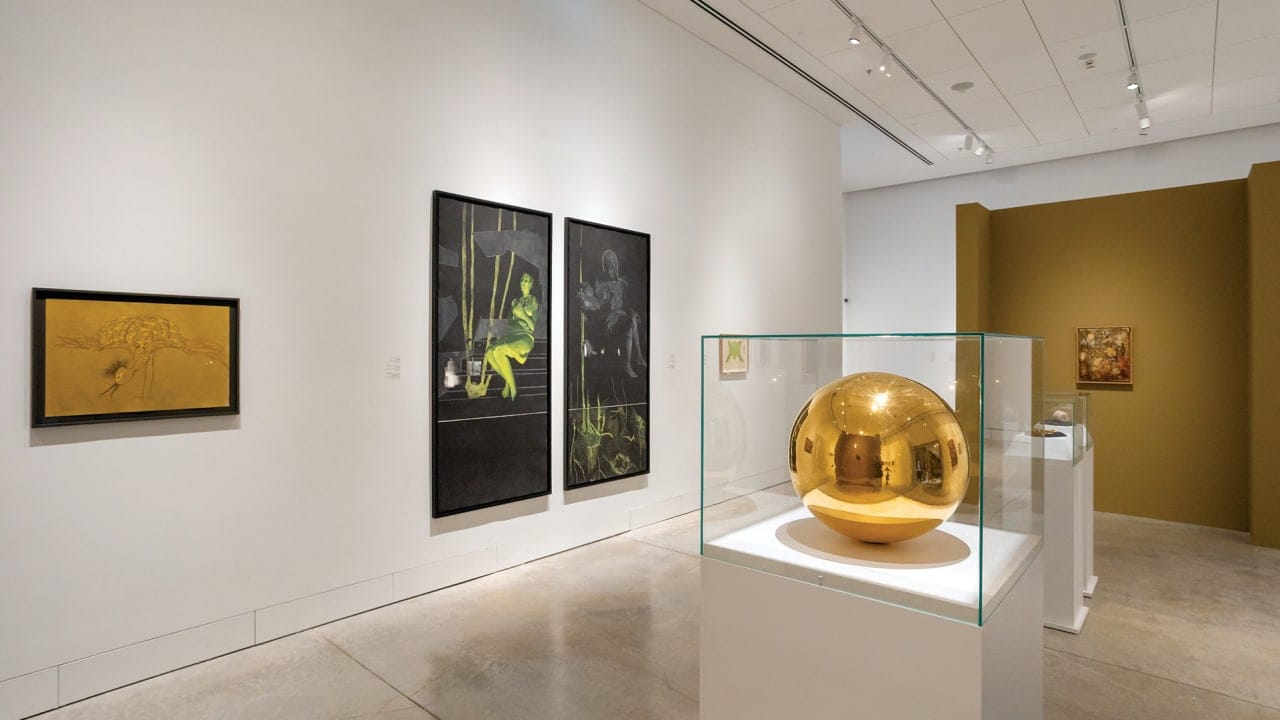
NOVEMBER 1, 2026 09:59‘For me, Jerusalem is a shot of gold,” said curator Marie Shek. “In my heart it’s close to God, close to what once could have been a dream, and maybe was a dream.”Shek built a whole exhibition around that idea. Gold: Touches of Gold in Contemporary Israeli Art opened this month at the Tower of David Jerusalem Museum and will run until March 2027. It brings together 16 Israeli artists who work with gold leaf, gold powder, gold thread, and metallic paint, alongside rare archaeological finds in gold, most of them never shown to the public before.The setting is part of the story. The Citadel’s stones go back more than 2,000 years, through the Hasmoneans, Herod, the Byzantines, the Mamluks, and the Ottomans. The first gold treasure ever found in Jerusalem’s archaeological history, a hoard of Byzantine coins, was excavated right here in the 1980s.For Shek, the show settles unfinished business. “This is my exhibition number 50 since ’96,” she said. That first exhibition was meant for the Tower of David, and it was a gamble. Shek came to the museum’s director at the time, Adi Semel, with a proposal for a sound art show, long before sound art was in fashion. Her idea was to exchange sounds between East and West through the arrow slits of the Citadel walls.“The arrow slits were once a place for shooting, for guns, for death, for murder,” she said. “I wanted to carry sound through the ear, from speakers in the western city into the mosque, into the East, and back.” Semel went with it. Eight months into the work, he lost his job, and the people who had worked with him went too.Marie Shek. (credit: ELAD SARIG)Shek was left holding a first exhibition and no venue. “You don’t know if you’re worth anything or who you are,” she recalled. She took the project to the Artists’ House in Jerusalem, where Ruti Tzadka agreed on one condition: Shek would bring the funds.She raised NIS 10,000, the full budget then, and gave each artist, including Gideon Gechtman, Buki Schwartz, Belu-Simion Fainaru, and Philip Rantzer, a room with a sound of his choice. A sound lab produced the catalog. Her son, then in second grade and now 38, still calls it her best show. She brought his whole class to see it, and he remembers.“That’s how I started my career,” she said. Thirty years and 49 exhibitions later, she has brought the 50th to the Citadel. “I wanted to close the circle at the Tower of David.”Over three decades, she curated all over the world, but the Citadel stayed with her. “It didn’t sit quietly with me that I hadn’t done something in this spiritual place,” she said. “This place speaks to me. Unlike most Tel Avivians I know, for me Jerusalem goes far beyond religion or politics. First, it’s international. Second, it’s eternal. I’m nothing; we are dust. There were Romans, Ottomans, and Byzantines; Herod lived here, and tomorrow there will be I don’t know what. To be part of the cultural food chain, that’s what I want in this world.”Shek grew up in Tunis and came to Israel as a child. She studied for her BA in Jerusalem, met her husband there while he served in the Foreign Ministry, and her children were born in the city. She knows how much it has changed. “But didn’t the whole world change?” she asked. “I get on the light rail, I get off at Davidka, I can see the Old City, and I start breathing again.”'It’s spiritual, it’s the Temple'GOLD CAME to her almost the moment she knew she would mount a show at the Tower of David. “For me, the place itself is a kind of gold,” she said. “It’s spiritual, it’s the Temple.”There was a suggestion to call the exhibition “Jerusalem of Gold.” Shek refused. “Absolutely not,” she said. “In my mind, Jerusalem is not of gold. Jerusalem is of wars. Afterward, everyone can build their own movie.”That is where her own movie begins. It ties back to the child from Tunis. “They told me Israel is a land flowing with milk and honey, and it wasn’t. It all connected,” she said. She recalls her childhood belief that the sidewalks in Israel “were covered with gold,” only to be disappointed upon arrival. “Maybe,” she told me, “maybe this is a way to close the circle.”She went looking for precedents and found few. “I haven’t seen many exhibitions with gold in the world,” she said. Instead, she spent days in the library of the Pompidou Center in Paris, reading about ancient cultures, the Middle Ages, the Renaissance, and Egypt. She found that gold always belonged to a culture. “It’s a substance that doesn’t oxidize, that doesn’t spoil, whose value is constant and only goes up.”Her catalog essay follows that thread. Gold has stood for power, holiness, beauty, and eternity, she wrote, from the tombs of the pharaohs through medieval and Renaissance churches to modern art. In the 20th century, it shed its religious ties, and artists such as Gustav Klimt, Yves Klein, Robert Rauschenberg, and Anselm Kiefer used it to probe the relations between matter and spirit, value and memory, and beauty and power.The Incas, she noted, called it the sweat of the sun, and the ancient Egyptians saw in it the flesh of the gods.Shek is known for exhibitions that hurt. “All my exhibitions give you a kick in the stomach,” she said. “Even when they’re poetic, they hurt a bit; they remind you, they’re cold. They deal with the harder side of humankind.”This time she decided otherwise. “I said, I will pamper myself. In such a very, very difficult time, I want people to come in and smile. I want the gold to heal, to be a friend.”For her, that meant no video. “Video steals the show,” she said. “I didn’t want competition. I wanted the eye of the visitors to stop at every work, look for the gold, and let it fill their souls.”The result is spare and calm. Every work stands on its own, and the eye moves from one to the next by color and light rather than theme. Shek admitted she chose some pieces purely by sight.She compared the process of selecting the works to clearing out a closet. “If I took down my wardrobe right now and kept only what I truly love, what I wear, and will keep, I’d keep 20%. Those 20% are this exhibition.”When I suggested a box of chocolates, she sharpened the image. “Godiva. I went to the Godiva store and chose: the nuts, the orange, not just milk chocolate. That’s what I did for four years.”Four years, 16 studiosThe exhibition took four years to put together, partly because of the war. The delay worked in its favor. It gave Shek and the artists time to find the exact work for each place on the wall, and gave some of them time to create new pieces specially for the show. Several of the works on display date from 2026.Throughout all four years, a constant question sat in the back of Shek’s mind: How would each artist sit beside the next?Three generations of one artistic family hang in the show. Moshe Gershuni, one of the most influential artists in the history of Israeli art who died in 2017, is represented by an untitled triptych from 1995. It’s made from acrylic gel and spray on canvas.In one of its panels, a field of gold is broken by a dark, crusted circle with red at its core, and a thin red drip runs down to the bottom edge. Shek chose the triptych by eye and only learned later, reading on a train, that all three panels dated from 1995.Facing the triptych hangs his son Aram’s Girl with Golden Hair (2024), which turns the formula around. The ground is black, a young woman stands in profile, and the gold lives only in the mass of curls lit up around her head. Moshe’s granddaughter Alma, born in 1996, made The Man with the Golden Helmet (2026), a clay relief painted in oil after Rembrandt. Here too, the figure is dark, and the gold gathers on the ornate helmet and a few flecks on the shoulder.Shek often chose the works together with the artists. “What do you love? What do you want it to be?” she would ask. Aram Gershuni, whom she calls a master, offered to paint her a new picture in the classical Renaissance style, with gold. Then, in his studio, she saw a profile he had already painted of his regular model, a young woman with golden hair. The painting, oil on wood, recalls the maidens of Sandro Botticelli. “I saw it and said, that’s it, perfect,” she recalled.Nelly Agassi, one of Israel’s most important artists, made her piece from scratch. Agassi, who is based in Chicago, kept Shek in the loop through daily phone calls and Zoom sessions, from the first samples of the material she bought in a Chicago store, some 200 fabrics in all, to the filling and every stage after.“It’s a birth,” Shek said. “I was the doula.” The result, Stronghold (2026), is a gold wall piece of embroidery, silk, and padding that bulges like a living thing.Joshua Borkovsky has painted for years on the Kaaba, the black cube at the heart of the Great Mosque of Mecca. His Pilgrimage (1986) sets gold leaf against black in a way that recalls the gold-embroidered black curtain that covers the Kaaba.“His gold is real,” Shek said. “He buys gold. It’s not expensive paint, it’s not just gold leaf, it’s real gold.” When she first visited, Borkovsky told her she should give him the whole exhibition. “He was right, in a way,” she laughed. At the press preview, he lectured at length on the Hajj and on his years of travel in the East.FOR YIFAT BEZALEL, gold is barely a material at all. In The Window (2023), a large drawing in oil, black gesso, and pastel, it appears only as a thin halo. “But for her the gold is the content,” Shek said. “It’s the Pietà. That’s what’s excellent.” Bezalel draws on Christian iconography and on the Kabbalistic sefirot, and her pencil and gold leaf pull the eye down before the light lifts it again.The only artist Shek had not known before is Elena Ceretti Stein, who lives and works between Israel and Milan. Shek saw her painting of a delicate, lightly gilded hand, Fuligo Septica after Durer (2025), at the Braverman Gallery and immediately thought of Dafna Shalom. Shalom’s Cast in Sign Language (2026) is a bronze fist cast in a gold hue, one of two hands that together spell the word “we.” Placed together, the two works read as a blessing.“It’s almost a religious exhibition,” Shek said, then corrected herself. “Not religious, spiritual. As if we received a blessing. Not from the Western Wall. A blessing from above, with the gold, in this place.”Other artists carry gold into very personal histories. Leor Grady embroiders Psalm verses in gold thread on linen, a technique tied to Yemenite Jewish culture, in Give Thanks to the Lord for He Is Good (2024). The catalog describes his work as an attempt to mend and re-stitch a history full of injustice.Elham Rokni, who came to Israel from Tehran as a child, built a private dictionary of symbols from Persian carpet culture. Her gilded Hoopoe (2024), Israel’s national bird, graces the catalog cover.Lilac Sasson’s The Iranian Series (2001-2003) places pages torn from a book on Iranian art and architecture inside iron boxes, partly covered with gold leaf that hides as much as it shows. Yoram Chisin, the third generation of an artistic family whose grandfather decorated a cathedral in eastern France, sometimes buries books under thick impasto.Miriam Cabessa paints with her body and household objects instead of brushes; at first glance, her painting on aluminum shows a gilded structure that recalls the Temple, and as the viewer moves, the building dissolves into glowing metal. Yoav Brenner’s Beat (2023) also asks visitors to move so the sheen can shift on the surface.Gabriel Klasmer shows six works on paper in which real gold and imitation gold play off each other, not without irony. At the center of the space sits Mosh Kashi’s Gold Ball (2012), a porcelain sphere in 24-karat gold that reflects the room around it and pulls every gaze toward it.“THE BOND between Jerusalem and gold runs deep, from the Midrash and Jewish tradition to the city’s very name in song,” said Eilat Lieber, director and chief curator of the Tower of David Jerusalem Museum. “But Gold reaches beyond history. It speaks to something timeless in the human spirit: the yearning for what is pure, true, and eternal, a yearning that grows strongest in times of hardship and uncertainty.“The works in this exhibition search for light within darkness, for the spark at the heart of things, and it is in the tension between shadow and beauty that they lift us from the everyday toward the sublime.”“As we open the 60th anniversary year of Jerusalem’s reunification, the Tower of David Jerusalem Museum continues to tell the story of this city through its contrasts: the fleeting and the eternal, creation and preservation,” she said. “Gold adds a vital contemporary layer to that story, one alive with Israeli talent and inspiration. I hope every visitor finds here not only great beauty, but a space to pause, reflect, and connect.”The Tower of David points visitors beyond the exhibition to more gold in its permanent galleries, among them a hoard of coins minted under the Byzantine emperors Maurice Tiberius and Phocas, found in the Citadel excavations, and a Byzantine gold ring engraved with a seven-branched menorah. On the roof of Phasael Tower, a viewpoint called “Jerusalem of Gold” takes in the city’s golden domes in a full circle.Down in the galleries, the gold comes in smaller touches: a halo, a thread, a fist, a shining ball. Shek wanted visitors to come in and smile, and they do. Fifty exhibitions into her career, she knows how to give every work its space, and she knows her artists the way a mother knows her children: what each one loves, and who should hang beside whom.The result is a beautiful show, worth seeing slowly, and more than once. As Shek put it, everyone can build their own movie.Gold: Touches of Gold in Contemporary Israeli Art will run at the Tower of David Jerusalem Museum until March 2027.Coins, a queen, and a biscuit tinThe archaeological display, curated by Ravit Nenner-Soriano, ties the show to the city’s ancient past. The items come on loan from the Israel Antiquities Authority and the Staff Officer for Archaeology in Judea and Samaria, and most of them are on public view for the first time.Two kinds of gold appear here. The first is coinage. “The coin is an object that passes to the merchant on one hand,” Nenner-Soriano says, “and on the other hand, it is a kind of propaganda of the ruler toward his subjects.”A gold coin of Ptolemy I Soter, the first ruler of the Ptolemaic kingdom after Alexander the Great, comes from the sacred enclosure on Mount Gerizim in Samaria and dates to the early third century BCE. It shows how closely the Egyptian kingdom was tied to the region.Beside it is a coin of Berenice II, wife of Ptolemy III, dated 246-221 BCE and found in the Givati Parking Lot excavation south of the Temple Mount. The queen appears alone, wearing a diadem and veil. “She was an independent ruler,” Nenner-Soriano says. “She was the queen of the Ptolemaic Empire and minted coins for herself. Berenice II says a lot of things inside this small coin.”A third find tells a quieter story. Four gold coins turned up in a small jug in an excavation near the Western Wall Plaza. Two date from the late Abbasid period (946-957) and two from the start of Fatimid rule (971-980). Someone hid the savings, meaning to come back for them, and never did. The two pairs of coins also record a change of regime, from Abbasid to Fatimid, in a single hiding place.The second kind of gold is jewelry: rings, earrings, amulets, and thin gold sheets from Roman and Byzantine tombs, dating from the second to the sixth centuries CE. They belong to the collection of Frances Emily Newton, a British missionary who lived in the country in the early 20th century.Newton did not dig. She bought from antiquities dealers she knew, and she was choosy. “She told them, give this to the authorities, I’m collecting only gold,” Nenner-Soriano says. She tagged each item with her name and a serial number, kept a diary of where each piece had been found, as the dealers told her, and stored the lot in a safe at her house in Haifa.When World War I broke out, Newton had to leave for England and gave the key to a neighbor. The Ottoman governor removed the safe and shipped it toward Turkey. The British army intercepted the shipment, and Newton later wrote that the collection came back to her almost whole.Determined that the public should see it, she packed it into biscuit tins, took it to Jerusalem, and left it on the desk of Prof. John Garstang, director of the Mandatory Department of Antiquities, who was out. The next morning, the tins were gone. Staff turned the offices upside down and searched the trash. The night cleaner, it turned out, had cleared the desk and thrown the tins away. They were rescued from the bin.When the Rockefeller Museum opened in 1938, a small part of the collection went on display in a case marked as the gift of Frances Newton. What is displayed at the Tower of David now is the part that was never shown.Newton’s lists have been lost, so the dating rests on comparison. One detail survives from her 1948 book: She loved one medallion so much that she wore it until her last day and asked in her will that it return to the collection. It is on display at the Rockefeller. – N.B.Follow us on Google
A shot of gold: Curator Marie Shek closes a circle at the Tower of David Museum Jerusalem
Full Article
Original Source
Read the full article at Jpost →KhanList aggregates and links to publicly available news content. We do not host full articles from third-party sources. Always verify important information with original sources.