
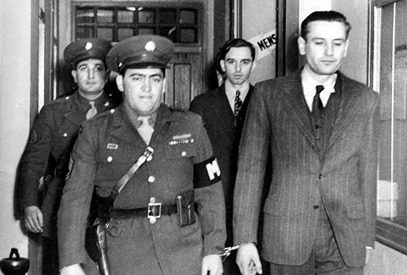
Editor’s Note: The opening passage is excerpted from Sara Vladic’s The Dangerous Shore: How a Motley Crew of Scientists, Mobsters, Double Agents, Retirees, Volunteer Pilots (and a Boy Scout) Stopped the Invasion of America (HarperCollins, 2026). That night, snow falls in heavy, wet flakes, coating Hancock Point in a thin, white blanket—the first snow of the season. Harvard Merrill Hodgkins, a high school senior and a Boy Scout, drives home from the Wednesday night dance at the Townsend Club. It’s just after eleven, and he’s navigating the winding, unlit road back to Crabtree Neck, as snow drifts down in near-blinding sheets. As he rounds a bend, his headlights catch two figures trudging through the snow. They’re moving slowly, heads down against the wind, dressed in long, city-style overcoats and slacks, clothes that look foreign here in the Maine woods. He slows the car, and the men turn their faces away from the light. It’s bitter cold, but they wear no hats, no boots. Hodgkins finds it suspicious. “You just don’t see folks walking without boots out here when it’s snowy . . . no one around here wears a topcoat in the winter.” He considers offering them a ride; something about them nags at his curiosity. “Shucks, if they were crazy enough to be out on a night like this, maybe I’d let them walk,” he thinks, edging the car to the side as they pass. Their faces are unfamiliar—strangers, he realizes, and in a place where six families live year-round, everyone’s face is familiar. Hodgkins watches them disappear around the bend, their steps trailing off toward the woods and the black sea. It’s a risky time to be out here alone, with recent whispers of spies landing on the Maine coast. He stops the car. He gets out and follows their footprints down the road, then down a little trail that veers off toward Sunset Rocks—a spot he knows well from rabbit hunting with his father, Dana Hodgkins, a deputy sheriff and local guide. Their tracks vanish into the trees near Kent Crabtree’s house. They’d come from the shore, Hodgkins realizes. “There was no reason for them to be coming from down there,” he ponders, unease prickling as he scans the empty coastline. The cottages along Sunset Rocks are empty in the winter—no reason at all for strangers to emerge from that path. Down the road, another local, Mary Forni, mother of three and the tax collector’s wife, is driving home from her weekly card game. It’s nearly midnight when her headlights pick up two men walking along the edge of the macadam highway, close enough that she can make out their thin, city-style coats, their shoulders hunched against the snow. She, too, feels that flash of unease. Forni tells her husband, who brushes it off with a laugh. The encounter with those two strange men lingers in Mary Forni’s mind, keeping her awake long into the night. By morning, she can’t shake her misgivings, so she shares them with her neighbor, Harvard’s mother. “They just weren’t like anyone you’d see here in November,” she said, the unease still fresh in her voice. “Honestly, it’s a wonder I didn’t stop and offer them a ride.” They quickly connect the dots to the two sightings. — ✦ — The strangers were German intelligence agents Erich Gimpel and William Colepaugh. On Nov. 29, 1944, U-1230 had delivered them to the Maine coast to gather intelligence in the United States. Four days later, the same submarine torpedoed the Canadian freighter SS Cornwallis off the Maine coast. The ship sank in less than 10 minutes, killing 43 of the 48 people aboard. Only five survived. Now, more than 80 years later, the Nomad Exploration Team has located the wreck nearly 400 feet beneath the Gulf of Maine. The discovery, made on July 11, 2026, followed seven years of research and expeditions to find the long-lost ship. It brings renewed attention to the lives lost and to the remarkable events ashore that wartime headlines would only partly explain. The Nomad Exploration Team recently located the wreck of the Canadian freighter SS Cornwallis. (Nomad Exploration Team) When Harvard’s father, Deputy Sheriff Dana Hodgkins, returned from a hunting trip, Harvard told him about the strangers. Dana initially suspected burglars, but his investigation of the area’s homes revealed nothing amiss. On Dec. 4, while in Bangor, he encountered an FBI agent he knew and mentioned Harvard’s experience. Within an hour, three agents arrived in Hancock to question the teenager. Federal personnel had already been sent to the area following the sinking of Cornwallis. The attack established that a U-boat was operating offshore. Harvard’s account supplied the first evidence of a potential enemy landing. Investigators checked transportation connections and telephone records. But the strangers had moved on. The decisive break eventually came from inside the operation. Colepaugh approached a friend who contacted the FBI on his behalf. Colepaugh surrendered, and the information he supplied enabled agents to arrest Gimpel. In its Jan. 15, 1945, issue, TIME described federal agents following the spies “almost as soon as they landed.” The article reported their arrests but did not explain Colepaugh’s surrender or the roles of Hodgkins and Forni. The effect was reassuring: enemy agents had arrived, and American authorities had been close behind. The fuller story gives civilian vigilance and a spy’s decision to surrender far greater importance. The FBI made the arrests, but that fact alone did not explain how the landing came to light or how the case broke. Along another stretch of Maine’s coast, USS Eagle 56 offers a different example of why wartime accounts deserve careful examination. In April 1945, the patrol vessel sank after a violent explosion. Survivors reported evidence of a submarine, but the official inquiry attributed the loss to a boiler explosion. Decades later, persistent research prompted a reassessment. In 2001, the Navy recognized the sinking as a combat loss caused by a German U-boat. The Nomad Exploration Team also located Eagle 56, finding the wreck in 2018 before its discovery was publicly announced the following year. These were separate events, with different circumstances. Together, they reveal how much the history of America’s wartime shores still rewards investigation. They are among the stories explored in The Dangerous Shore: a war of merchant crews, intelligence officers, sailors, and ordinary Americans confronted with extraordinary responsibilities close to home. For families of those lost aboard Cornwallis, the discovery establishes the ship’s final resting place. For the rest of us, it brings the war off America’s coast into sharper focus. These waters carried merchant crews toward home, enemy submarines within reach of shore, and secrets that would outlast the fighting. Finding Cornwallis was no small undertaking. After years of searching, the Nomad team nearly missed the wreck entirely, finally detecting it in the last 100 yards of a sonar survey. Confirming the discovery required dives into cold, dark water nearly 400 feet deep, with strong currents and conditions that challenged even these experienced divers. With Cornwallis and Eagle 56, the Nomad team has brought renewed attention to two ships whose histories reach well beyond the circumstances of their sinking. In Hancock, that history also survives on an ordinary stretch of road. Before anyone knew the strangers’ names or their mission, a teenager noticed their clothes, and a mother refused to dismiss her unease. Neither knew the whole story. Both recognized something worth telling. More than 80 years later, a team of divers has given us another reason to listen. Sara Vladic is the New York Times bestselling co-author of INDIANAPOLIS and author of The Dangerous Shore, which explores the Americans who defended the home front during World War II.
A shipwreck, two Nazi spies and the Boy Scout who noticed
Full Article
Original Source
Read the full article at Militarytimes →KhanList aggregates and links to publicly available news content. We do not host full articles from third-party sources. Always verify important information with original sources.