
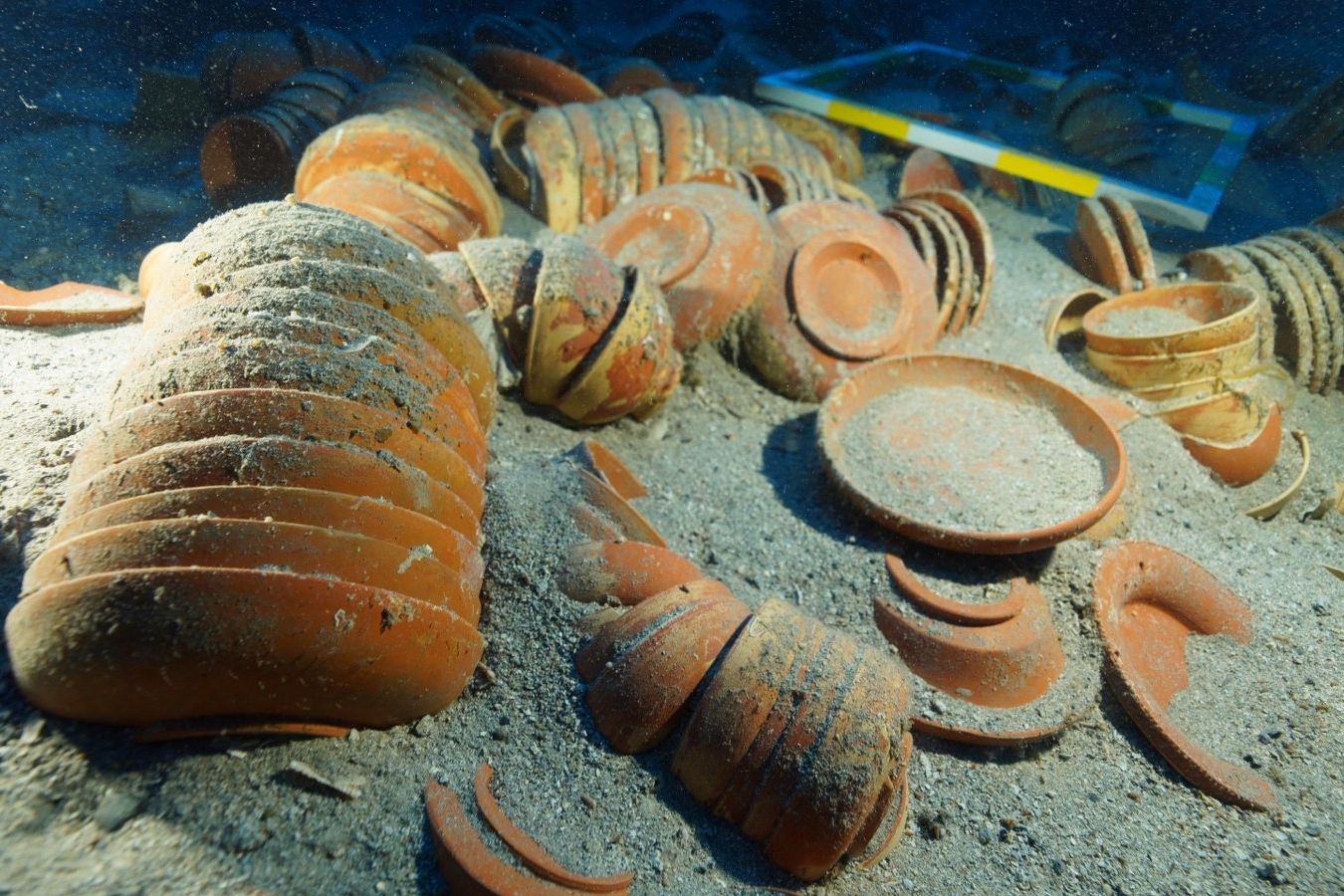
Researchers believe that the vessel’s plates and bowls were made in the ancient city of Rhosus, once praised by Roman statesman Cicero for its “fine pottery” October 7, 2026 7:45 a.m. The dishes were packed carefully, and many remained intact. Akdeniz University More than 2,000 years ago, a ship full of fine tableware sank to the bottom of the Mediterranean Sea after departing from what is now Turkey. Last year, divers and archaeologists began excavating the wreck and its cargo, much of which is extremely well preserved. It includes stacks upon stacks of plates; bowls; and trays purpose-built for different foods, such as nuts, fish and soup. “These artifacts, which have survived in good condition to the present day because of the clay placed between them when they were packed into crates, preserve evidence of Anatolia’s production expertise and the Mediterranean’s trading history,” Mehmet Nuri Ersoy, Turkey’s culture and tourism minister, announced in a social media post, per a translation by the state-run Anadolu Agency. Researchers from Turkey’s Akdeniz University first came across the wreck during a 2023 underwater archaeological survey near the town of Adrasan, along the country’s southern coast. A team led by underwater archaeologist Hakan Öniz began excavating the site last year, the university notes in a statement. Marine archaeologists first discovered the wreck during a 2023 survey. Akdeniz University The ship lays between 138 and 180 feet below the surface. Among the sand-buried wreckage, researchers found coins from the Anatolian city of Antioch that date to the first century B.C.E. From these, they deduced that the ship sank at least two millennia ago. The researchers sorted the thousands of ceramic artifacts into 122 different types of dishes: plates, bowls, trays and amphorae of varying sizes. The amphorae were probably made on the Aegean Islands, while the bulk of the plates and bowls were likely manufactured in the port of Rhosus, now the Turkish city of Arsuz. Rhosus was famous for its ceramics, which were known as rhosica vasa. The Roman statesman Cicero even mentioned the city in a letter to his friend Atticus in 50 B.C.E., calling the dishware “fine pottery.” The Roman Empire started absorbing Anatolia more than a century before Cicero wrote that letter. The peninsula was among its first eastern conquests. Rome’s expansion would continue well past this pottery-making port, eventually reaching around the Black Sea. Did you know? Rome’s Eastern empire The Eastern half of the Roman Empire was known as the Byzantine Empire and outlasted the Western half by 1,000 years. Researchers believe that the wrecked ship was sailing within a trading network between Antioch, Greece and the Italian Peninsula. According to a 2023 paper published in the Journal of Maritime Archaeology, it likely sank on its way to Rome, after running aground on hidden shoals during a storm. Öniz and co-author Emre Okan, an archaeologist at Turkey’s Duzce University, wrote that the wreckage is among a “rare class of shipwrecks of which the cargo consists of a clearly defined ceramic class.” The Akdeniz University team is still excavating the wreck, with the aid of underwater robots, per the statement. As Ersoy wrote in his post, “We are bringing 2,100-year-old tableware to light from the depths of the Mediterranean.” You Might Also Like Get the latest stories in your inbox every weekday. More about: Ancient Civilizations Ancient Greece Ancient Rome Archaeology Artifacts Ceramics Cool Finds European History Greece History Italy Roman Empire Shipwrecks Turkey
A Ship Carrying Stacks of Ancient Dishware Sank Off the Coast of Turkey 2,100 Years Ago. Its Ceramic Cargo Is Still Remarkably Intact
Full Article
Original Source
Read the full article at Smithsonianmag →KhanList aggregates and links to publicly available news content. We do not host full articles from third-party sources. Always verify important information with original sources.