
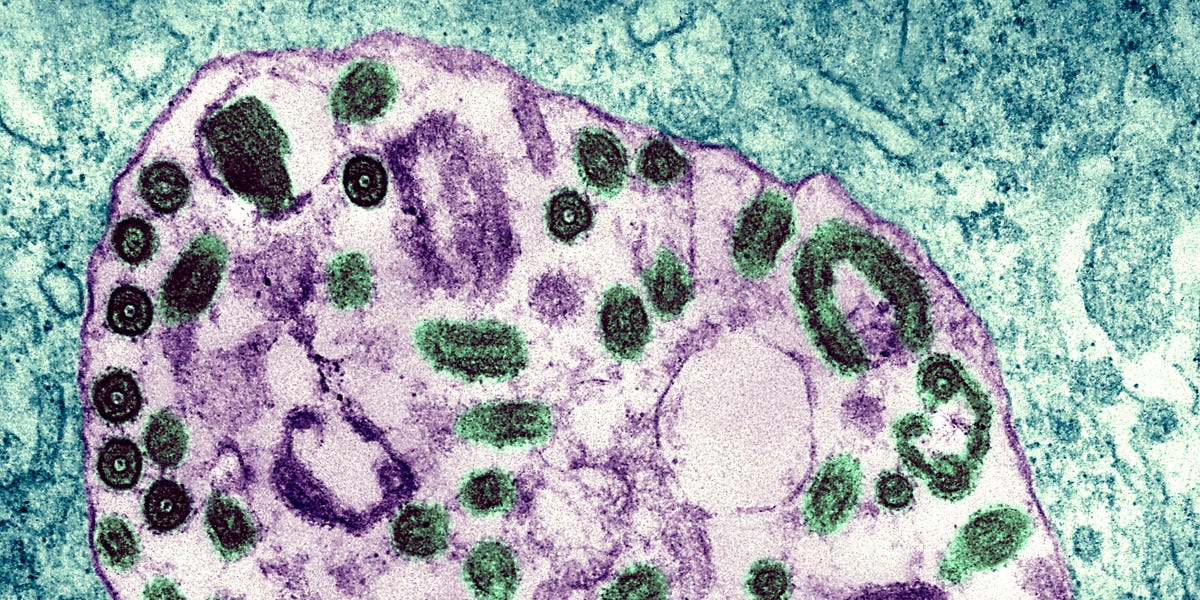
4 min readA Soviet scientist died agonizingly from Marburg virus after accidentally infecting himself during weaponization research at a Siberian biolab.The virus mutated into a deadlier strain inside the infected researcher's body, which Soviet bioweapons scientists then weaponized into powder for potential biological attacks.The weaponized Marburg variant remains stored at a Russian research facility today, raising ongoing concerns about accidental or intentional release decades after the Cold War.Many stories and secrets were lost in the ash heap of the Soviet Union’s collapse. But one fact is not in doubt: Dr. Nikolai Ustinov died painfully.“I can say it was a terrible death,” said Dr. Ken Alibek, formerly Dr. Kanatjan Alibekov, in a 1998 Frontline documentary. “He was dying for about two weeks. It was blood from everywhere, from nose, from eyes, mouth, ears.”Dr. Ustinov had become infected with a disease for which there was no cure. From the moment he contracted Marburg virus (MARV), a member of the Filoviridae family with symptoms similar to its cousin Ebola, his fate was sealed. But while Marburg infections typically come from an exchange of bodily fluids with an infected person, or contact with an Egyptian fruit bat, the manner in which Dr. Ustinov came to be infected is something stranger and far more sinister.Dr. Nikolai Ustinov worked at the State Research Center of Virology and Biotechnology, also known as VECTOR, conducting research at their maximum-security BSL-4 lab in Koltsovo, Siberia. Ustinov was researching the deadly Marburg virus, but not with the intention to find a cure; his work to better understand the disease was with an aim toward weaponizing it.There’s some disagreement as to just how Ustinov contracted Marburg himself. While it’s agreed that an accident occurred in the course of his daily research activity—purposefully infecting guinea pigs with the horrific bleeding disease via syringe—two stories have emerged for how it happened. The aforementioned Frontline report alludes to a second scientist being in the lab, whose syringe-wielding hand slipped and jabbed the finger of Ustinov, who was holding the next small, furry, soon-to-be viral victim. But Annie Jacobsen’s Biological War suggests that Ustinov made the error entirely himself, accidentally injecting his own finger instead of the guinea pig.Once Ustinov realized what had happened, Jacobsen recounts, he took action:“Dr. Ustinov quickly left the lab through one of Vector’s airlocks, took a chemical shower to decontaminate the biohazard suit he was wearing, and used an emergency telephone to call his boss. His supervisor instructed him to go to Vector’s biocontainment hospital, also equipped with submarine-like airlocks.”Ustinov’s wife Yevgenia could only see her husband through a window, and could only speak to him via a telephone, up to and including their final goodbye. She was spared, however, seeing the extent of what the deadly virus was doing to him; his colleagues, according to Frontline, “wrapped him in sheets to his chin during her visits.”But Ustinov understood that his colleagues did need to know the details of what the virus was doing to him. They were viral researchers, after all, and his infection offered a singular opportunity to advance their knowledge. “With clinical detachment,” the U.S. Naval War College recounts in an article on the event, “he documented his own decline in a journal with bloodspotted pages.”Following his death, a team of biohazard suit-adorned doctors went to work conducting an autopsy on Ustinov. They extracted his spleen and liver and removed his blood via syringe. What they discovered was that, while the virus was slowly killing Dr. Ustinov, it was also evolving inside him. “It had transformed,” Jacobsen writes, “into a far more virulent germ than the original strain of Marburg virus Dr. Ustinov had been working with when he accidentally stuck himself with that syringe.”Ustinov’s remains were placed in a “zinc-lined coffin,” and the new strain that had developed in his body was named “Variant U” in his honor.In the Frontline special, Dr. Alibek was asked about what became of “Variant U” after Ustinov died:“INTERVIEWER: What did you do with it?KEN ALIBEK: A virus that was isolated from his organs was used for manufacturing new variants for biological weapons.INTERVIEWER: So it would be more virulent?KEN ALIBEK: Yes, it was more virulent.”Jacobsen writes that by early 1988, the scientists in the USSR’s bioweapons division, Биопрепарат (Biopreparat), began work to mass produce “Variant U.” “They dried it into powder to create a dust to one day be covertly spread around enemy territory and inhaled as part of a biological weapons attack.”Of course, the Marburg-U bioweapon was never unleashed by the Soviet Union before its collapse. In April of 1992, Russian President Boris Yeltsin called for “the termination of research on offensive biological weapons, the dismantlement of experimental technological lines for the production of biological agents and the closure of biological weapons testing facilities.”But that didn’t mean the supply of powdered Variant U was suddenly swept away. “To this day,” Jacobsen concludes, “it is understood to be housed at Vector.” Whether it will ever make its way out has yet to be seen.After all, accidents can happen.Michale Natale is a News Editor for the Hearst Enthusiast Group. As a writer and researcher, he has produced written and audio-visual content for more than fifteen years, spanning historical periods from the dawn of early man to the Golden Age of Hollywood. His stories for the Enthusiast Group have involved coordinating with organizations like the National Parks Service and the Secret Service, and travelling to notable historical sites and archaeological digs, from excavations of America’ earliest colonies to the former homes of Edgar Allan Poe.
A Scientist Bled to Death for Two Weeks. The Virus He Left Behind Is Sitting in His Lab.
Full Article
Original Source
Read the full article at Popularmechanics →KhanList aggregates and links to publicly available news content. We do not host full articles from third-party sources. Always verify important information with original sources.