
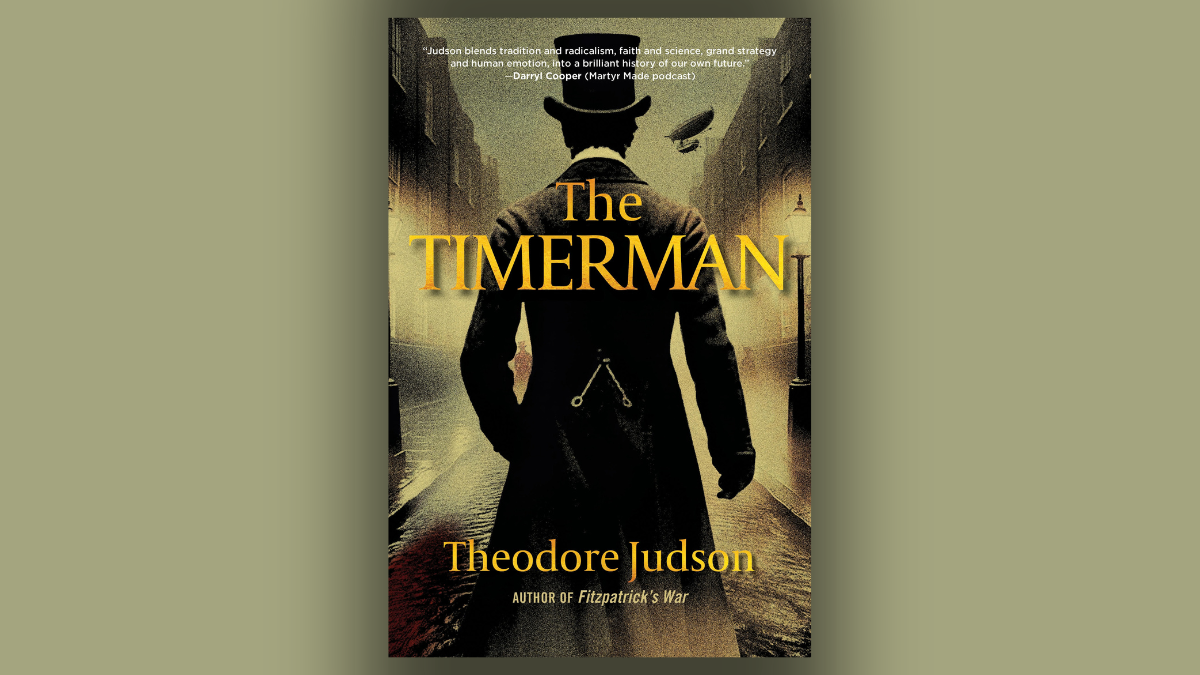
Italian philosopher and novelist Umberto Eco once said that “[a] novel is a machine for generating interpretations.” While most readers today will expect something straightforward out of a novel, with a plain path of growth and development for the characters resulting in a satisfying conclusion, there are still novelists out there who want the reader to figure things out for themselves. Frank Herbert may have accidentally done this in the 1960s with Dune, writing what he thought was an obvious warning against a single leader having too much power. When the public largely interpreted his book as endorsing Paul Atreides’ ascension, he wrote Dune: Messiah to clarify his position on the matter. Readers still debate Paul’s morality to this day, even if Herbert wrote four more sequels to affirm his own take. Herbert died in 1986 and Eco died in 2016. But in 2026 it seems less common for a writer to challenge to his own readers, asking, “What do you think is going on here?” and leaving them to sort it out. Theodore Judson, who wrote Fitzpatrick’s War in 2004, recently released a new sequel called The Timerman. Both books will have readers arguing into the night over Judson’s vision for the future. Fitzpatrick’s War has a clever conceit; it is fashioned as a memoir by a future hero in the year 2453, annotated by his detractor in 2591. In this chronology, the 21st century was a time of electric storms and EMP blackouts that knocked technology backward into the age of steam. We come to find that these storms weren’t natural: They were the result of satellite weapons launched intentionally to remove the comforts and ease of our time, forcing mankind to spend its energy farming and surviving. Thus occupied, we no longer spent our days immersed in the degeneracy overrunning society. The United States and Canada as we know them both fall, and in their wake the Yukon Confederacy is forged, mostly in the Mountain West and High Plains. Aggressively religious and hardworking, the Yukons build themselves a new nation with traditional values built into its laws. Our protagonist, Bruce, tells the story of his life and career in the service of the titular Fitzpatrick, who aims to expand the Yukon Confederacy by weakening and defeating her less-religious neighbors. Bruce does so with cunning and intelligence, committing morally questionable acts along the way. He explains that the Yukons’ government was bloated and corrupt but he remained a righteous man, yet his future detractor, Van Buren, paints Bruce as the corrupt one, and says the government did everything above board. Living in our current time of hyper-partisanship, it’s not difficult to see what Judson might have been saying with this: People lie, history books are wrong, you might be serving an illegitimate empire. He could also just as easily be saying the government is so messed up that no good person inside of it could straighten it out. The reader will find a way to see their own worldview in the story, and this is where Judson paints his sharpest picture of human behavior. In essence, Bruce and Van Buren are waging a war of narratives. Fitzpatrick’s War found a limited but devoted reader base in its time, growing in popularity in certain online circles. In 2026 Judson returned to the world he created to show another side of the Yukon Confederacy, this time through the eyes of one of the mysterious “Timermen,” a secretive organization that infiltrates and subverts neighboring powers that could rival the Yukons’ government down the road. One such place, Cumberland, has sent infiltrators into the Yukon with the goal of shutting down their satellites, which would immediately put the Confederacy at a technological disadvantage. Thus, the Timermen need to send their own infiltrator into Cumberland to take them down first. The main character, John Randel, is a loyal Yukon of low birth (his mother was a prostitute). If he succeeds in dismantling Cumberland, he’ll improve his station. The job will take years of deep cover work, and he’ll have to balance the weight of his religious devotion and the inherent dishonesty that comes with espionage. Although he intertwines himself in Cumberland’s court, he’s able to get close to their sinful institutions and use their vices against them. Once again there is a surface-level takeaway that will be plain to the reader: In a righteous society, sin makes you politically vulnerable in ways you won’t predict. That seems obvious, yet there will be many other interpretations of this text depending on who reads it. It’s a fascinating fictional exercise for Judson to stress-test his own vision of the future by showing it in both a good and bad light. Popular culture rarely hesitates to show The Left as selflessly noble and The Right as a bunch of bigoted hicks, but Judson wasn’t afraid to portray a ruthless version of his own “right side” as flawed or even wrong in the execution of its powers — almost as if warning against the concentration of power, but hey, that’s just one interpretation. Someone could argue that he’s treading over the same ground as Herbert, though he’s less ambiguous about whether the Timermen are right to take out Cumberland. The Yukons’ power depends heavily on keeping everyone else’s digital tech from coming back online. If technology were to progress beyond that, mankind would again slide into decadence. There are plenty of discussions and takeaways in that idea alone — as well as moral assessments, some of which many readers won’t like. Is technology bad? Or is it just a problem because of what mankind is likely to do with it if they have too much of it? A famous mathematician once said that “[the] Industrial Revolution and its consequences have been a disaster for the human race.” Is Judson putting his supposedly preferred form of government in the same ideological camp as the Unabomber? That’s a bold move. But he’s also bold enough to show that a morally upright theocracy wouldn’t be a utopia by any means. These are thick and robust novels, especially the first one, which has stuck around for a reason. The Yukons may have used their satellites to flatten all of the digital technology, but Eco’s Machina Interpretiva is still humming right along, and a new wave of readers is bound to create scores of new responses. Graham Bradley is a second-generation trucker, avid reader, and longtime book reviewer. He has also published over a dozen novels and short stories. His Substack is Trucker Man Reads. book reviewBooksFitzpatrick's WarPoliticsscience fictionThe TimermanTheodore Judson
A Science Fiction Novel That Stress-Tests Our Political Future
Full Article
Original Source
Read the full article at Thefederalist →KhanList aggregates and links to publicly available news content. We do not host full articles from third-party sources. Always verify important information with original sources.