
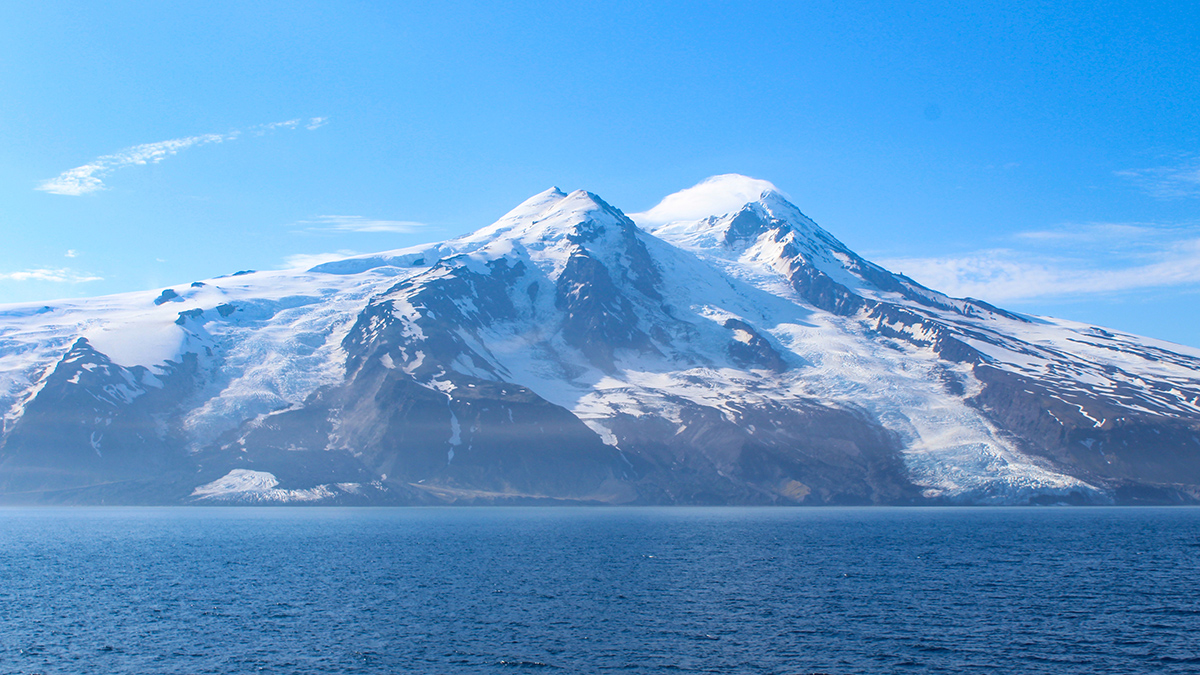
On 10 March 2025, an oceanic transform fault in the Arctic Ocean slipped and generated a magnitude 6.5 earthquake. Three minutes after the event, a rock avalanche on Jan Mayen Island, 7 kilometers away, buried one of its glaciers under nearly a million cubic meters of rock. Other Arctic islands have experienced similarly strong quakes that didn’t cause avalanches, so why did it happen on Jan Mayen? New research found that a series of previous smaller avalanches, possibly enabled by warming-degraded permafrost, had weakened the rock slope above Jan Mayen’s Kjerulf Glacier. When the strong quake struck, the rock slope collapsed and buried the ice. “Where we have permafrost, it is degrading because of the increase of the temperature,” said lead researcher Guilherme de Melo, a seismologist at GEOMAR Helmholtz Centre for Ocean Research Kiel in Germany. Shaken Up Three minutes after the main shock, between 30% and 50% of Kjerulf Glacier was buried by rock. Norway’s Jan Mayen Island is no stranger to seismic activity. The small, tadpole-shaped island sits in the Arctic Ocean next to the Jan Mayen oceanic transform fault, where the North American and Eurasian tectonic plates are sliding past each other at a speed of 14 millimeters per year. The two largest of the island’s many glaciers, Weyprecht and Kjerulf, lie along the slope of Jan Mayen’s central volcano, Beerenberg, the northernmost active volcano in the world. But the March 2025 quake was the first time scientists had observed a rock avalanche on Jan Mayen triggered by a nearby earthquake. The researchers set out to discover why it happened and gathered seismic data, Global Navigation Satellite System (GNSS) data, infrasound records, and satellite imagery, as well as long-term weather and climate records for the region. Before the 10 March 2025 oceanic earthquake, Kjerulf Glacier (Kjerulfbreen) reached Jan Mayen’s coastline (left). The offshore quake caused a rock avalanche that has covered nearly half of the glacier with rocks (right). Credit: de Melo et al., 2026, https://doi.org/10.1073/pnas.2617210123, CC BY 4.0 The data they compiled clearly connected the offshore quake and the rock avalanche on Jan Mayen, showing significant shaking and surface displacement on the island immediately following the main shock. The island also experienced more than 1,500 aftershocks over the next 3 weeks. The data also revealed why this particular quake was so destructive: Satellite imagery showed that smaller rockslides happened in 2017, 2019, 2023, and 2024, all clustered around the spot that ultimately collapsed in 2025. The team suspected that the previous rockslides destabilized the slope above the glacier enough that one strong quake sent it crashing down. Three minutes after the main shock, between 30% and 50% of Kjerulf Glacier was buried by rock. Four hours later, ice calved off neighboring Weyprecht Glacier, too. The team published these results in Proceedings of the National Academy of Sciences of the United States of America in September. Permafrost Degradation “This study brings together seismic and GNSS observations, infrasound, radar and optical imagery, and air temperature records, which is a notable achievement,” said Eirini Makopoulou, a physical geographer at Stockholm University in Sweden who was not involved with this research. One critical piece of the rockslide puzzle illuminated by the synthesis of data is that there was no ground shaking recorded before the earlier rockslides. On the basis of long-term trends of warming air temperatures on Jan Mayen, the researchers suspected that thawing permafrost, not seismicity, weakened the rock slope and made it more vulnerable to collapse. “Warming can reduce the strength of ice-filled fractures, potentially making some steep coastal and glacier-adjacent rock slopes more susceptible to failure when an earthquake occurs nearby,” Makopoulou explained. However, she was not entirely convinced of the degree to which permafrost degradation made the Jan Mayen avalanche more likely. She said it was “plausible,” but that temperature measurements from the rock slope itself, rather than from the air, could strengthen the connection. Kjerulf will remain buried “for a long time to come.” “The contribution of warming to this failure remains uncertain, and this single event cannot establish how widespread such changes in susceptibility might be,” Makopoulou said. “Future risk assessments should identify where strong earthquake shaking could affect unstable permafrost slopes, where avalanche material and resulting waves could travel, and where communities, infrastructure, and tourism activities are exposed,” she added. de Melo pointed to rock avalanche events in Greenland in 2023 and Alaska in 2025, in which permafrost degradation and glacial thinning may have contributed to slope instability. And north of Jan Mayen is Svalbard, he added, which is also vulnerable to permafrost degradation, near other active transform faults, and has experienced similarly strong earthquakes in the past. What will happen to Kjerulf Glacier now? Over time, de Melo said, some of the debris should penetrate the glacier while some may remain on its surface. Either way, it looks like Kjerulf will remain buried “for a long time to come,” he added. —Kimberly M. S. Cartier (@astrokimcartier.bsky.social), Staff Writer Citation: Cartier, K. M. S. (2026), A rock avalanche buried an Arctic glacier. Was climate change to blame?, Eos, 107, https://doi.org/10.1029/2026EO260320. Published on 21 October 2026. Text © 2026. AGU. CC BY-NC-ND 3.0Except where otherwise noted, images are subject to copyright. Any reuse without express permission from the copyright owner is prohibited.
A Rock Avalanche Buried an Arctic Glacier. Was Climate Change to Blame?
Full Article
Original Source
Read the full article at Eos →KhanList aggregates and links to publicly available news content. We do not host full articles from third-party sources. Always verify important information with original sources.