
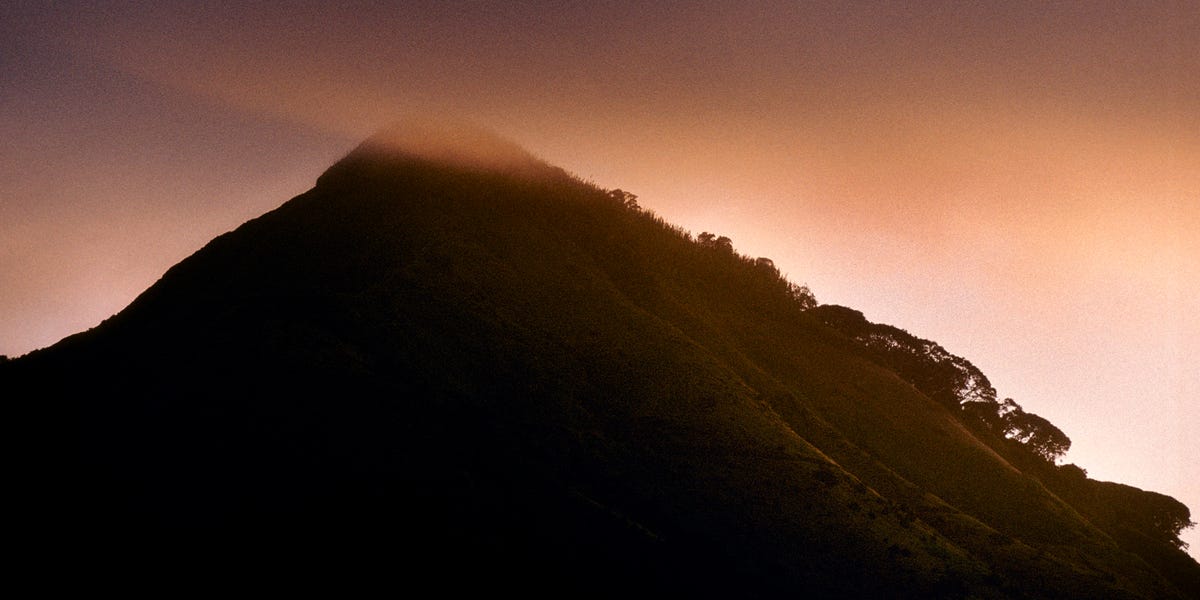
The word “terraforming” is typically reserved for discussions of other worlds. Sci-fi writers dream up vast galactic empires where humans have bent entire planetary ecosystems to their will while, in the real world, the world’s richest man contemplates a similar future. But on the remote island of Ascension in the South Atlantic, an accidental 180-year-long experiment shows what happens when you terraform our own planet. Some see the story as a small slice of hope for areas around the world facing desertification in the face of climate change, while others see the history of Ascension Island as a warning about humanity’s impact on the natural world.Around one million years ago, volcanic eruptions along the Mid-Atlantic Ridge pushed the island up out of the Atlantic. It went unseen by humans until 1501, when Portuguese admiral João da Nova came across it. Two years later, Portuguese navigator Afonso de Albuquerque found it again on the Christian holiday of Ascension Day, which is how the island got its name. However, neither of these expeditions set up shop on the island, and it wasn’t until 1815 when Napoleon Bonaparte was exiled to St. Helena, an island located some 800 miles away, that the United Kingdom finally established a military outpost Ascension to keep tabs on him (a good idea since he’d escaped exile once before).Some of the most colorful descriptions of Ascension come from naturalists arriving at the island in the decades following British settlement. Among these voices was a young Charles Darwin, who arrived on the island in the summer of 1836 and described it as possessing a “naked hideousness.”“Those who have beheld a volcanic island, situated within an arid climate, will be able at once to picture to themselves the aspect of Ascension,” Darwin wrote. “To complete this desolate scene, the black rocks on the coast are lashed by a wild and turbulent sea.”However, a little less than two centuries after this bleak description, the island is now a lush tropical cloud forest filled with eucalyptus, bamboo, banana plants, araucaria, and Cape bramble—all plants from three separate continents. So how did this happen? Well, the short answer is humans, but the slightly longer answer is the work of the British botanist Joseph Hooker. In 1847, Hooker persuaded the Royal Navy to bring plant specimens from the Kew Gardens in London to catch rain, reduce evaporation, and improve soil health, according to El Pais.The introduction of these plants, along with more humans (who brought with them insects, rats, and cats, in a cyclical parade of invasive species), essentially terraformed the island, turning a once desolate landscape into something more suitable for human habitation.Some scientists see this history as a possible blueprint for fighting desertification, which is spreading as climate change threatens vulnerable ecosystems. Among them is Victor Maull, who recently finished a Ph.D. at Pompeu Fabra University focused on the island.“In the laboratory we are working to make minimal models that can explain changes to ecosystems,” Maull said in a press statement. “Normally, we model ecosystems that degrade, but with Ascension we have the opportunity to understand the reverse process and see if we can invert the collapse.”However, other experts who spoke to El Pais have a different interpretation of Ascension island’s ecological history—one that stresses caution rather than celebration. Although Darwin had little positive to say about the island on his visit, endemic species did live on the roughly 34-square-mile island back then. Today, those native species are being crowded out by invasive plants that now cover almost the entire island. One of those natives, the Ascension Island parsley fern, was thought to be extinct until 2009, when researchers found four plants clinging to a cliff.“What remains today is an unusual combination of species—bamboo, eucalyptus, ficus and others—that would never have grown or evolved together naturally in an ecosystem,” Tiffany Simpson, director of Conservation and Fisheries for the Ascension Island Government, told El Pais. Because of this mismatch, even some of the invasive plants are struggling to establish roots in the shallow, volcanic soil, causing many trees to topple over during fierce storms.Whatever one makes of its history, Ascension offers two lessons. It shows that deliberate intervention may help hold back advancing deserts, and it warns of what can be lost when humans reshape a one-of-a-kind ecosystem to suit their own needs, whether on this planet or another.Darren lives in Portland, has a cat, and writes/edits about sci-fi and how our world works. You can find his previous stuff at Gizmodo and Paste if you look hard enough.
A Remote Island Holds a Major Warning Sign for the Future of Humanity
Full Article
Original Source
Read the full article at Popularmechanics →KhanList aggregates and links to publicly available news content. We do not host full articles from third-party sources. Always verify important information with original sources.