
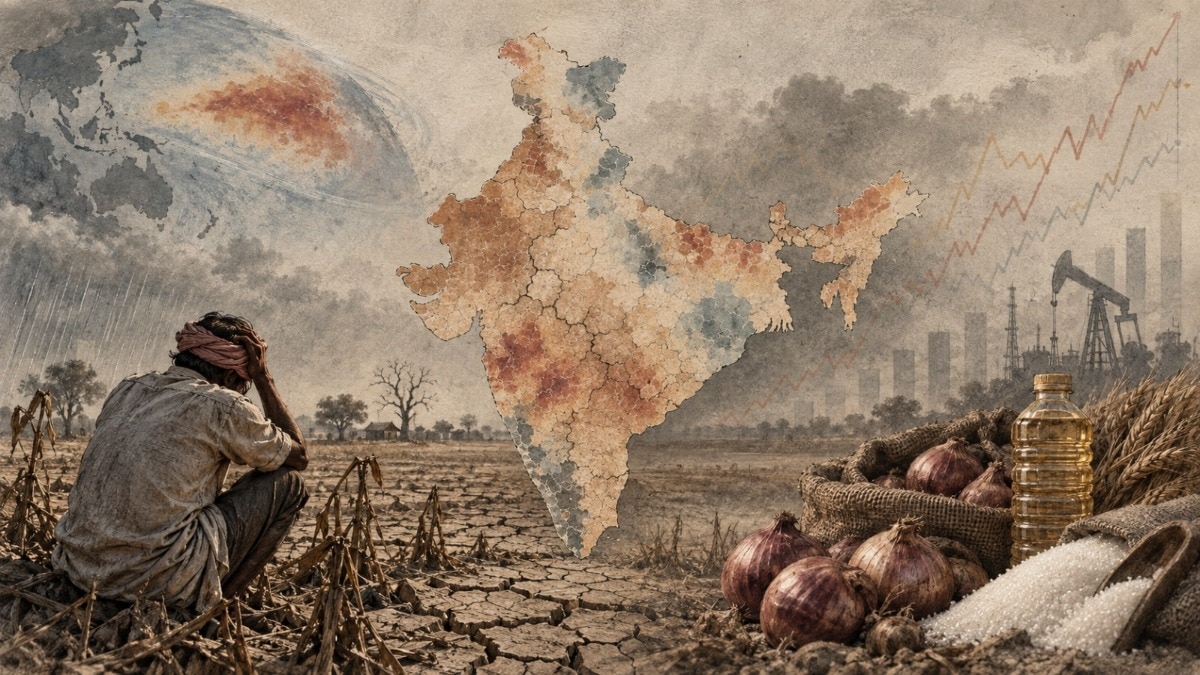
A kilo of onions has doubled in price in a year. India's monsoon is 15 per cent short, but more than half of this year's rise in food prices came before it failed.Last September, a kilo of onions cost Rs 27 on average in India. This September, it costs Rs 54. Sugar has gone from Rs 47 to Rs 59 on the same shelf in the same period.Ask why, and the answer everyone reaches for is the rain. India's monsoon is 15 per cent short with under a fortnight to run, and the stretch of the Pacific most often blamed for a weak one is the warmest on record for the date.But the kitchen was getting dearer before the sky did anything. Food inflation climbed from 3.47 per cent in February to 4.78 in May. That's before the season began. More than half of this year's increase arrived ahead of the monsoon now being blamed for it.That is what makes this year worth following. A record El Nino is arriving on a market where prices have already been climbing for months, and where an import bill set outside the country never waited on the rain at all. The pressures are stacking rather than taking turns. The Nino 3.4 region of the equatorial Pacific stood 2.9 degrees Celsius above its 1991–2020 average on September 16, warmer on that date than in any year since satellite measurements began in 1982. Among completed events, only the El Nino of 2015–16 has run hotter, at 3.01 degrees. This one has not peaked. AN EVENT THAT IS STILL GROWINGTwo degrees is the level at which forecasters call an El Nino "super"; though they usually judge it on a three-month average rather than a single day. On daily readings, this one first passed two degrees on July 10 and has stayed above it since, 69 days to September 16, on the sea-surface temperature series the United States National Oceanic and Atmospheric Administration publishes.Five completed events have reached that level since 1982, and four of the five have come since 1997. That is a clustering, not a trend: 44 years is a short record and five events are not many. What can be said plainly is that the two strongest in it are 2015–16 and this one, 11 years apart.THE MONSOON IT IS BEING BLAMED FORBetween June 1 and September 17, India recorded 686.4 mm of rain against a normal of 806.8 mm, according to the India Meteorological Department's cumulative rainfall bulletin. The IMD's scale puts anything within 19 per cent of normal in the "normal" band. So, 15 per cent is not officially a drought.The national figure hides the country. Nineteen of the 36 meteorological subdivisions are 20 per cent or more below normal. Rayalaseema has had barely half the rain it should have by now, at 51 per cent short. Punjab is 39 per cent short, Marathwada 38, and Bihar 36.That list reads as a map of what India eats: rice in Bihar, pulses and oilseeds in Marathwada and interior Karnataka, and in Punjab, the grain the rest of the country buys when its own harvest fails.Rain deficit is not the same thing as a dry field, and the ground tells its own story. Some 52 per cent of India was abnormally dry or in drought in the week to September 16, on the India Drought Monitor's Combined Drought Index, which blends rainfall, runoff, and soil moisture. A fifth of the country was in severe drought or worse.None of these arrived unannounced. In its second-stage long-range forecast, the IMD put the season at 90 per cent of the long period average, give or take four points, and gave a 60 per cent probability that it would end deficient. It pointed to El Nino conditions developing over the equatorial Pacific.THE RISE THAT STARTED FIRSTRetail inflation, the figure the Reserve Bank of India watches against a 2–6 per cent tolerance band, was 4.8 per cent in August. Food inflation was 5.95 per cent, according to the Ministry of Statistics and Programme Implementation, and it is the part dragging the other up. The steadily rose from 3.47 per cent in February to 5.95 in August.Split that run at the start of the season, and the order of events is clear. Food inflation gained 1.31 percentage points between February and May, before the monsoon, and 1.17 points between May and August, during it. Prices were not only rising before the season; they were speeding up before it, and the monsoon is adding to a climb already underway rather than starting one.Food is rising faster than everything else. So, households that spend the largest share of their money on food are carrying the largest share of the increase. The onion and sugar prices at the top of this story come from the Department of Consumer Affairs' daily retail price report for September 17. They are the all-India averages the department publishes, drawn from what state civil supplies departments report.PRESSURE THAT HAS NOTHING TO DO WITH RAINOf the 21 everyday foods the Department of Consumer Affairs has tracked since January 2015, only six have beaten general inflation — five of them are cooking oil. Vanaspati is up 118 per cent against general inflation of 73 per cent.India buys most of its edible oil abroad. So, that price is set outside the country and does not wait on the monsoon. Brent Crude is around $104 a barrel, up 71 per cent this year. A failed season moves neither number, and both reach the same kitchen.WHAT IS NOT SETTLEDEl Nino years are associated with weaker Indian monsoons, and the relationship is well established, but it does not act alone and nothing here establishes that this El Nino caused this deficit. The stacking is the finding; the apportioning is not available.The season's ranking is less solid than it sounds, too. One account this week has India on course for its driest monsoon in 17 years; a Guardian commentary the same week called it the weakest in 20.WHAT HAPPENS NEXTThe season closes on September 30. Christian Werner, managing director of the Australian consultancy Global Weather Climate Analytics, expects the shortfall to finish between 13 and 16 per cent. He said a cyclone could form over the Bay of Bengal late in September and bring rain to the east and north-east, without shifting the national figure much.Mark Roulston, the planetary scientist who founded Lancaster University's CRUCIAL prediction platform, puts a 68 per cent probability of the season ending between 10 and 20 per cent below normal.For prices, Yuvika Singhal, an economist at QuantEco, put the rule of thumb at roughly 25 basis points added to food inflation for every percentage point the rain falls short. The published data does not separate how much of this season's shortfall has already reached the shelf and how much has not.The government has already dropped the duty on sugar imports and is selling subsidised onions through its own outlets in some states.Last year shows how fast the ground can move. The 2025 monsoon finished at 108 per cent of the long-period average, according to IMD's own Monsoon 2025 report. In one year, the rain a farmer plans around has swung by 23 percentage points, close to a quarter of a normal season.The ocean driving it has not finished warming. The climb in food prices did not wait for it.- EndsPublished By: Pathikrit SanyalPublished On: Sep 18, 2026 19:55 IST
A record El Nino lands on prices that were already rising
Full Article
Original Source
Read the full article at Indiatoday →KhanList aggregates and links to publicly available news content. We do not host full articles from third-party sources. Always verify important information with original sources.