
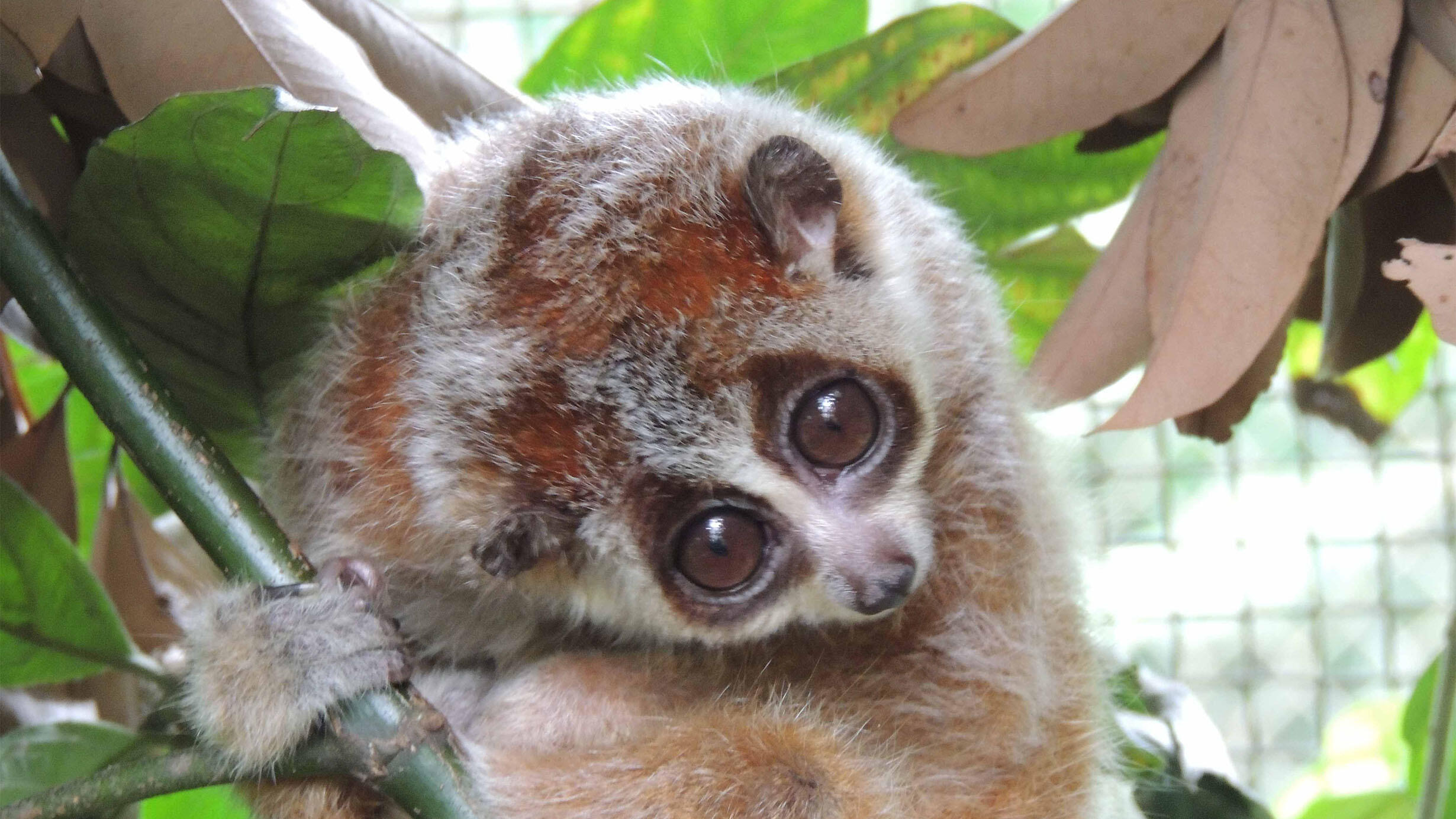
A recent study documented 98 northern pygmy slow lorises living in the wild in Guangxi, China, roughly doubling the country’s known population of the endangered species.The species was previously thought to live almost exclusively in Vietnam and Laos.The northern pygmy slow loris was only identified as a separate species in 2023; physically, it’s plumper, fuzzier, and has a flatter nose than the southern species.Like all lorises, northern pygmy lorises are threatened by habitat loss and hunting for the wildlife trade and for use in traditional medicine. Plump, fuzzy and venomous, with wide eyes, a button nose and sharp teeth, northern pygmy slow lorises were thought to reside almost exclusively in Vietnam and Laos. However, new research has documented 98 of the endangered primates in Guangxi, China, in what could be the country’s largest known population of the species. The finding, published in the journal Integrative Zoology by researchers at Guangxi Normal University, expands the known range of the nocturnal primate and suggests that a substantial population may have gone undetected in Guangxi’s rugged karst forests. The species, Xanthonycticebus intermedius, was previously thought to number just over 100 individuals in China, primarily in Yunnan province. Its known range also extends south into northern Vietnam, reaching as far as Hai Van Pass. Anna Nekaris, a professor of ecology, conservation and environment at Anglia Ruskin University in the U.K. and founder of the Little Fireface Project that focuses on lorises, said she’s excited by the discovery and hopes it will inspire research on this understudied species. “A lot of these nocturnal animals — they’re so little known in the wild, they’re so little researched, that when you actually do go look for them and you find them, that’s incredible,” Nekaris said. Pygmy slow lorises are native to Southeast Asia. Xanthonyticebus intermedius, the northern pygmy slow loris, was only recognized as a distinct species in 2023 after genetic and morphological research separated it from its close relative, the southern pygmy slow loris (Xanthonycticebus pygmaeus). The northern pygmy slow loris, was only recognized as a distinct species in 2023 after genetic and morphological research separated it from its close relative, the southern pygmy slow loris. Image by Quang Tran Thanh/Leo.wildtour. Researchers said government reports indicate that pygmy lorises, possibly confiscated from the wildlife trade, were released in Guangxi years ago. But Mary E. Blair, associate director at the Center for Biodiversity and Conservation at the American Museum of Natural History, said the answer for why the species has now been found in Guangxi is likely simpler: The animals are difficult to find, and researchers had not previously looked for them in the region. “When I was doing the countrywide surveys in Vietnam, there were lots of slow lorises everywhere, but just nobody was looking for them because you have to go out all night long to survey for them,” Blair said. The researchers surveyed six areas of Guangxi between June and October 2025, covering nearly 286 kilometers (178 miles). They detected lorises in four of the six areas, with the highest number, 37, occurring in Longzhou. Researchers reported high encounter rates, notably 1.08 individuals per kilometer in Ningming and 0.93 in Pingxiang. Of the 98 lorises documented, 79, or four in five, were living outside protected areas. Nekaris said the finding fits what researchers have observed in other countries. Although slow lorises are threatened by habitat loss, they can persist in fragmented forests and mixed-use landscapes where food resources remain available. But living outside protected areas can also expose lorises to a key threat: the wildlife trade. Nekaris said their elusive nature makes them a “non-target” species, often captured opportunistically by hunters searching for other wildlife. The animals can then enter the pet or traditional medicine trades, with Japan being the world’s most significant market for pet lorises. Like all wild animals, lorises make for poor pets, Blair and Nekaris said, even if their appearance makes them appealing to the trade. Nekaris said the perceived “cuteness” of X. intermedius makes it more sought after than its southern relative. She said traders categorize the two as “the cute ones and ugly ones,” as southern pygmy slow lorises are more slender with larger, pointier muzzles, while X. intermedius is fuzzier and plumper, with a shorter, flatter “button nose.” Southern slow lorises, such as this animal researchers have named Uli, have pointier muzzles and more slender bodies than the northern species. Image courtesy of Anna Nekaris. Lorises are the world’s only venomous primates, delivering a toxic bite once they combine an oily secretion from glands on their upper arms with their saliva. They’re routinely defanged by traders before being sold as pets. Their toothcomb, a vital structure lorises use to groom themselves and scrape gum from trees, is also often removed during defanging. Traditional medicine is another major driver of the loris trade, particularly in parts of Southeast Asia where the animals occur naturally. “They are used in more than 100 remedies in traditional medicine,” Nekaris said, citing her research into loris use in Cambodia. “They’re used more than pangolins. When we were studying them in the wild, people would say, ‘Please, can you just bring me back one for my wife? She’s just given birth. We really need a loris.’” Nekaris said the animals can be processed in numerous ways, with their oil, fur, meat and bones used in different remedies. In some communities, lorises are also soaked in rice wine, which is then consumed as a traditional tonic. Blair said she and her colleagues “re-discovered” X. intermedius in 2023 after genetic analysis of museum specimens confirmed that a species first proposed by Vietnamese primatologist Dao Van Tien in the 1950s and 1960s was distinct from the southern pygmy slow loris. The original specimen was a juvenile, making its classification difficult, and the species was considered invalid. “We used museum specimens from all over Vietnam and also from here in the U.S., and for the first time, we’re able to very clearly see that genetic distinction,” Blair said. “Again, just because nobody was able to look before, it had definitely been hypothesized before by Dao Van Tien. That’s what we were able to show, so we’ve resurrected the name that he had originally given the species.” The Guangxi discovery comes as researchers are working to address a broader lack of attention toward nocturnal primates in Asia. Nekaris said a workshop in November will bring together researchers working on lorises, tarsiers and other Asian nocturnal primates to develop the first action plan focused on the group. “I really hope the more information that gets out there to the public,” she said, “a new generation might want to start studying these animals.” Banner image: Northern pygmy slow lorises have been dubbed the “cute” pygmy slow lorises by wildlife traders, thanks to their plump fuzzy bodies and “button” noses. Image courtesy of Mary Blair/CBC-AMNH. Out of captivity, into conflict: slow lorises struggle to survive after release Citation: Yang, D., Wei, X., Liu, S., Huang, S., Long, J., Bin, G., … Fan, P. (2026). The northern pygmy slow loris Xanthonycticebus intermedius found in Guangxi, China. Integrative Zoology. doi:10.1111/1749-4877.70100 Credits Topics
A rare slow loris may have a much larger population in China than scientists thought
Full Article
Original Source
Read the full article at News →KhanList aggregates and links to publicly available news content. We do not host full articles from third-party sources. Always verify important information with original sources.