
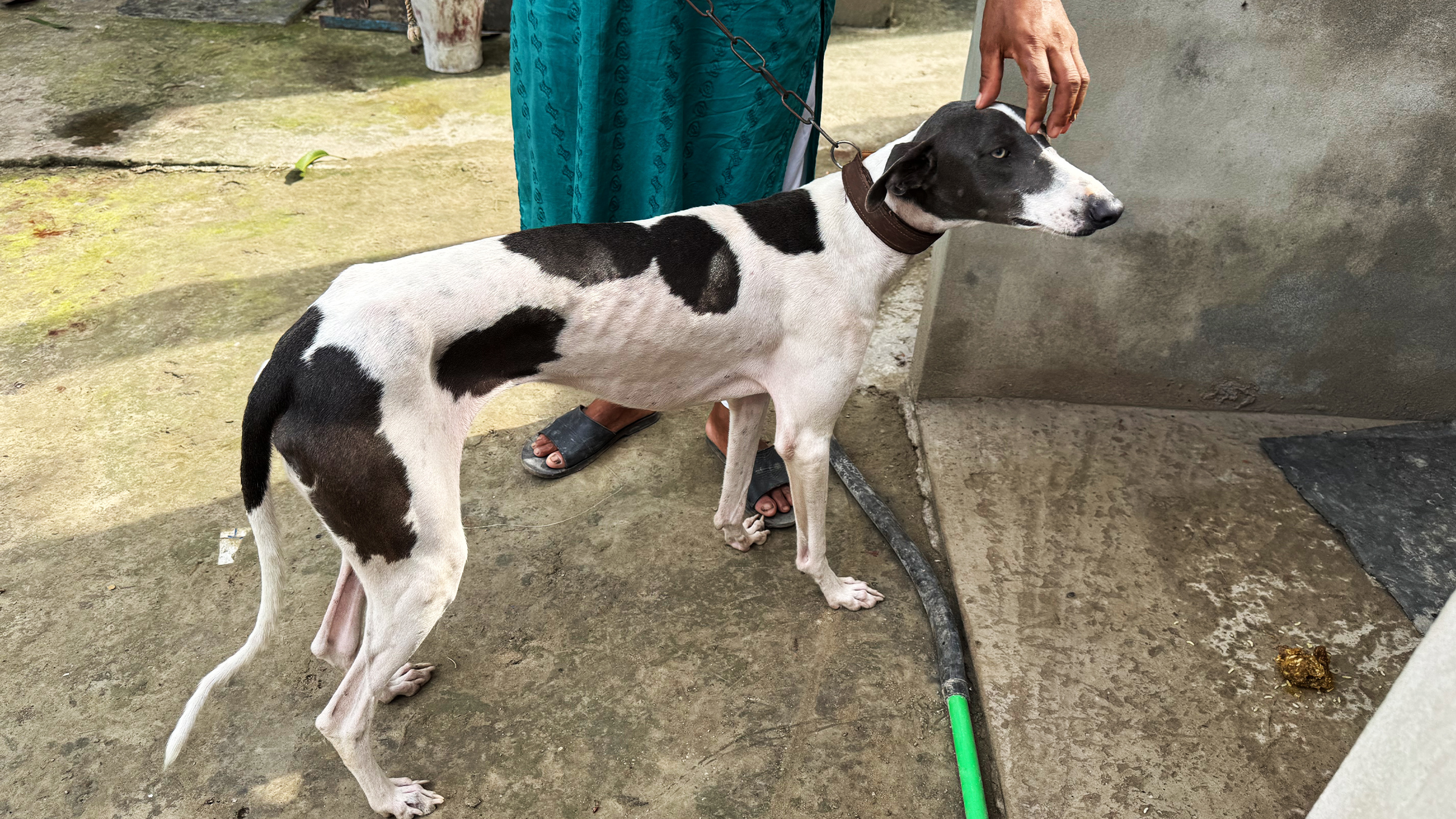
A native Bangladeshi breed of dog, the Sarail or Bengal hound, is thought to have originated more than 200 years ago in the small town of Sarail.It’s origin story is fuzzy: that it claims lineage from the English grayhound is undisputed, but there’s debate about the rest of the mix, whether wolf or a local hunting dog known as pahari daal kutta.Currently, there are fewer than three dozen purebred Sarail sighthounds thought to exist across the country, with no plans by the government to protect this native breed.Artificial breeding, like artificial insemination, can save the Sarail hound from extinction, experts say. Dogs are generally not treated well in Bangladesh, where the majority Muslim population holds a conservative approach to domesticating dogs. Here, kicking a resting or passing stray dog is often seen as amusing. This hostile attitude, for decades, justified the authorities culling stray dogs. In 2019, the passing of the Animal Welfare Act finally put a stop to such institutional killing of dogs. Nevertheless, a deeply entrenched negative prejudice against dogs still persists. For instance, last year, a woman in the northwestern town of Ishwardi, who was disturbed by the neighborhood stray dogs, made the news by allegedly packing puppies in a sack and drowning them in a pond. The resulting public outcry forced authorities to file a criminal lawsuit against her. Bangladesh is home to nearly 1.7 million dogs — 83% of them strays, which suffer from hunger, malnutrition, injury, or cruelty by humans. Consequently, a group of animal lovers has emerged to put a stop to inhumane treatment of stray animals, advocating for their protection. Unlike other parts of the country, the people in the small town of Sarail, located about 95 kilometers (60 miles) northeast of the capital, Dhaka, have strived for generations to save a native dog breed named after the town: the Sarail hound. Proud of this heritage, some people in and around Sarail are trying to save this rare breed from extinction. Pet lovers, some from abroad, travel to Sarail in search of a puppy, ready to pay up to 60,000 takas ($500), according to some dog enthusiasts Mongabay spoke to. Some customers pay the breeders in advance to get a puppy before a female conceives the next cycle. A 9-month-old Sarail Hound is chained at the residence of a breeder. The Sarail hound’s color varies from brindle to mixtures of black, white, and brown, with a prominent white marking down the face. Image by Kamran Reza Chowdhury. Sarail hound: Aggressive and loyal Dog enthusiasts Mongabay spoke to said the Sarail sighthound is aggressive, agile in catching prey, and can jump up to 2 meters (7 feet) high. One of its central characteristics is its keen eyesight. Aref Abdullah Arif, a schoolteacher in Sarail, said his family has been rearing the hounds for decades now, and today own seven purebred dogs. “Sarail hound is a dreaded name to thieves and criminals,” Arif told Mongabay. “It has a tremendous instinct for identifying thieves, or people they deem untrustworthy. They carry out preemptive attacks.” He shared an experience of the Sarail hound’s vigilance: “I usually take dogs for a walk at night. One night, I was walking with a leashed dog. Suddenly, the dog started jumping looking upward. I looked in the direction and found someone in a tree cutting an electricity cable. When I threatened to unleash the dog, he climbed down fearfully and we caught him.” The Sarail hound is sensitive, too, according to Sarail hound enthusiast Kaiser Tamiz Amin, as reported by Bangladesh’s Daily Star newspaper in 2013. “A few years ago, I got seriously sick, and I was on bed rest for two weeks. I found my dogs lying next to my bed eating almost nothing for the whole period,” he said. He added that when his mother died in 2011, their four Sarail dogs refused to eat a whole day and night. A Sarail hound pair at the residence of breeder Md. Mir Hossain Ali in Kuttapara neighborhood in Sarail subdistrict. Historically, the Sarail hound was popular in British India and was called the Bengal hound. Image by Kamran Reza Chowdhury. How is it indigenous? No definitive written records regarding the origin of the Sarail hound are available. Local lore has it that the Sarail hound originated in Sarail more than 200 years ago. The story goes that a Sarail landlord, Dewan Majtuba Ali, chanced upon a Briton accompanied by an unusual-looking dog — now assumed to have been an English Greyhound — during his travels. They made a trade, and Ali went home with the dog. During one of his hunting trips thereafter, the dog got lost in the jungle. Later, she returned pregnant. The puppies had long tails, and showed an aggressive behavior similar to wolves. The local people believed that the dog had mated with a wolf. Thus, they said, the Sarail hound came into being and spread through the area. The 2013 Daily Star report quoted Amin as saying that traders from the Arabian Peninsula, Central Asia, and Western India often travelled to this part of Bengal on horseback, bringing with them Central Asian hounds, famous for their attacking instinct, for security. He further said that the British brought with them European Greyhounds, also known for their hunting instinct. “To me, both versions seem correct. At one point, both the breeds might have crossbred, which became Sarail,” he said as quoted in the report. Another young Sarail hound enthusiast, Md. Yousuf Abdullah, son of Arif the schoolteacher, contested that version of the hound’s origin story. “The Sarail hound is Sarail’s indigenous breed, created by mixing the English Greyhound and our local hunting dog, the pahari daal kutta, which became extinct much earlier. The agile daal kutta was once abundant in the jungles of Sarail,” he told Mongabay. Abdullah said he learned about the daal kutta from another Sarail hound enthusiast in Dhaka. The late dog lover reportedly conducted a genetic test: The results showed that the Sarail hound’s genetic profile largely (more than 80%) matched that of the English Greyhound. “Majtuba Ali had hunting dogs collected from the surrounding hills. The English Greyhound he procured possibly mated with these pahari daal kutta and the puppies were the Sarail hound,” Abdullah said. A leashed male Sarail hound looks vigilantly at Md. Mir Hossain Ali’s house. An adult male Sarail hound’s height ranges from 60-75 centimeters (24-29 inches), and it can grow to a length of up to 90 cm (35 in), including the tail. Image by Kamran Reza Chowdhury. Number dwindled “Although Sarail is famous for the dog breed, there are currently fewer than three dozen authentic Sarail hounds,” Md. Habibul Islam, the district livestock officer for Sarail, told Mongabay. “The number of purebred Sarail hounds is even scanter.” An authentic breeding takes place when an authentic male mates with an authentic female, and the puppies are considered purebred. The locals say the hound was abundant up to the 1990s, but its number declined gradually thereafter. They blame genetic changes, crossbreeding, and a lack of proper health care. Besides, rearing them is costly, forcing many breeders in Sarail to abandon the practice. At present, a maximum of six families in Sarail, a few of families in Dhaka, and one family each in Habiganj, Narsingdi, and Rangamati districts are known to rear Sarail dogs, according to Mansur Ahmed, Sarail’s subdistrict livestock officer. “You will find a handful of Sarail hounds having around 80% of the original characteristics,” he said. Why crossbreeding happens A challenge that breeders said they face is getting an uninterested male to mate with a female in heat. Md. Mizan Mia, a resident of Katanishar village, part of Sarail, recently acquired a 9-month-old purebred female Sarail hound. “I rear the Sarail hound to save it from extinction, but the problem is the availability of an original male. Without an authentic Sarail male, the puppies will not be purebred,” he told Mongabay. Md. Mir Hossain Ali, another Sarail-based breeder, said he had a similar problem. “Currently, our family has one male and one female Sarail hound. The female had an early mating cycle, but the male did not. Now [in September], the male enters his mating cycle, but the female is not ready. So we’ll have to wait for the next cycle,” he told Mongabay. Md. Mizan Mia plays with his 9-month-old female Sarail hound at his residence. The hound’s physical features resemble those of the English Greyhound, with long legs, a lean body, a long tail, and a narrow face. Image by Kamran Reza Chowdhury. Habibul Islam, the Sarail livestock officer, told Mongabay that there are no government programs aimed at conserving the breed. “We are thinking of initiating a project to save the Sarail hound,” he said. Md. Kabirul Islam Khan, a professor of genetics and animal breeding at Chattogram Veterinary and Animal Sciences University, told Mongabay that, “Artificial breeding [like artificial insemination] can save the hound. If the government decides, we can apply artificial breeding.” Banner image: Md. Mizan Mia, a resident of Katanishar village of Sarail subdistrict, calms his 9-month-old female Sarail hound at his residence. Image by Kamran Reza Chowdhury. Feedback: Use this form to send a message to the author of this post. If you want to post a public comment, you can do that at the bottom of the page. Credits Topics
A rare hound with a storied past faces an uncertain future in Bangladesh
Full Article
Original Source
Read the full article at News →KhanList aggregates and links to publicly available news content. We do not host full articles from third-party sources. Always verify important information with original sources.