
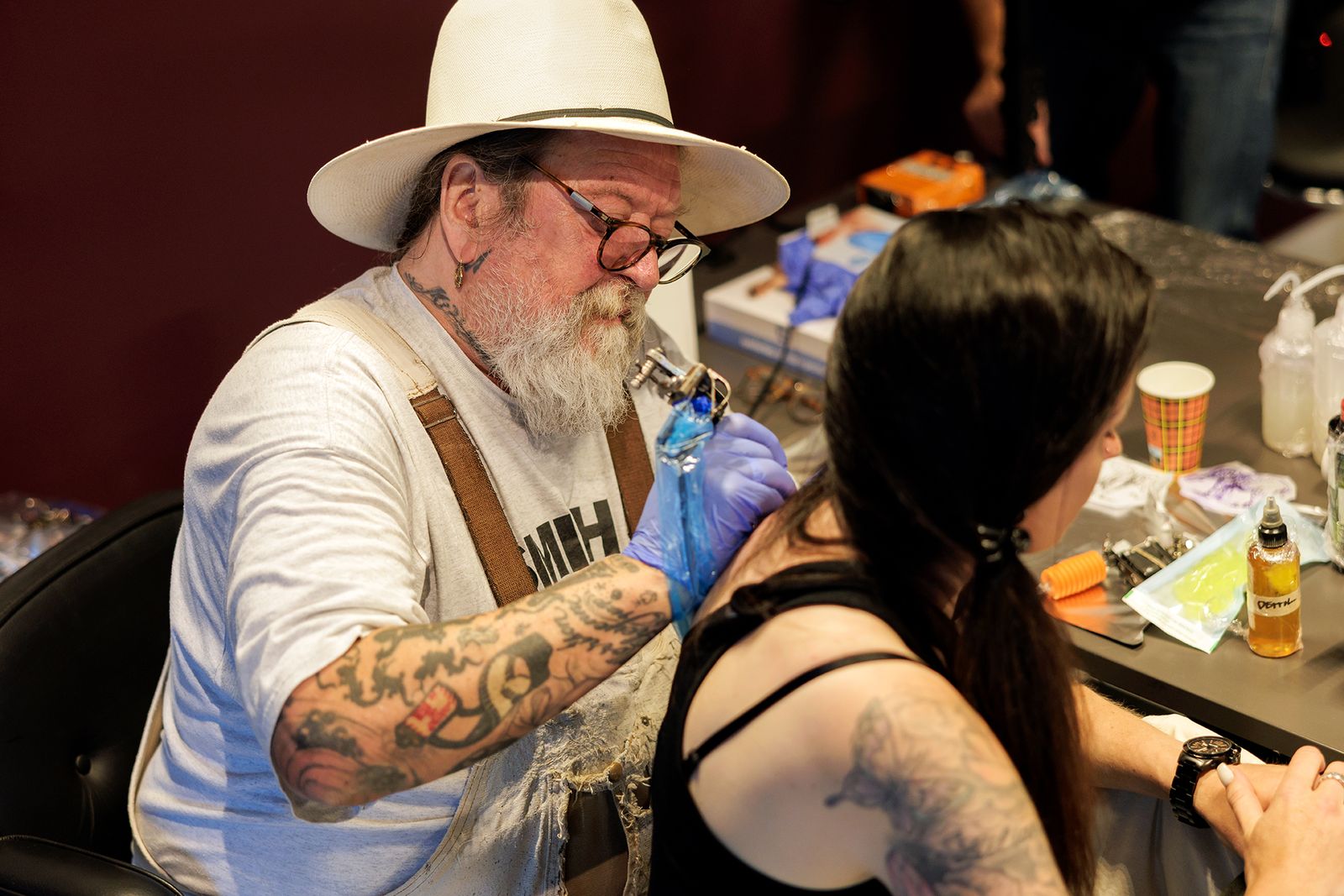
Visitors can choose from dozens of designs pulled from Rembrandt’s works, including lions, windmills and even his self-portraits. One participant was selected for a full-back tattoo of “The Descent from the Cross” November 3, 2026 1:11 p.m. Renowned tattoo artist Henk Schiffmacher is once again leading the "Poor Man's Rembrandt Project," which enjoyed successs during its first iteration in 2023. Mark Bolk, courtesy of Schiffmacher and Veldhoen / Museum Rembrandthuis Four centuries after famed painter and draughtsman Rembrandt van Rijn defined the Dutch Golden Age with a vivid mastery of light, shadow and emotional depth, his works are once again emerging prolifically in his home country. This time, however, the canvases are human skin. In a pop-up studio at Amsterdam’s Rembrandt House Museum, where the artist lived and worked for 19 years, a team of renowned tattoo artists have embarked on a two-week effort to recreate the Old Master’s etchings and paintings in ink. For between roughly $110 and $390, the “Poor Man’s Rembrandt Project” is offering visitors the chance to book a tattoo session and leave with a souvenir that lasts a lifetime. “Globally, more tattoos are sold than wall art. An old tattoo artist once called tattoos ‘the poor man’s Rembrandt’—a work of art more affordable than a painting by the old master, yet no less carefully chosen or executed,” Henk Schiffmacher, a world-famous tattoo artist and the project’s lead, says in a statement. “For us, it is an incredible honor to work in the very place where Rembrandt’s spirit still lingers.” The Poor Man's Rembrandt Project Schiffmacher, known in the business as Hanky Panky, is joined by artists Tycho Veldhoen, Morrison Cheyenne Schiffmacher, Rupa van Teylingen, Frederik Moens and Olof Arrevik. This is Schiffmacher's second iteration of “The Poor Man’s Rembrandt Project.” Its first edition, launched in 2023, was considered a resounding success, not least because of Schiffmacher’s stellar reputation as a tattoo artist and art historian. Throughout his decades-long career, before tattooing was mainstream, he organized some of Europe’s first tattoo conventions. Schiffmacher was one of the few people “who cared about tattooing enough to make sure its visual, cultural heritage was kept and looked after and not chucked in the bin,” Matt Lodder, an art historian at the University of Essex, tells Mike Corder of the Associated Press. Since the project launched on October 26, most of the tattoos have come from the artists’ flash sheets. Inspiration for a tattoo can come from anywhere, from the smallest background details of an obscure Rembrandt etching to the most prominent feature of a world-renowned work. These include the elephant named Hanksen that Rembrandt depicted several times, as well as lions, windmills, sailors, merchants and other figures that populate his landscapes and portraits. The artist’s own visage, from his dozens of self-portraits, and signature are also available for the inking. Several flash sheets offer clients tattoo options from a variety of Rembrandt etchings and paintings. Schiffmacher and Veldhoen / Museum Rembrandthuis “This is all about content,” Milou Halbesma, director of the Rembrandt House Museum, tells the Art Newspaper’s Senay Boztas. “We are a museum of craftsmanship, and we are trying to throw open the craft of Rembrandt and his students as widely as possible. If you translate that to today, we have a number of world-famous Amsterdam creators … And this is a chance to get a tattoo from one of these masters.” One person, 28-year-old Bo Kwakernaak, was selected to participate in the project’s marquee tattoo: a free replication of Rembrandt’s 1633 etching The Descent from the Cross across his entire back. The famous etching—depicting a crowd of people taking Jesus down from the cross following his crucifixion—was chosen for its emotive drama and functional display. “The spine almost becomes part of the cross,” Schiffmacher tells the Art Newspaper. Did you know? Ancient ink Archaeologists used high-resolution digital imaging to discover intricate tattoos of tigers, stags and a leopard on a more than 2,000-year-old Siberian “ice mummy.” Created over multiple sessions, the full piece will take the team of tattoo artists, each contributing their expertise to the scene, roughly 20 hours to complete. The tattoo’s final sit-down will take place on the night of November 7 at the museum itself. Those involved in this year’s effort can’t help but compare Rembrandt, who enjoyed making smaller prints that were more accessible to everyday people, with modern-day tattoo artists. “I think [Rembrandt] would have some kind of click with Henk Schiffmacher,” Epco Runia, the museum’s head of collections, tells the New York Times’ Nina Siegal. “They have a little bit the same kind of character.” “The Poor Man’s Rembrandt Project” is available at the Rembrandt House Museum in Amsterdam through November 7, 2026. You Might Also Like Get the latest stories in your inbox every weekday. More about: Art Art History European History European Travel History Netherlands Painting Pop Art Pop Culture Rembrandt
A 'Poor Man’s Rembrandt' for a Few Hundred Bucks? At Amsterdam's Rembrandt House Museum, a Pop-Up Tattoo Studio Is Inking 17th-Century Masterpieces on Human Canvases
Full Article
Original Source
Read the full article at Smithsonianmag →KhanList aggregates and links to publicly available news content. We do not host full articles from third-party sources. Always verify important information with original sources.