
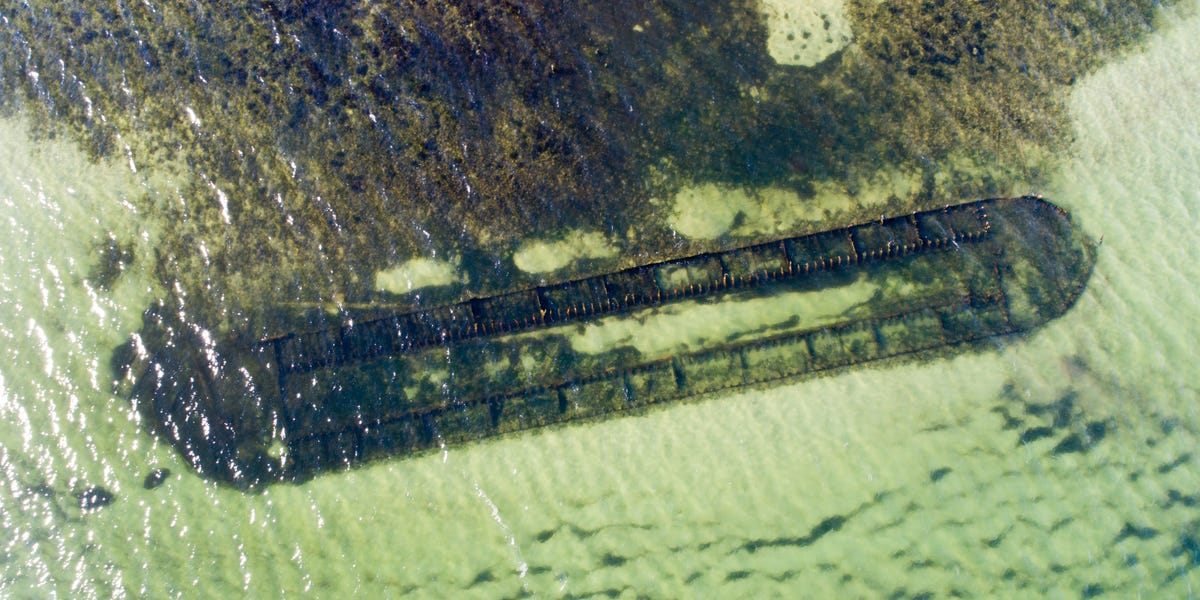
3 min readHere’s what you’ll learn when you read this story:A 17th-century shipwreck was discovered in Germany’s Bay of Greifswald during the construction of a new pipeline.Although the ship is highly deteriorated, artifacts found in the silty soil lead experts to believe it undertook long voyages.A collection of tools hints at an on-board workshop and includes one item that remains a mystery.In northeast Germany’s Bay of Greifswald, timber planks from a 17th-century shipwreck were discovered alongside wrought-iron anchors, lost shoe soles, and an array of tools. Researchers found the wreck while the area was being prepared for a liquefied natural gas pipeline. They recovered 60 artifacts, including several rare finds, from the clinker-style vessel.Researchers had to work fast to secure the artifacts, sending teams of five divers down 25 feet to the silty seabed for 22 dives over 12 days before construction activities halted their research. A study published the International Journal of Nautical Archaeology chronicled the initial finds.Because the wreck surfaced during survey work, the team was able to document it where it lay. A surviving hull fragment identified the vessel as a clinker-style ship, meaning it was constructed with overlapping planks secured by iron nails and waterproofed with tar.Two wrought-iron anchors and a wooden buoy, along with significant lengths of rope, suggest the ship was anchored in the bay when it went down. Traces of burnt timber strongly indicate that a fire on board may have caused the ship’s demise.The soft silt of the seabed and murky water clouded the divers’ vision, and the artifacts were scattered in different locations and almost entirely buried in the sand. Because the ship itself wasn’t well-preserved, these artifacts tell most of the story.“When I saw the collection of artifacts in the photography, it occurred to me that they must have come from a wreck,” said Michal Grabowski, an underwater archaeologist at the University of Warsaw, according to Phys.org.The largest surviving section of the hull is a 24-foot-long piece of timber. Dendrochronological analysis of this piece and one other shows that the timber for the ship was felled between 1615 and 1639.The artifacts include expected items, such as anchors, rope, and two shoe soles with leather straps, but there were some unusual finds, too. “A particularly distinctive object uncovered on site was a bilge pump tube,” the authors wrote. Hollowed from a single oak trunk, it measured nearly 12 feet in length.“The upper edge most likely functioned as a discharge outlet, channeling pumped water to a scupper on the vessel’s side, where it was expelled overboard,” the authors wrote. “Remains of two metal fittings were noted near the tube’s upper opening, presumably used to secure a handheld [pump brake] that controlled the up-and-down motion of the pump rod.”Chisels, drill bits, and sharpening gear turned up among the finds—the kit of a crew equipped to make repairs at sea. “The wreck can be confidently identified as a clinker-built vessel dated to the first half of the 17th century [C.E.], apparently well prepared for the prolonged voyages,” the authors wrote, “as can be assumed by the presence of ship equipment such as a bilge pump, a set of anchors, and a well-equipped onboard workshop.”The authors believe a “particularly intriguing artifact” came from that workshop: a yellow clay brick encased in wood containing several holes. Researchers surmise it was an “improvised sharpening device for the drill bits or chisels, possibly repurposed from a damaged device of similar function and subsequently mounted in a newly manufactured wooden housing.”“I had no idea what it was, but I really wanted to solve the mystery,” Grabowski said. “And I still very much want to.”Because the pipeline route ultimately bypassed the wreck site, the team hopes to discover additional artifacts there. “I think it’s like a little time capsule,” Grabowski said of the ship, which is now covered in sandbags. “A small puzzle piece that forms part of a much larger picture: the history of seafaring in the Bay of Greifswald. Without these small pieces, we would never be able to identify the bigger stories or connect the larger fragments of the picture.”Tim Newcomb is a journalist based in the Pacific Northwest. He covers stadiums, sneakers, gear, infrastructure, and more for a variety of publications, including Popular Mechanics. His favorite interviews have included sit-downs with Roger Federer in Switzerland, Kobe Bryant in Los Angeles, and Tinker Hatfield in Portland.
A Pipeline Crew Found a 400-Year-Old Shipwreck—and a Mystery They Still Can’t Solve
Full Article
Original Source
Read the full article at Popularmechanics →KhanList aggregates and links to publicly available news content. We do not host full articles from third-party sources. Always verify important information with original sources.