
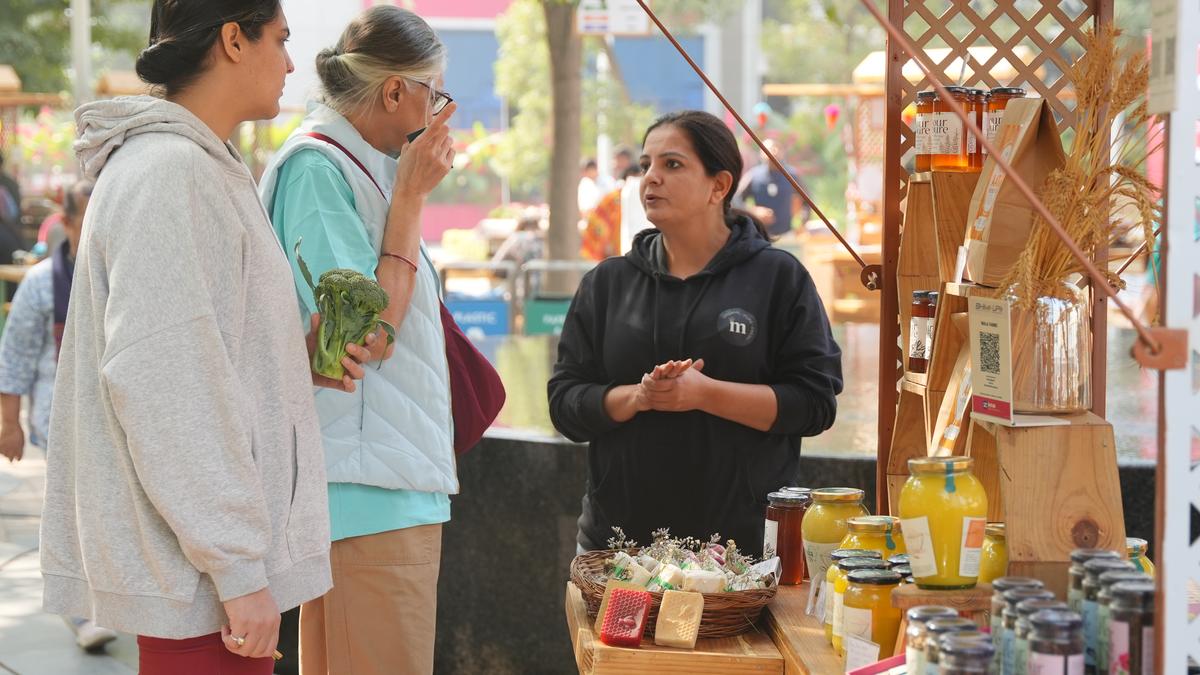
At a recent dinner in a South Delhi home, the conversation moved quickly from the delicious meal to what had gone into its making. The host, Neeraj Singh, a tech consultant and enthusiastic home cook, shared that each dish had been cooked in cold-pressed groundnut oil — part of his effort to replace everyday pantry staples with what he considered were “healthier alternatives”, despite their higher price.“I’ve replaced most of the basmati in my kitchen with varieties like joha that we grew up eating in Assam,” chimed in advertising professional and guest Pakhi Sharma. She used to bring back the indigenous short-grain rice after every visit home, she told us, but now buys it online — at almost twice the price. Another guest spoke of brewing only single-origin coffee from a small estate in Chikmagalur.That dinner-table conversation reflects a broader shift in how a growing section of urban India shops for food today. Consumers are no longer only trying to eat right; they’re trying to eat better, choosing provenance-driven, clean-label products over mass-market ones. But, as is the wont in our country, people practise a selective kind of premiumisation: trading up things such as the oil, coffee or rice they care about, while remaining price-conscious about other items in the pantry.My own pantry has gradually made room for cold-pressed mustard oil and extra virgin olive oil, different varieties of rice, including jeerakasala and black rice that I alternate with my regular rice, and options for refined sugar such as date sugar, coconut palm sugar and desi khand (unrefined sugar). There is even a jar of date honey sitting alongside the more conventional staples. None of these choices came about at once. But increasingly, I find myself looking beyond the brand name to ask where an ingredient comes from and how it has been made. A snapshot of cold-pressed oils from the writer’s pantry | Photo Credit: Satarupa Paul A taste for provenanceCold-pressed oils are perhaps the most visible manifestation of this shift. Market research company IMARC Group estimates that the Indian market for such oils grew from ₹580.3 million in 2020 to ₹755.2 million in 2025, and could reach ₹1,213.8 million by 2034. And the trend extends beyond things such as oils, single-origin coffee and chocolate, varietal honey, and heritage rice. Coffee harvesting at Nandan Coffee | Photo Credit: Special arrangement Artisanal cheese and bread, for instance, have a big market; the latter being driven in part by demand for sourdough and other clean-label breads. Fermented foods are another expanding category: IMARC estimates India’s fermented superfoods market at $1.3 billion in 2025, including kombucha, kefir, kimchi and miso.The shift became particularly visible after the pandemic, when food sourcing and health came under greater scrutiny. “There is now a mainstreaming of the idea that the food you get in the market may or may not be ‘healthy’. That you can’t buy things just on the basis of a brand name or a shop name because you don’t know if the maida is bleached, what’s in the oil, or how much pesticides were used to grow the produce,” says Shalini Krishan, who runs Goa-based restaurant Edible Archives, and a project that researches indigenous ingredients and works directly with small farmers. Last year, they launched hampers with varieties of indigenous rice, ghee and produce from specific regions, all with their own stories, which was very well received. Varieties of indigenous rice | Photo Credit: Salaam Ottayil Such buyers, however, remain relatively small and are concentrated in the country’s bigger cities. “You have to be of a certain economic strata to go premium,” says Puneeta Chaddha Khanna, founder of HandpickedByPC, a farmers’ market in Gurugram. “But it doesn’t equate to wealth alone; it’s also about awareness and exposure.” Puneeta Chaddha Khanna, founder of HandpickedByPC | Photo Credit: Special arrangement Anand Sankar, co-founder of Sayb and Tons Valley Shop — which brought the people and produce of Uttarakhand’s Tons Valley to the rest of India — is of a similar bent of mind. “There’s a lot of interest in Tier 2 and 3 cities for our fresh apples, unfiltered juice and clean label products, but it doesn’t scale,” he says. “Populate it on a map and it looks we are selling across India, but 70% of our business comes from Mumbai and Bengaluru, followed by Chennai and the NCR.” Anand Sankar, co-founder of Sayb and Tons Valley Shop | Photo Credit: Special arrangement “Food safety in India is in a very dangerous space right now. There is a huge trust deficit between the FSSAI, the farmers, the manufacturers, and the consumers. I also see customers with very varied states of awareness: some have in-depth scientific knowledge, while most are just WhatsApp aware.”Anand SankarCo-founder, Sayb and Tons Valley Shop Harvesting apples in Uttarakhand’s Tons Valley | Photo Credit: Special arrangement The price of ‘better’A bottle of varietal honey from Two Brothers Organic Farms or Beez can go up to ₹900, as compared to ₹280 for 400 g from a big brand. A litre of cold-pressed groundnut oil costs ₹500, while mass market brands sell for around ₹195. Heritage rice sells for ₹300 a kilo, while its white rice equivalent starts from just ₹45. What exactly are consumers paying for? “Customers of premium foods are a mixed bag. I have seen extremely well off people, who would not blink at spending a lot of money on something else, baulk at spending too much on rice. And I’ve seen those of middle class backgrounds, like a young teacher for example, who buys only indigenous rice or gets oil fresh from the oil mill.”Shalini KrishanFounder, Edible Archives Shalini Krishan | Photo Credit: Sohail Joshi Part of the answer lies in how these foods are grown and processed. Khanna, who is also an organic farmer, talks about the mustard oil she produces in small quantities. With few wooden presses available around Delhi-NCR, she sends her mustard seeds to Rajasthan for cold-pressing, paying ₹120 a litre. The oil is then left to settle naturally for a month, leaving roughly 20% that she cannot sell. “That is why there is a premium attached to this,” she says. “It’s the process, the wastage and the lower yield.”Meanwhile, Yahvi Mariwala, co-founder of Nandan Coffee, an organic coffee company based in Kodaikanal, cautions against treating labels that command a premium as shorthand for quality. “There’s always a risk of them becoming marketing buzzwords rather than meaningful indicators of quality,” she says. “‘Single-origin’ simply tells you where the coffee [or something else] comes from — it doesn’t guarantee exceptional quality. Similarly, ‘organic’ speaks to farming practices, not necessarily flavour.” For consumers, the real test should be whether brands can back their labels with information about origin, processing, sourcing. Yahvi Mariwala, co-founder of Nandan Coffee | Photo Credit: Amrita Samant Is premium always healthier?Does paying more necessarily mean eating better? “Some are healthier, some aren’t,” says Delhi-based nutritionist and author Kavita Devgan. A bean-to-bar chocolate is still chocolate, just as no heritage grain or organic vegetables can compensate for a poor overall diet lacking proteins and fibres. Kavita Devgan, Delhi-based nutritionist and author | Photo Credit: Special arrangement Cold-pressed oils, however, are one switch she believes has nutritional merit. Unlike refined oils that undergo high heat and extensive processing, these retain more of their naturally occurring antioxidants, vitamin E and plant compounds such as polyphenols.Provenance is more complicated. “Knowing where a food comes from can offer greater confidence about its quality and authenticity, but does not automatically make it more nutritious,” she says. The challenge is to ask the right questions about food. Eating better may depend less on upgrading what is in the pantry than understanding what those upgrades actually deliver.The writer is an independent journalist and photographer who covers travel, food, culture and sustainability.
A pantry with a past: Indian consumers are seeking indigenous, organic produce
Full Article
Original Source
Read the full article at Thehindu →KhanList aggregates and links to publicly available news content. We do not host full articles from third-party sources. Always verify important information with original sources.