
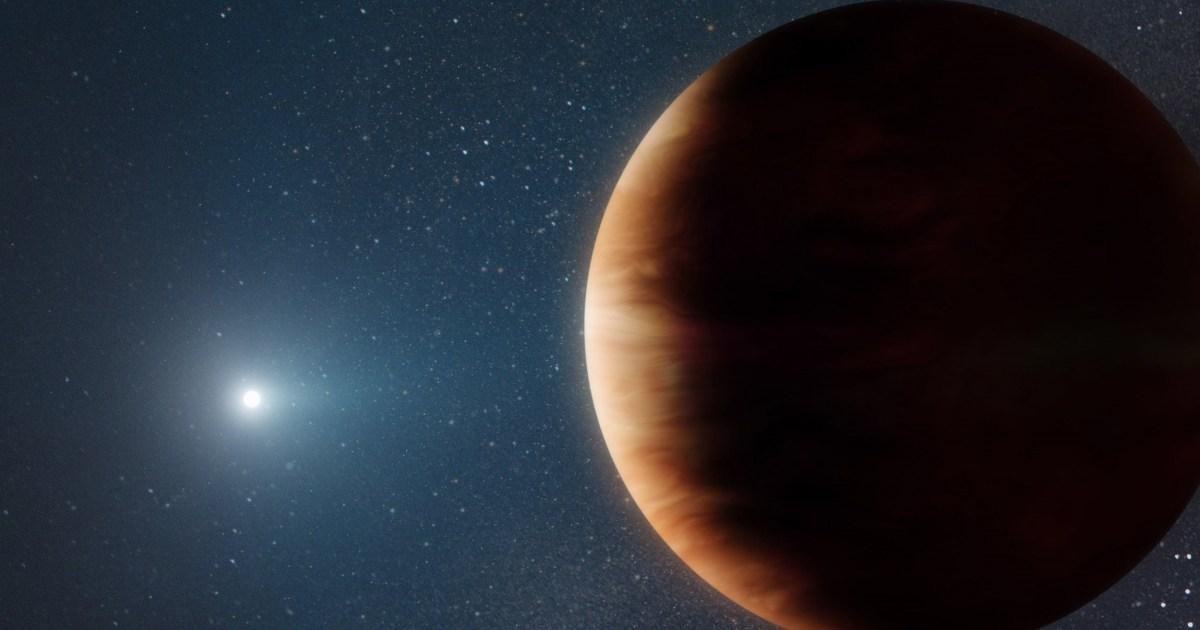
Enjoy the solar rainbow (Picture: Getty Images/Mark Hollands/University of Warwick) When you look up at the stars, these tiny pinpricks of light all look the same colour. But these cosmic radiators actually shine all sorts of colours depending on how hot they are. Scorching solar newborns are blue, lukewarm ones are yellow and elderly stars shine orange and red. ‘Any other colours, green included, are not possible,’ Mark Hollands, an astrophysicist at the University of Warwick, tells Metro. Well, that is until Hollands and his team found one. Why is this star green? WDJ1330+6435, which is about 4,000°C, glows a ghostly green (Picture: Mark Hollands, University of Warwick) Astronomers have long thought white dwarves, the embers left behind when a star dies, follow the same temperature colour rule. They’re hot, so they are a bluish white, hence the name. But as Holland and his co-authors wrote in their paper published in the journal RAS Techniques and Instruments, these solar husks can actually be colours never seen in other stars. Researchers calculated what colour 151 white dwarfs would look like to the human eye. Of them, 146 live up to their name. Yet WDJ1330+6435, a dead star 280 light-years from Earth, or about 165trillion miles away, in the constellation Draco, glows green. This white dwarf has been absorbing iron-, magnesium-, and sodium-rich slush from the rocky planets that once orbited it. ‘Think of something like asteroids or minor planets that have ventured too close to the white dwarf, have been shredded into dust by tidal forces and then rained down onto the stellar surface where they get mixed in,’ Hollands says. White dwarves, while very hot, shine dimly (Picture: PA) Chemical elements – the things in the periodic table – absorb different colours of light and spit out the rest. Sodium’s favourite colour is orange, which is why sodium street lamps glow a dull yellow. WDJ1330+6435 is so dense that the star’s helium plasma, the gooey fourth state of matter, makes the sodium soak orange, yellow and red light. ‘This absorbed radiation is then re-radiated at other wavelengths, with the emergent spectrum having a beautiful green colour,’ Hollands says. If our sun – which, as Hollands says, is white, not yellow – were replaced with WDJ1330+6435, Earth wouldn’t be the same. Hollands says the star would be tiny in the sky as it’s 100 times smaller. Earth would have a wider orbit as the white dwarf’s gravity isn’t as strong. ‘Even if we could move the Earth closer in somehow, so that the star appeared bigger in the sky, plant life on Earth absorbs mostly violet and red light, reflecting the green, to grow,’ he adds. ‘With some of these wavelengths missing from WDJ1330+6435, that certainly wouldn’t be good news for us.’ Are there other coloured stars? White dwarves are like giant cotton wool balls, tinted by the material they absorb (Picture: Mark Hollands/University of Warwick WDJ1330+6435 is the first known genuinely green star in the Milky Way. It’s one of five white dwarf stars the astronomers found that glow an odd colour because of the material in their atmospheres. Hydrogen- and helium-filled wisps were cyan or a pale blue and stars that swallowed asteroids or rocky planets were yellowish or, in the case of WD J1330+6435, chartreuse. Carbon-rich ones were pink or purple, like WD J1011+2845, which is 48 light-years from Earth in the constellation Leo Minor. The star glows a salmon-pink hue because its convection zone – layers of hot and cold slush – is so deep that carbon leaks from inside it. ‘We also found some of these carbon-rich white dwarfs to be pale purple as well, if the stellar temperature is a bit higher and the abundance of carbon a bit lower,’ says Hollands. Another white dwarf, WD J1011+2845, that would appear pink to the human eye (Picture: Mark Hollands/University of Warwick) As white dwarf stars can’t be seen directly from Earth, the astronomers deduced their colours using star spectrum data, the ‘fingerprint’ left when starlight is split apart by wavelength. Hollands says that while the findings don’t change how we see white dwarf stars – no pun intended – they show just how colourful the universe is. Even brown dwarf stars, failed stars too small to attain the gravity needed to get their hydrogen motors running, can sparkle. ‘Most of their light is radiated in the infrared, but a small amount is still emitted at visible wavelengths, with absorption from sodium, potassium, and titanium oxide affecting their perceived colours,’ Hollands says. ‘Other people have in the past worked out the colours of brown dwarfs from their spectra and determined that they would be violet or purple.’ Get in touch with our news team by emailing us at webnews@metro.co.uk. For more stories like this, check our news page. Arrow MORE: Invisible jet of radioactive goo is heading for Earth – should we be worried? Arrow MORE: Botticelli’s ‘Venus’ muse died from brain tumour as researchers spot clue in iconic painting Arrow MORE: Could AI be messing with our memories? Scientists think so News Updates Stay on top of the headlines with daily email updates.
A new star has been discovered – one scientists thought was ‘impossible’
Full Article
Original Source
Read the full article at Metro →KhanList aggregates and links to publicly available news content. We do not host full articles from third-party sources. Always verify important information with original sources.