
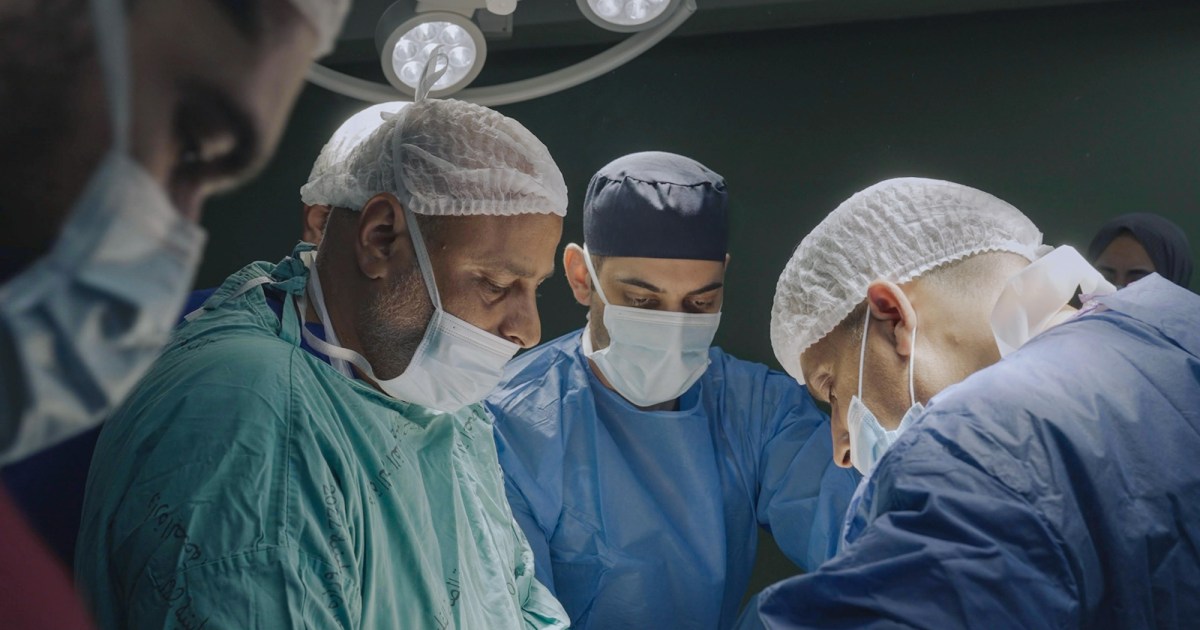
Dr. Feroze Sidhwa operates on a patient in Gaza. Watermelon Pictures Get your news from a source that’s not owned and controlled by oligarchs. Sign up for the free Mother Jones Daily. Poh Si Teng couldn’t bear the silence as the Israeli government killed hundreds of Palestinian journalists in Gaza. Some were her former colleagues at Al Jazeera, where Teng had been a documentary commissioner—yet the American news media remained, as she put it, “pin-drop” silent. So Teng emptied her life savings to make American Doctor, which follows three American physicians— Mark Perlmutter, Feroze Sidhwa, and Thaer Ahmad—a Jewish, Zoroastrian, and Palestinian Muslim trio. They set out to Gaza in March 2025, though Ahmad is turned away by Israeli border guards and never gets in. Sidhwa and Perlmutter treat patients with limited equipment (and often without painkillers) in the half-destroyed Nasser Hospital and bonding with their Palestinian colleagues, many of whom are working even as their own family members are killed. The film opens with an argument between Teng and Perlmutter, an orthopedic surgeon, in Perlmutter’s home in North Carolina. He shows her a photo of six Palestinian babies, lined up in a row. They’ve all been killed. Teng will pixelate the image—or not use it at all—to respect the children’s dignity, she explains. Perlmutter, angry, calls that journalistic malpractice. It’s a question that underlies the entire project: how do you keep a story of mass murder both human and unflinching in its refusal to hide from the destruction American tax dollars have wrought? The doctors encounter firsthand evidence that Israeli forces are systematically targeting children: Sidhwa, who spoke with Mother Jones in 2024, saw children shot in the head “nearly every day” at Nasser and the Gaza European Hospital. Returning to the United States, they join Ahmad on another Sisyphean mission: trying to make US lawmakers understand the horrors they’ve seen. I interviewed Teng about her new film, out now, and what she hopes audiences will glean. What made you choose to make a movie about Gaza? The thing that really broke me—I used to work at Al Jazeera English. Seeing colleagues that I respected being targeted and executed, and then just pin-drop silence from a lot of my peers. I was just so frustrated. This was 2024. I thought, there has to be a way to talk about this. I’m going to try and make a film. I became so cynical about American journalists—to be fair, some journalists were standing up. But journalistic institutions and newsrooms weren’t. It was almost as if a different standard was being applied to Gazan journalists. And then I thought to myself, doctors. Any sane person, they’re not going to say that doctors should be kidnapped, targeted, killed. And we believe our doctors, right? So this felt like the way in, to tell the story. “You show too much, and it’s gratuitous, it’s ineffective, people are going to turn away and shut it off. You show too little and it’s not real.” Mark—he’s ever the eternal optimist—he was like, ‘I’m going to train you as my scrub tech nurse and take you into Gaza.’ I thought, that’s never going to happen. If anybody does even a cursory search, what are they going to find? New York Times, Al Jazeera. It’s over. I worked with this incredible team in Gaza: cinematographer Ibrahim Al-Otla and co-producer Mohammed Sawwaf. What you see is a testament to their craft and their courage. We were filming in March 2025 when there was already a blockade, so there was no food going in. They were starving with their children, and they committed to film it with the promise that we would bring this film to the United States and show everybody what was going on. That requires, I don’t even have the words for it. A level of concentration and mastery and craft. How did you zero in on these three doctors to be the center of your story? I saw Mark in a news clip sometime in the fall of 2024. He said there’s no ceasefire because politicians are [beholden] to lobby groups. Mark is a breath of fresh air. I went to meet Mark, and then within that same week, he introduced me to Thaer and Feroze. When it comes to filmmaking, when you get a chance to meet one participant who’s so engaging, so charismatic that you want to live in their world, you consider yourself very lucky. When you meet three, that is beyond luck. So it became clear, upon meeting the three of them–we’re gonna make this movie. It’s gonna be real. Director Poh Si TengWatermelon Pictures Towards the beginning of the movie, Thaer—the Palestinian-American doctor—is refused entry to Gaza by the Israeli military. You end up following his journey as he tries to advocate for his people in the US. When he didn’t get in, I was really crushed. He’s said this publicly before–but he disappeared. When he couldn’t get in, he didn’t return my phone calls. He was so embarrassed and crushed by it, he said, I just feel like my story doesn’t matter anymore. He just wanted to be there with his people, to serve his people. So I went to Chicago. Then I texted him. He’s like, yeah, all right, come over. He just wanted to be there. One moment that stuck with me was early on, when you and Dr. Perlmutter are debating how much of the violence to show. How did you end up resolving that question? As a former journalist, I’ve always grappled with—how much do you show? You show too much, and it’s gratuitous, it’s ineffective, people are going to turn away and shut it off. You show too little and it’s not real. It’s a huge disrespect to those who have survived, those who have been lost. It’s a huge disservice. That scene that you’re talking about was the second day I was filming with Mark, and he is very, very angry with me. He was basically saying, you’re like the rest of them—you’re like all the media that won’t show what’s going on—and I was deeply ashamed. It’s not the violence aspect that was top of mind. It was, how do we get to know Palestinian healthcare workers as people? How do we see them just as we see healthcare workers in the United States? They have their doctor’s banter in the [operating room], they laugh with each other, they love life just as we do. As for the more difficult imagery, it was just enough. “Especially if we believe we live in a democracy, we have certain levers that we can pull. So let’s pull them.” You get to know the health care workers first, and then you see what they have to go through. That was what was important for me. Because as far as violent imagery goes, I’ve watched a lot of films that have to do with conflict, war, and genocide, and this doesn’t come close to any of that [in what’s shown onscreen]. We are in their world, and we learn to love them—that’s why the film is the way it is. We are immersed in the world of Nasser Medical Complex. What do you hope that this film achieves? There are three paths forward. Be like Thaer, who’s strategic and politic and careful, and able to bring people together. Be like Mark, who doesn’t mince words. Say what needs to be said because it has to be said, that this is a genocide. Or be like Feroze, do the homework. Want to convince the most difficult of audiences? Know your facts and have the patience to talk to people. They are not perfect. They’re just trying. I hope that people watching also just try. Especially if we believe we live in a democracy, we have certain levers that we can pull. So let’s pull them. At the end of the day, we’re just advancing the message my colleagues, our colleagues, told us to. Let the American people know.
A New Documentary Follows Doctors Into Gaza
Full Article
Original Source
Read the full article at Motherjones →KhanList aggregates and links to publicly available news content. We do not host full articles from third-party sources. Always verify important information with original sources.